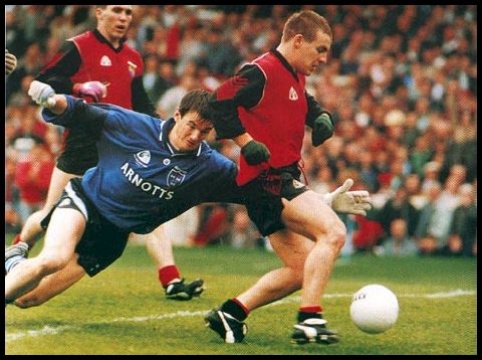
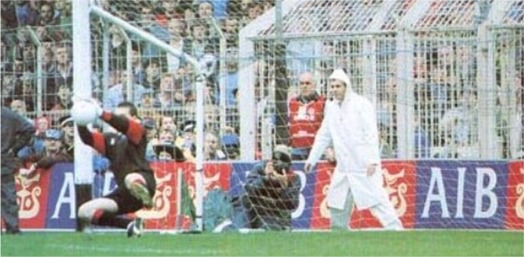
| Gaelic football is an Irish field sport that can probably most easily be described as a cross between soccer and rugby (And is somewhat similar to Aussie Rules Football, if you're familar with that). It is played with a ball slightly smaller, but heavier, than a soccer ball. It is generally played on a field about 140 yds long and 90 yds wide. At each end are goalposts with a crossbar (the crossbar is a litle higher than on a soccer goal, but lower than on rugby goalposts). If you kick the ball through the posts and under the crossbar, that's a "goal" worth three points. If you kick it through the posts but over the crossbar, it's a single "point." You can either kick the ball or play it with your hands. You can catch the ball in the air or off a bounce. You can't pick it up off the ground, although you can kick it into your own hands. You can run with the ball for four steps, after which you must either bounce it off your toe (soloing) or bounce it off the ground, however you aren't allowed to bounce it off the gound twice in a row (at least every other time must be off the toe) You cannot throw the ball to a teamate, but you are allowed to "hand pass" it, where you strike it with your hand. Gaelic football is also a very physical game. Although you do not tackle your opponents, you can physically challenge them and attempt to knock the ball out of their possession. Teams are made up of 15 players, lined out as follows: Goalkeeper Right Coner-Back Full-Back Left Corner-Back Right Half-Back Center Half-Back Left Half-Back Midfielder Midfielder Right Half-Forward Center Half-Forward Left Half-Forward Right Corner-Forward Full-Forward Left Corner-Forward Unlike in soccer and rugby there is no offsides, so players are spread out throughout the whole pitch the whole game. There is still alot of running involved though, especially if you're a midfielder! For the complete rules of gaelic football, click here. |
| Introduction To Gaelic Football |
 |
 |
 |
 |