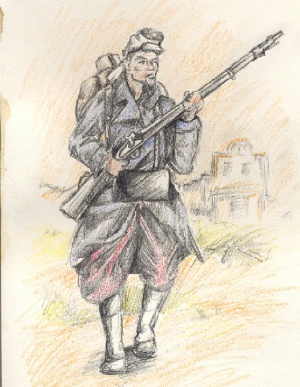
patterned after the 1822 musket, some of the early muskets even being converted into Thouvenin rifles. These rifles were officially adopted in 1846 and saw limited use in Crimea. They had a flip up sight graduated to 1200 yards. The MLe 46 had a tendency to fowl and the pillar had a tendency to bend after long use, but in general, it prooved a reliable weapon.
During this time the famous Claude minie invented a two piece bullet. This bullet was cylandrical with a hollow base in which resided an iron plug, when the rifle was discharged the plug helped expand the bullet skirts and it would effectively engage the rifling. The "minie" ball, in its final appearance, was an invention of a French Captain, Tamister. It kept the hollow skirt and added three grooves, these providing a ledge for lubricant and weakened the bullet so it would better engage the riflings. Minie's bullet did not require the cumbersome pillar design and by 1849 his new rifles were influencing the world's arms industry.
The french minie was termed the MLE 1853/54 rifle and came with three bands, finished bright or in bronze. It was aproximately 56 inchs and of large caliber. (ie .69 to .80) A shorter MLE 1853 Dragoon was also produced. A third short model, the MLE 1859 carbine de Chassuer was only 53 inchs long and carried only two bands and a sword bayonet. The rifle would serve the foreign legion valiently in mexico. The beliugered legionaires at Camerone poured accurate rifle fire into mexican ranks, helping them to make their now famous stand against the Mexican Juaristas These rifles also found issue to Northern and Southern units in America's war between the states. These were disliked for their tremendous calibers and often discarded in favor of the .577 caliber Pattern 1853 Enfield rifle muskets.
By the mid 1860s it was clear france needed a new weapon, a cartridge firing one. The Germans and their breech loading Dreyse needle guns had prooved the superiority of a cartridge gun. In 1866 the French adopted the Chesspot. The rifle was a bolt action design, and like the Dreyse, was also a Needle gun. It fired a consumable .433 cal silk cartridge which was suseptable to the elements and fouling. It was manuelly cocked and had a rubber washer to help seal the bolt from escaping gasses. It was an improvement on the German design, but already obsolete. During the Franco-Prussian war it performed descently against the Prussians. A lack of arms during the war, compelled the French to buy Remington rolling blocks from the US and convert their old muzzel loaders to breechloaders. This was done with the addition of a hinged breech block, directly attributable to the British designer, Snider. These arms were 0f .81 caliber and surely only a stop gap measure.
When the Germans approved their new 1871 mauser rifle, firing a metalic cartridge, the French followed suit. They immediately started producing the MLE 1874 Gras. This was basically a conversion of the Chesspot firing a metallic cartridge. The bolt was redesigned and an extractor placed in it. There were two models, the MLE 1874 and the MLE 1866/74, the later being a conversion of the earlier Chesspot. A channel was later cut in the receiver to aid in cartridge extraction should the extractor malfunction. M 80 appears on these models.
The first repeater to enter French service was the Kropatscheck, it was made by styer for the French marine infantry. It had a bolt much like that of the Gras but had an 8 round tubular magazine under the barrel. A scoop like carrier brought the rounds up from the magazine. In 1884 another model was produced, this one was quite similar to that of 1878 but was of new production for the infantry. Many Gras rifles were converted into MLE 84s by the addition of a magazine. The Kropatscheck met its last issue in the form of the MLE 85, basically the same as the privious models, only with a two peice stock. These were mainly an answer to the German Tubular magazine 71/84. At this time both England and the United states still employed a single shot military rifle.
The true break through came in 1885 when a French Chemist discovered how to make smokeless powder from gun cotton. Again, France revolutionized the arms industry, just as minie had done forty years earlier. Higher velocity was obtained and fouling eliminated. The new MLE 86 "lebel" rifle went into production. This was basically a Kropatscheck rechambered and barreled for a new 8mm round. The cartridge was revolutionary, but the rifle was not. The new round left the muzzel at an astonishing 2350 feet per second and did not obscure the firer's vision. The higher muzzel velocity permitted the use of a smaller, modern bullet. Amazingly, the Lebel remained in service for nearly sixty more years and saw use in France's old colonies into the mid fifties. It served Vichi troops well into WWII. All this from a rifle that was more or less antiquated by 1900. In an attempt to update the design the French produced the Berthier.
This rifle used the same complicated bolt as the Lebel but was fitted with a mannlicher style magazine, capable of only three shots. These were designed by Berthier, a French engineer and produced only in carbine form for mounted troops. The Carbine de Cuuirassiers MLE 90 featured a bent bolt and a catch that released the charger which was taken wholey into the magazine and, when empty, dropped out a trapdoor just infront of the trigger gaurd. These carbines were only 37 inchs long. A Mousqueton D'artillerie version with a bayonet lug was provided later in 1892. In 1902 a long rifle was issued to levies in Indo-China, these were called the Fusil de Tirailleurs Indo-chinois Mle 1902. This rifle acted as a pattern for the Fusil des Tirailleurs Senegaleis MLE 1907 which was issued to colonial troops. At the outbreak of WWI the French authorities realized that the Berthier was supperior to the lebel and issued it to line troops as the Fusil d'Infanterie MLE 07/15. Many of these rifles would be produced by the American firm of Remington. Soon officials realized the rifle's three round capacity was insufficient and updated it , creating the MLE 16. This added an extension to the magazine which brought the capacity up to 5. The Mousqueton MLE 1916 also appeared, this was a carbine version of the standard MLE 16. In the late 30's many Berthier rifles were re-barreled to Frnaces new 7.5mm caliber. The rimmed 8mm Lebel worked well in a tube magazine, but jammed in a box and did not function well in machine guns, thus the change. The Berthier, in its final form, had the mannlicher style magazine deleted in favor of a conventional box magazine and was altered to the new 7.5 mm round. Despite developement then underway for a semi-automatic rifle, nothing had been approved. A new 7.5mm MAS 36 bolt action had been authorized but only very few were available when the war began. France had been financially unable to replace all of her aged small arms. When the test of arms with Germany came in 1940, France's antique rifles prooved they could not make the grade. |