Att mjölka bearbetar med maskin av kotidig sort
 Utvecklingen av mjölka bearbetar med maskin användbart tog flera årtiondetestandfel, med skillnaden fastautvecklingen, och godtagandeinotherinnovationer av mejeri, liksom att mjölka som är hygieniskt, och behandling, av det Babcock testar, och det centrifugal cream-coloured jobbkortet. Somewriters av det 19th mejerit av århundradet och publikationerna av AGrecognized som ett behov för bra mjölka bearbetar med maskin, men, var all dissatisfaitswith vad erbjöds. Andra avskräckte alla försök med bearbeta med maskin som mjölkar, uppgiftslämnaren som det var konstgjort eller intrinsicallyverminen med kon. Så sent som 1892, S.M. Babcock (av berömda Babcockof testa), skrev insida medborgareslagen ha lik följd en lägre qualityof för att mjölka och fälla ned normana av djuren av mejeri”, att ”mjölka bearbetar med maskin skulle. I Advokaten av bönderL.B. Arnold sekreterare av Assoc. Amerikanslag, skrev om greatvaluen av formulera av räcka i utvecklingen av juverofbovinen och varnade mot tillflykten till mjölka för bearbeta med maskin.
och prefektdagen som leker den on-line kasinopoker, spelar. skriv in precis för kasinopoker för lek det on-line funktionsläget
Lär att allt om den olika on-line poker härskar och variationer. från poker hyr rum, pokerturneringar till den videopd poker.
Apparaterna tidigast som mjölkar mekaniskt, var rör som sattes in i milkwith som, styrkan öppnar muskeln av sphincteren, av denna itpossible faktumdanande mjölkar för att köra. Rör ut ur trä användes för detta ämnar, as well as av pirnsna av fjädern. Skilfully gjorda rör av pengarna, gutta-perched, av elfenbenet och av de rena benen lanserades på marknadsföra i århundrade av mid-19th, och, i faktum, var någon stillbild wellsold i det 20th århundradet.
En roman som mjölkar röret som in illustreras Vetenskaplig amerikan i 1875 använt en ventil av glidbanan som var längst ner av varje catheter till, beclosed förutom öppning. Man beviljade flera patent av theUNITED PÅSTÅR för att mjölka fogade ihop rör av böjlig rubber leda i rör todirect mjölkar i ösregna. Brett leda i rör ökade redan currentproblemen av föroreningen med bruket av cathetersna.
För att mjölka catheteren klandrades för olika problem, liksom thediffusionen av sjukdomen, försvagade muskler av sphincteren orsaka thecontinuous strömma, och skador med l5At oss mjölkar. I 1868 writerofen Amerikanagronomen handstil för en ifrågasätta om att mjölka rör, ”De som säljer dem uppehället som är blyg av amerikanagronomen; gör så återförsäljare i humbug, allmänt. Vi är lystna av att ge något sådan ting ett mässaförsök, och, har försökt och har missat, även för att bevittna ett försök av enmilker ",. Emellertid tio år efter, i 1878, all kliver den samma publikationssoftenssatonalityen in godkännande egentligen alltid mjölka rör; ”fanns medger det en skada mot alla andra metoder av trairequetheobsolete en och, oss för att ha klädde med filt påverkandeceskadan, och var mycket försiktiga stunder som sågs till att mjölka för lamachine. Personliga Aftera testar, oss étéforcés för att ändra våra föregående åsikter ”,. The article continues to describe a whole of tubesargentésfinissant in rubber tubes of India to lead the laitdans abucket. In this moment, The American Agronomist started to accept advertisements for milking machines, although, verylittle were printed. Their expressed opinion was that lestrayeuseswere little of value, but, did not make any evil apparentde badly withthe cows. Large the variety and a many machines trayantesancians canbe classified by category in two groups, those which tried to emulatethe draft of the hand (the dispositifsmécaniques ones of pressure),and those which tried to emulate the calf desuccion (devices ofvacuum). The partisans of the two types detrayeuses proved to be avariety without end of pendantplus objects 50 years, until the modernpulsator did gaining it clearly à la method of aspiration.
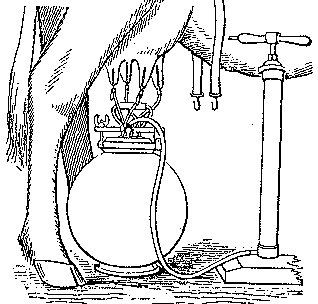
The milking machines of vacuum earliest used a large cupdegutta-perched, adapting above the whole udder, and sontreliées to ahand pump. Hodges and Brockenden fixed English unbrevet for such adevice in 1851. In America, AnnaBaldwin made patent such a milkingmachine, using a pump depichet and of a bucket in its illustration ofpatent. In 1859, S.W.Lowe, of Philadelphia, made patent a cup equippedwith undiaphragme with 4 holes for milk. A pump withaspirationopérée with the crank drew milk from each of the fourtrayonsimmédiatement. Such devices created an aspiration continuesurthe udder, damaging the fabric mammaire and making fréquemmentdonnera kick the cow.
In 1859, John Kingman, of Dover, NH, made patent a cup detrayon canwith the elastic support for the use with unetrayeuse of pump withaspiration. The first successful use destasses of trayon with amilking machine of vacuum is found in the brevet1860 L.O. Colvin,perhaps of the most famous inventor del' America of the milkingmachines old. This dispositifd' aspiration actuated by lever drew agreat answer from agricultural lapression. The favorable articles arebeen published inside The Newspaper Of Farmer Of Dairy, The Agricultural Gazette, and much of smaller publications. However, the milking machinedeColvin always subjected milk them cow with the constant vacuum,causing blood with the swimming pool there. Colvin sold the patentanglaispour this machine for $5000, and, at least 1500 machines haveétévendues in England, according to an article inside The Agricultural Gazette. In the UNITED STATES, Colvin was successful, and, continuedà apporter of the improvements much more and to acquire new patents.
In Scotland, William Murchland invented a very successful milkingmachine devide in 1889, which hung suspended under the cow. Oneaaccordé to him a patent of the UNITED STATES in 1892. The milkingmachine of Murchland, with the milking machine celebrates "thistle",was intensivementexaminée by the mountain and the agriculturalcompany of Scotland en1898. Many of other milking machines ofaspiration pumped by hand ontété conceived in thirty years to come,with the machine of Mehringau foot being, perhaps, finales intrayeusesd' aspiration of pre-pulsator. This machine was congratulateddansune letter with The Slag Of the Cluster in 1898. Two cows could be milked at the same time, to the assistancedecette machine, with the sitting down operator on top is bench,entreles cows, and to work the levers of foot to provide the vacuum.Lamachine of power of foot of Mehring was still launched surle gonewell in the 20th century and much were sold. Fine Unexemple recentlywas noted with one of the exposures deBrimfield, evaluated to $400.
The pulsator was presented the first time in the milking machinede"thistle", using a pump of vacuum led by vapor. Tandisque themachine of thistle presented problems of hygiene, ellea proven aneffective milking machine. In The Slag Of the Cluster, in 1898, a critic of the machine of thistle shown à l' exposure ofHamburg censured the machine for its écoulementintermittent, asobserved in the tube of driving glass to the ship delait. This criticwas Dr. Benno Martiny, one of the scientists delaitery more in frontof time. The pulsator, having pourrésultat this flow intermittent iswhat finally carried out à une milking machine really realizable. TheUSDA finalementexaminé and gave is approval with a milking machinedepulsator in 1898.
During the end of the 19me century, whereas much ofinventeursluttaient with the problems of the constant milking machinesof aspiration, others worked with a large variety ofdispositifsmecanic to simulate the draft of the hand. The majority ofcesdispositifs incorporated the rollers or the fingers which haveparintermittence tightened on the trayon, often functioning top enbas.Some of these devices simple, others were sontcomposés of hundreds ofparts and worked at side desmanivelles. Such mechanical milkingmachines were still faitesbreveter after the turning of the century,in spite of the arrival desmachines of pulsator. The mechanicalmilking machines do not have pucompenser the size changing milk cow astrayantprogressé, and did not milk with the achievement. Theyontégalement forced milk again in the udder.
With so much of inventors applying to the task, why ledéveloppementof a satisfactory milking machine it ensured 50 years?Cette questionwas perhaps answered in an exit 1879 of The Agricultural Gazette, where a comparison was made with the development of the bindingdegrain. By this year, the 5000 UNITED STATES and the patentsanglaisavaient be file for improvements in récolteuses.L' articlesuggests that the fast development of the binding of granulatedfacilitated per many test and suggestions by desfermiers. The test ofa binding of grain did not offer any risk, whereas the test of amilking machine could (and) make the grandmal with the cow, or atleast, its dairy production. Fermiersétaient quite naturally littlelaid out to offer to them troupeaucomme guinea-pigs, and this couldhave been the largest obstacle audéveloppement of the milkingmachine.