Japan: “Free, Fair, and Global”?
An Analysis
In the 1980s, Japan seemed to be an economic powerhouse on the road to worldwide dominance in trade and finance. Its factories were producing high-quality goods at an unprecedented rate, exports were blossoming, trade surpluses were the rule, and government and business worked hand-in-hand to promote the national good. By the 1990s, however, Japan had entered a protracted economic slump that threatened to tumble the neighboring economies of East Asia. The economic bubble had burst: asset prices
collapsed, bank debts mushroomed, and government management was seen as the cause –not the cure- of Japan’s woes.
 To stem the tide of decline, in 1996 the government of Prime Minister Ryutaro Hashimoto unveiled a “Big Bang” package of reforms aimed at reforming and restructuring Japan’s financial and economic system. This plan would deregulate and liberalize the country’s rigid economic framework and put an end to the “convoy” system whereby fast and efficient institutions traveled at the speed of the slowest institution in order to
protect the latter. Although the “convoy” system contributed to great macroeconomic stability, it had also shielded inefficient institutions from the realities of the marketplace. To many observers, Hashimoto’s reforms represented no less than a complete reversal of Japan’s traditional post-World War II model of closely managed economic development.
To stem the tide of decline, in 1996 the government of Prime Minister Ryutaro Hashimoto unveiled a “Big Bang” package of reforms aimed at reforming and restructuring Japan’s financial and economic system. This plan would deregulate and liberalize the country’s rigid economic framework and put an end to the “convoy” system whereby fast and efficient institutions traveled at the speed of the slowest institution in order to
protect the latter. Although the “convoy” system contributed to great macroeconomic stability, it had also shielded inefficient institutions from the realities of the marketplace. To many observers, Hashimoto’s reforms represented no less than a complete reversal of Japan’s traditional post-World War II model of closely managed economic development.
According to Hashimoto, the “Big Bang” would transform Japan into a “free, fair and global” economy as follows:
Free – Japanese markets would allow greater access to foreign investors and would increase the types of businesses in which financial institutions could compete and invest; international transactions would be simplified and restrictions reduced; there would be improvements in asset management systems.
Fair – Markets would promote greater disclosure and transparency of rules; more effective safeguards would be put in place to ensure that transactions were conducted honestly; enforcement mechanisms would be strengthened.
Global – Laws and standards would be updated and modified to match international norms; coordination with international agencies and institutions would be strengthened; flow of goods and services across borders would be facilitated.
The present analysis will evaluate the prospects for success of Prime Minister Hashimoto’s reforms against the backdrop of Japan’s current economic crisis.
Administrative Reform
One of the most distinguishing aspects of Japan’s political and administrative structure is the close working relationship between important politicians, key bureaucrats and top business executives. Although politicians are nominally in charge of government, in many instances key bureaucrats actually wield much more legislative influence than members of the Diet or even the prime minister himself. For example, the Ministry of International Trade and Industry (MITI) exercises
broad authority over many aspects of economic policy, including foreign trade, resource management, domestic commerce and technology. Similarly, the Ministry of Finance (MOF) holds tremendous sway over macroeconomic and fiscal policy.
In order to reduce the role and influence of legislative bureaucracies in the policymaking process, Hashimoto’s reforms included provisions to:
 |
Bolster the executive authority of the prime minister and cabinet.
|
|
Reduce the number of ministries and streamline ministerial procedures.
|
|
Reduce the size of the legislative bureaucracy and civil service.
|
|
Privatize the nation’s huge postal savings and insurance systems.
|
|
Redefine ministerial structures and responsibilities.
|
Analysis
It was doubtful whether Hashimoto’s administrative reforms would go far enough in breaking the entrenched interests of Japanese ministers and powerful bureaucrats. Although efforts to streamline the government were admirable, simply reshuffling agencies would not do much to scale back the power and influence of the governmental bureaucracy. It was also likely that Hashimoto would encounter significant resistance from members in his own party who were reluctant to break the “iron triangles”
between key politicians, top bureaucrats and big business executives.
Regulatory Reform
 Under Hashimoto’s leadership, Japan became much more committed to widespread regulatory reform. The goal was to reduce bureaucratic “red tape” and promote fair and efficient competition in all aspects of the Japanese economy. As stated in its Action Plan for Economic Structural Reform, the Ministry of International Trade and Industry was entrusted
with developing a plan to deregulate the following key areas of the economy:
Under Hashimoto’s leadership, Japan became much more committed to widespread regulatory reform. The goal was to reduce bureaucratic “red tape” and promote fair and efficient competition in all aspects of the Japanese economy. As stated in its Action Plan for Economic Structural Reform, the Ministry of International Trade and Industry was entrusted
with developing a plan to deregulate the following key areas of the economy:
|
Energy
|
|
Logistics
|
|
Information and Telecommunications
|
|
Finance
|
|
Distribution
|
Essentially, the goals of Hashimoto’s regulatory reforms were to maximize the capabilities of labor, capital and technology; improve the commercial environment to enhance the competitiveness and viability of Japanese industry; and improve the efficiency and effectiveness of the public sector.
Analysis
Although bureaucrats deserved much credit for Japan's accomplishments, the regulatory system they represented stood in the way of progress. Given the complex nature of the modern economy, bureaucrats were no longer seen as architects of economic progress but as impediments. Indeed, deregulation and attention to public needs were more likely to come from strong political leaders than from the regulators themselves. Nevertheless, it was an open question whether Hashimoto possessed sufficient political
will to carry out his proposed regulatory reforms to the bitter end. A strong backlash from regulators and bureaucrats was expected.
Educational Reform
Hashimoto’s educational reforms were aimed at weaning Japanese students away from traditional rote-learning approaches and toward more interactive learning methods. Specific measures were designed to foster the following changes in Japan’s tradition-bound education system:
|
Modernize the education system to reflect current realities; institute the latest pedagogical practices; incorporate technology in the classroom; reduce pressure to achieve academically at all costs.
|
|
Increase cooperation between the education system and business; better prepare students for entry into the business world.
|
|
Promote student exchanges and internationalization of learning; improve foreign language education and increase contact with foreign education systems.
|
|
Improve administration and teacher training; integrate the upper and lower school systems; foster educational reform and innovation.
|
Analysis
Hashimoto’s educational reforms would encounter resistance from traditional educators and administrators. Conservatives would decry the shift away from methods that have put Japanese students at the forefront of math and science achievements despite the drawbacks of the education system. Much like in the US, reform of Japan’s education system was painfully slow.
Financial Reform
Soon after taking office, Prime Minister Hashimoto announced his ambitious “Big Bang” plan to radically restructure Japan’s financial sector. As originally envisioned, this sweeping package of reforms aimed to:
|
Eliminate all artificial barriers between banking, investments and insurance.
|
|
Lift the prohibition on holding companies.
|
|
Deregulate the insurance industry.
|
|
Liberalize the foreign exchange market.
|
|
Overhaul corporate accounting and taxation policy to reflect market asset values.
|
|
Strengthen oversight and supervision of lending institutions.
|
|
Give the Bank of Japan (BOJ) greater autonomy in financial policy-making.
|
Standing in the way of these reforms, however, was the problem of massive debt. Because the Japanese have traditionally favored saving over spending, banks and other lending institutions had at their disposal large sums of investment capital that they freely lent to other banks and lending institutions. But as the economic bubble burst, banks soon found themselves entangled in a wave of bankruptcies and non-performing loans that they struggled in vain to conceal.
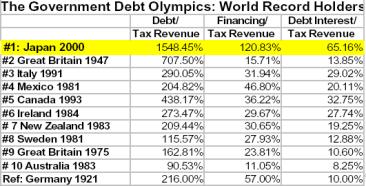
 Coupled with the private sector debt problem was the government’s own bloated deficit spending. To many observers, government debt had become a veritable sumo that was choking private investment and impeding any hope of a rapid economic recovery. The following table shows the extent of Japan’s indebtedness as of the year 2000:
Analysis
Despite efforts to trim the national budget and liberalize the financial sector, Hashimoto’s reforms were likely to confront significant resistance from traditional opponents of reform, namely: conservative politicians, vested bureaucrats and key business executives. Indeed, the current state of Japan’s financial affairs can be viewed through the prism of the ongoing struggle to overturn previously unchallenged interests and bring a modicum of transparency and freedom to Japan’s financial
dealings. Unless efforts to stimulate public consumption and channel private savings to other investment vehicles besides postal and savings banks were successful, it was doubtful that the Japanese government’s so-called “stimulus” packages would have much success in pulling Japan out of its economic morass.
Fiscal Reform
As noted above, Hashimoto’s reforms were constrained by the ballooning budget deficit and the need to stimulate consumer demand. Even worse, Hashimoto was caught in a quandary: Japan’s aging population called for higher expenditures to support the elderly; on the other hand, the decreasing birth rate had placed tremendous pressure to trim spending in preparation for the day when a smaller base of workers would have to support the elderly. In response, Japan implemented measures to trim the budget
deficit by increasing the consumption tax from 3% to 5%. Although this seemed a fiscally responsible measure, it had the negative consequence of further depressing the economy.
In specific terms, Hashimoto announced that fiscal reform would comprise five key principles, namely:
|
Reduce discretionary spending over previous years’ levels.
|
|
Set spending limits as soon as possible to implement reductions before the year 2000.
|
|
Drastically scale back government programs and not initiate any new ones.
|
|
Cap the ratio of taxes, social welfare expenditures and the budget deficit to national income at 50%.
|
|
Accelerate the target date for reforms and move the deadline for reducing the budget deficit from the year 2005 to 2003.
|
Analysis
Implementation of Hashimoto’s fiscal measures was likely to arouse strong opposition from the ministries and agencies that administer government programs as well as from companies and lobbies that benefit from those same programs. As spending cuts began to take effect, popular support for the prime minister’s fiscal reforms was prone to erode and further complicate his efforts to reduce the scope of the national budget. That Hashimoto would be able to successfully implement his fiscal reforms was
by no means certain.
Social Security Reform
 According to Japan’s Ministry of Health and Welfare, the most significant goal of social security structural reform was to maintain “…under 50% the ratio of the taxation and social security burden, which is a percentage of taxes and social insurance premiums, against national income.” To achieve this aim, the Ministry of Health and Welfare under Hashimoto
fixed its sights on:
According to Japan’s Ministry of Health and Welfare, the most significant goal of social security structural reform was to maintain “…under 50% the ratio of the taxation and social security burden, which is a percentage of taxes and social insurance premiums, against national income.” To achieve this aim, the Ministry of Health and Welfare under Hashimoto
fixed its sights on:
|
Establishing a long-term insurance system.
|
|
Increasing the efficiency and quality of medical services without compromising the universal insurance system.
|
|
Balancing benefits to burdens in order to maintain a financially healthy public pension system.
|
|
Improve welfare and medical services for the disabled.
|
Despite the optimistic goals of Hashimoto’s reforms, it became clear that radical steps – such as decreasing the amount of pensions, postponing pension payments until age 65 instead of 60, and making cuts in medical services – would be required to maintain the solvency of Japan’s social security system.
Analysis
As long as Japan’s economy continued to grow, it was not excessively burdensome to maintain the universal system of health care and the social security infrastructure. Unfortunately, the continuing economic decline made it virtually impossible to balance the contradictory goals of expanding health care access to the elderly and disabled while cutting costs. Sadly, the future is not bright for Japan’s social security system as fewer and fewer workers will be available to support an increasingly
larger base of elderly retirees.
Conclusion
As the locomotive pulling the trains of its neighboring economies, Japan plays a dominant and influential role in the success and prosperity of all of Asia. Were Japan’s administrative, regulatory, educational, financial, fiscal and social security reforms to falter or fail, the repercussions would extend throughout the entire region and most certainly affect the economies of North America and Europe. Despite Hashimoto’s mixed record in implementing structural reforms in the Japanese economy, it is
incumbent upon responsible policy makers everywhere to make sure that succeeding prime ministers are afforded every opportunity for success. Indeed, it would be an ignoble ending to a noble cause were the “Big Bang” to end up as the “Big Whimper.”