Liceo Domingo Santa María

Electivo Ingles

Teacher Michael Rossel H.

CONNECTIVES


This handout is concerned with the general organization of a piece of academic writing (e.g. A report, an essay, an assignment, a project), its structure and particularly the way in which the different parts are linked together. The plan below of a piece of writing -in this case an essay- will help to explain the overall structure.
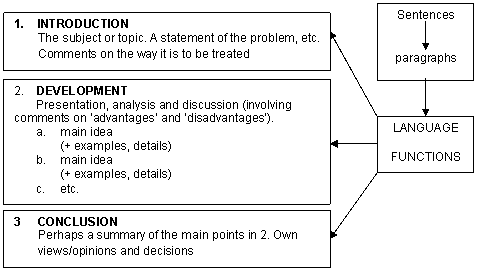


Connectives: The main connectives are grouped below according to the similarity of their maening with three basic connectives and, or, but.


1 and

a.       listing

1.     enumeration

2.        addition

a.       reinforcement

b.       equation

b.       transition

c.        summation

d.       apposition

e.       result

f.         inference

2. or

g.       reformulation

h.       replacement

3. but

i.         contrast

j.         concession


1. and


a.       Listing:

1.       Enumeration indicates a cataloguing of what is being said. Most enumerations belong to clearly defined sets:

Pentágono: First, ... Pentágono: Furthermore, ... Pentágono: Finally, ...


Pentágono: One, ... Pentágono: Two, ... Pentágono: Three, ...


  etc.


Pentágono: First(ly), ... Pentágono: Second(ly), ... Pentágono: Third(ly), ...


                                                                                                                             etc.


above all       = mark the end of an ascending order

first and most important(ly)      = mark the beginning of a descending order

 

Pentágono: And to conclude, ...Pentágono: In the second place, ...Pentágono: Morover, ...Pentágono: To begin/strat with, ...       

Pentágono: Lastly / finally, ...Pentágono: Afterward, ...Pentágono: Then, ...Pentágono: Next, ... 


2.       Addition to what has been previously indicated.

a.       Reinforcement (includes confirmation):
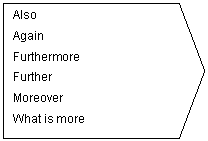
 

Pentágono: Also
Again
Furthermore
Further
Moreover
What is more
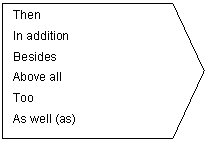
Pentágono: Then
In addition
Besides
Above all
Too
As well (as)


b.       Equation (similarity with what has preceded):
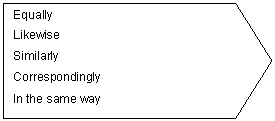
 

Pentágono: Equally
Likewise
Similarly
Correspondingly
In the same way


b.       Transition can lead to a new stage in the sequence of thought:

 

Pentágono: Now
With reference/respect/regard to
Regarding
Let us (now) turn to ...


Pentágono: As for
As to


                                                                              Often used when discussing something briefly
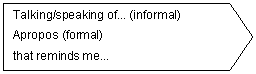
                                              

Pentágono: Talking/speaking of... (informal)
Apropos (formal)
that reminds me...
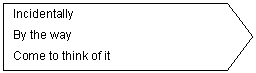
Pentágono: Incidentally
By the way
Come to think of it


                                                                                                                                                                            Indicates a digression

                                                                                                                                                                            and an afterthought


                               spoken language


                                                                                                                                                                            to introduce a digression


c.       Summation indicates a generalization or summing-up of what has preceded:
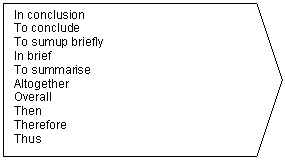
 

Pentágono: In conclusion
To conclude
To sumup briefly
In brief
To summarise
Altogether
Overall
Then
Therefore
Thus


d.       Apposition used to refer back to previous sentences or to parallel or related refernces:


i.e., that is, that’s to say

in other words

or, or rather, or better

and

as follows

e.g. for example, for instance, say, such as, including, included, specially, particularly, in particular, notably, chiefly, mainly, mostly (of)


e.       Result expresses the consequence or result of what was said before:
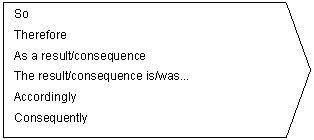
 

Pentágono: So
Therefore
As a result/consequence
The result/consequence is/was...
Accordingly
Consequently


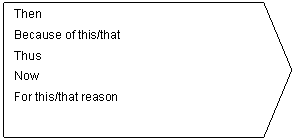
Pentágono: Then
Because of this/that
Thus
Now
For this/that reason


f.         Inference indicates a deduction from what is implicit in the preceding sentence(s):
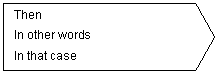
Pentágono: Then
In other words
In that case
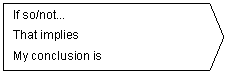
Pentágono: If so/not...
That implies
My conclusion is
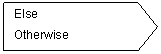
Pentágono: Else
Otherwise


g.       Reformulation to express in other way:
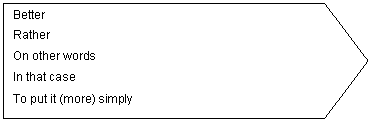
Pentágono: Better
Rather
On other words
In that case
To put it (more) simply


h.       Replacement to express an alternative to what has preceded:
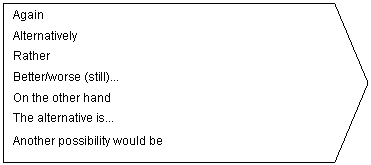
Pentágono: Again
Alternatively
Rather
Better/worse (still)...
On the other hand
The alternative is...
Another possibility would be


3.  but


i.         Contrast with what has preceded:
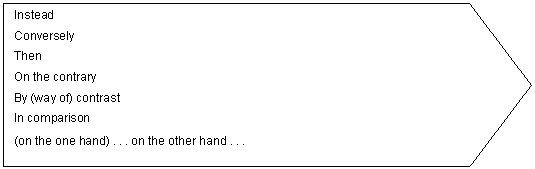
Pentágono: Instead
Conversely
Then
On the contrary
By (way of) contrast
In comparison
(on the one hand) . . . on the other hand . . .


j.         Concession indicates the unexpected, surprising nature of what is being said in view of what was said before:


Besides

(or) else

However

Nevertheless

Nonetheless

Notwithstanding

Only

Still

While

(al)though

Yet

In any case

At any rate

For all that

In spite of / despite

After all

At the same time

On the other hand

All the same

Even if / though


Hosted by www.Geocities.ws

1