| Driving tips: | |
| Avoiding deers | |
| Braking | |
| Braking - Heal & Toe Techniques | |
| Shifting | |
| Steering - Oversteer | |
| Steering - Smooth Hands | |
| Winter Driving |
|
Driving Your WRX: Avoiding Deer See the Animal Early As to your driving: Be careful about outdriving your headlights. You begin to outdrive your lights when you could not stop in time to avoid something that your headlights begin to illuminate. Obviously, this is why fog and other atmospheric factors may force you to reduce your speed. Use your high beams! It is remarkable how many people do not tip their high beam lights up the moment that a car has passed and there are no other cars coming. Another trick here is to delay tipping them down until you first see the actual headlamps on an oncoming car. Until you see the car itself, or the marker lights of a truck coming over a rise, you have a few more seconds of good illumination that you should be taking advantage of. This sort of vigilance also keeps you awake so that your scan is good... speaking of which:The scan for deer and other animals is very important. Look ahead of course, but also check to the sides and look at the banks. Deer will frequently jump onto the road from the bank, and if you see them early it can make the difference in slowing to avoid them. On curves, look to the inside of the corner, as your lights illuminate the outside; anything to the outside can be seen with peripheral vision while you are checking the inside. This may seem tiring, but if you establish the habit it becomes more natural. When You See the Deer Lets divide encounters with deer into three distances: Far, near, and what I will call "ambush" distances. If they are far away, you have plenty of time to act, slowing gradually for them. If they are near, say 30 to 75 yards away, you will need to use maximum or near maximum braking, but wont likely get stopped before you get to them, so your moves are important. If they jump out at you from an "ambush" distance, your natural reactions will come to play; you have about 1 or maybe 2 seconds and only one or maybe two control inputs before the issue is decided. (Example; a deer jumping from the roadside unseen until just prior to impact) Most problem issues are in the "near" distances, if you are vigilant. Evasive Action Far distances: If they are far away, you can simply slow down and stop if needed. Good job spotting them early! Don't get complacent, definitely slow down when you get to the spot where you saw them, as deer are sometimes skittish - and remember the rule that there are usually more than one. If you saw one crossing in front of you from left to right, assume that there will be more crossing at or near that spot in a few more seconds. Near distances: What about those middle distances where you and the deer have more time to play zig-and-zag? This is where many encounters fall. To reiterate, the scenario is that the deer is in the road, or about to run into the road, and you are close enough that you have to do something. FIRST, brake hard. Don't turn yet, and resist the adrenaline rush that makes your hands want to "do something" until you really need to. After a few encounters of this sort, your mind will start to slow things down for you after the initial rush. Get the binders applied (remember threshold braking?) and start scrubbing off speed. NEXT, the brakes have been applied, now think "next step". You are about one full second into the issue, still tracking straight, scrubbing speed like a champ without upsetting your contact patch by swerving. Your mind is recovering from the adrenaline rush, and it's you and the deer. How close is it? Is it running? If it is crossing, go behind it; if it is running straight down the road, try to let it pick a direction while you scrub speed, and commit fully to one side if you must to give the deer a direction to run from. Do you have another full second of hard, straight ahead braking before you may have to swerve? Use it, as much as you can, before turning / swerving. If you must swerve hard, let up on the brakes slightly to avoid the tail coming way out, unless you want it to; also be prepared for a quick countersteer to rock the back end back into line and get full braking back on. There are a lot of possibilities here, but you get the idea. The main thing that I want to convey is: Use the adrenaline to get into braking, but don't go into maneuvering unless / until you really need to. When you do maneuver, know what you are trying to do. This all takes about 2-4 seconds. There may be an instance where you have to accelerate, such as: Deer crossing left to right close, no hope to get behind him; you would need to jump to the right and hit the gas. I almost never accelerate unless it is clear that it is the only escape. It is a mistake tothink at the last moment that if you accelerate through the deer it will somehow do less damage to the car. Every foot and mile per hour will count, stay on the brakes. A Few More Thoughts |
|||
|
ABS works in different ways, but to illustrate this point, I’ll take an example of, say, a Subaru Outback with four people in the car on a snowy surface (this may be easier to visualize given a heavier car on a slick day): You begin a panic stop, depressing the brake. The car goes up to maximum braking, and then one wheel begins to slide or lock. As it does so, the car momentarily pulses the pedal back to you, which feels like a “brp” under your foot. In doing so, it allows that locked wheel to again rotate. This helps in two ways – first, a tire brakes most efficiently when it is just short of locking up, exerting the maximum effort on the surface. When it goes beyond that point and slides, braking is diminished. Second, by keeping the wheels from locking up, ABS helps maintain directional control, especially if the driver is steering around an obstacle while braking. In effect, in a panic stop ABS allows the driver to pound the brakes as hard as he or she wishes, but still have effective braking and directional control. Remember that a tire gets maximum braking just before the point of lockup. Without ABS a driver can get maximum braking effort by braking to the point of wheel lock, and then reducing the pressure ever so slightly to the point where the wheels are rotating again. This is known as “threshold braking”. The dangers of course are in backing off a bit too much and not getting maximum effort, and in maintaining directional control while braking. Back now to an ABS equipped car: By using threshold braking, it is even possible in some cases to do better than ABS. Remember the pulsing action that some ABS systems use to allow the locked wheel to rotate again? While this is happening, the braking effort on the other three wheels is momentarily lessened also. On a slick snowy surface, if you continue extreme hard braking so that ABS is constantly activated, the lessened brake force is extremely evident. It almost feels as though the car starts sliding faster! If this happens to you, back off slightly to allow the ABS to disengage, and use threshold braking… release ever so slightly as the ABS starts to “brrp” back at your foot. A well executed stop will have you riding that edge, with ABS intermittently engaging as you modulate and keep feeling that threshold. On DRY pavement with good traction, you can stand on it almost as much as you need to. Disclaimer: As with anything else, threshold braking takes some practice; if you have ABS, have not practiced this to a confident level, and need to panic stop, stand on the brakes and steer where you want to go. Heel and toe technique
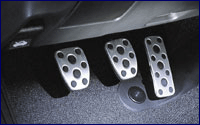
Heel and toe is so named because you in effect use the ball or big toe side of the right foot to maintain pressure on the brake, and use the heel or right side of the heel of the right foot to blip the gas. In most cars, this requires a bit of contortion of the right foot, twisting the ankle to the left, pulling the toes up and rotating the foot counterclockwise, as the gas pedal is further over or down than the brake pedal. To do this properly causes a cramp, but it is only a temporary situation. It is now that the excellent pedal placement of the WRX comes to light! In the WRX, you need only depress the brake with the left side of the foot, and have the right side of the foot ready to blip the gas. I find that with gently timed shifts a blip just after passing neutral works well for me. There you have it! With heel and toe you can effectively brake, downshift and blip the throttle all at once - a great skill to have in your quiver of techniques. |
|||
Shifting The WRX has a good sense of timing. The pedals are well positioned, and on upshifts RPMs match reasonably well. Picture this: You are running up through the gears, and as you push in the clutch and release the gas in an upshift, the RPMs drop. As you re-engage the clutch, the RPMs have fallen by 1000 RPMs perhaps, say from 5000 to 4000 (just for the sake of argument). As you re-engage the clutch, do those RPMs match what the rest of the drivetrain is running at? In the WRX, for most usual upshifts, yes. In other words, if after shifting into fourth your car will be running at 4000 RPMs AND the engine is ALSO at 4000 RPMs when you release the clutch, the shift will be silky smooth. If the engine is turning at 3400 RPMs and the drivetrain will be at 4000, the car will buck as you release the clutch while the engine catches up to the wheels. In average upshifting, I’ve found that the RPMs match in the Impreza very naturally. This is a nice characteristic, as it makes for smooth shifting without much work on the drivers part. How do you stop avoid bucking on up or (especially) downshifts? You can “match RPMs” with your right foot on the throttle. As you get to know a car, you naturally get to know about what engine speed the car will be at given combinations of car speed and gear selection. You don’t have to calculate it; rather, it becomes an instinct. Try this: You are decelerating and want to downshift for third gear. You can just shift hard into third, but there is a more elegant way. First, when you shift not every shift needs to slam the gear selector around. Engage the clutch; go quickly into neutral but then just exert enough pressure to make the shifter go in without forcing or slamming it . This is a stitch slower than slam shifting the car, but your transmission will last a lot longer. On upshifts, it may give the car more of a chance to match RPMs by itself. On downshifts, you may need to match RPMs with your right foot. Heres the key, and when well done the timing is a thing of beauty: As you shift into the lower gear and just before releasing the clutch, just blip the throttle so that the RPMs climb. When done well, the RPMs blips upward a bit, the gear selector hits the new gear, the clutch is releasing just as the RPMs stop their upward movement or just after, and the RPMs match together nicely. Obviously this takes a bit of practice and varies from car to car. When you really get to know your car, you may note that certain things like even oil viscosity change your engine response – heavier oil will cause the RPMs to drop a tad more quickly, lighter oil will have the opposite effect. To make sure that you have the theory again: If you shift down and just release the clutch without blipping the throttle, the car needs to catch up with itself and will buck / snort and generally act angry at you. When you just add this little blip with the right foot as the shifter goes through neutral, it helps tremendously. When you get to know your particular car enough to do it well, it is quite satisfying. Once you master a few of the basics such as these, you will find that even a casual drive down a road can be very enjoyable because you are taking an interest in driving WELL. Work on smooth hands, matching RPMs and remember threshold braking. In future installments, we can take techniques a bit further with things like left foot braking and heel techniques. Until then, work on these safely, and enjoy! |
|||
|
Steering - Oversteer Still, the WRX is so sure-footed that it is confidence - inspiring. One night you are coming home late on a nice stretch of two-lane road. Maybe it's a little wet, maybe not; but it's the first time for you and the WRX on this road, and you're enjoying it. Suddenly, because the WRX eats up the straight stretches faster, you're left carrying a lot more mail into one corner than you are used to. Still, that's ok, you are smooth and the car is handling it until the corner tightens. You instinctively lift off the throttle and the tail of the car steps out, slewing around to the outside of the left - hand corner. You somehow manage to stop your right foot from hitting the brake, but as the rear wheel drops off the edge of the pavement into gravel, the issue has been decided. The right rear corner kisses the embankment, which snaps the nose around to the right into the bank also, spinning the car and making a sickening crunch. What happened here? Oversteer, or more precisely, oversteer caused (induced by) lifting off the throttle. Lets go over the terms "oversteer" and "understeer". Oversteer is a condition where the rear of the car is losing or has lost traction and is sliding to the outside of the bend. (Picture a rear wheel drive car on snow, with a driver hard on the gas or a dirt track car going around a corner). Understeer is the condition where the front of the car has lost traction and is sliding first (picture a corner on a snowy road were you ever in the situation where you turned the wheel but the car did not respond, and kept going straight?)
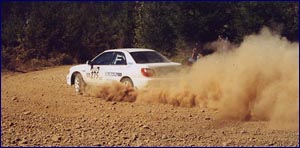
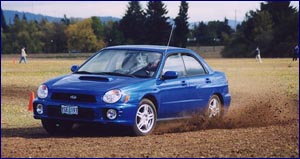
Some cars have more of a tendency to understeer (nearly all front wheel drive cars, such as Civics and Integras) and some have a natural oversteering tendency (generally rear wheel drive cars like the 911, with some exceptions like the Honda CRX). I should note at this point also that the general handling characteristics of a car also change with speed! That same Civic or Integra that understeers at 40 mph may oversteer at 80 mph. Now, lets assume that a car is being driven in a constant, large circle on a track, and speed is increased gradually until the car begins to break traction. In an Integra, that will be the front wheels and if the driver simply lifts off the throttle it will solve the problem. Weight transfers from the rear wheels to the front, giving them the additional traction that they need. In a car that oversteers however, lifting the throttle takes more weight away from those rear tires, which are already scrabbling for traction. In fact, picture that car going around the circle again even if the car is solidly tracking around that circle, the driver could lift off the throttle and unbalance the car to where the back end steps out slightly. If that same driver brakes hard, the back end may likely slew completely around to the front end. Is this oversteer a problem? Well, yes and no. It can be used as a tool during competition to reposition the nose of the car in the direction that you want it to go. In rally, it is desirable to have a car that can be easily pitched into oversteer on loose surfaces, as oversteer is much easier to deal with than understeer, and it leaves you with more options on unknown corners. When you are surprised by oversteer, however, or don't have the room to deal with it, then it can ruin your day. Back to the Impreza the WRX and 2.5 have some general tendencies to understeer, but this can be translated very easily into oversteer by braking or lifting the throttle. To a driver skilled in front wheel drive, this tendency can be a surprise. To sum up: Take care that if you get too deep into a corner and lift throttle or brake as you are turning, you will need to cope with oversteer. This becomes particularly true on slippery surfaces so what to do? Use your brakes before you get to a corner, and pick braking points wisely; slow to a reasonable speed to allow some safety margin. If you find that you have come into a corner way too hot, try staying at neutral throttle (don't change throttle position at first) and see how well the car sticks. If the rear starts to lose traction, of course steer into the skid and keep tracking around the corner. Rather than lifting throttle at this point, you will need to stay neutral or even add a bit of throttle to fasten the back end. Your alternative is to let the thing spin and try not to hit anything, which may be a better choice in some cases. |
|||
|
Steering - Smooth Hands
Try this – when you are driving through a corner on the road, practice making the transition from straight travel into the corner as smooth as possible… and as slow as possible. In a good corner, the driver turns the wheel just as much as necessary to make the corner without extra input, keeping the wheel steady once the car is set into the corner and just as smoothly “rolling out” of that turn. A good portion of doing this requires looking far enough ahead of the car to pick the proper line through the corner so that your car is where it should be to track the whole corner smoothly. If you watch an exceptional driver, hand motions are minimized because he or she is planning ahead and making corrections only a little at a time. Obviously, discussion on the proper line through a corner could fill a chapter in a book and may be the subject of a future article. For now, know that you should look as far down the road as possible when cornering, and plan to position your car in the lane so that your car can make the most constant radius turn as possible. Avoid “early apexing”, or going to the inside of the corner too soon, as this leaves you with fewer options if the turn suddenly tightens. |
|||
|
Winter Driving Hazards Ice - The most perilous times can be when the road is wet from rain or snow, and evening is approaching. It is very important to watch the freezing point; if you are traveling into the evening and the temperature is dropping, it is likely that you will see some ice. Everyone knows it, but it is worth saying that the bridges will freeze first!!! Even if I am traveling in rain with wipers on, and a rooster tail of spray is coming off the car, if a bridge comes up I listen carefully and feel the road, and always try to take the bridge straight across. If the bridge is on a corner, plan your line to minimize turning while on the bridge. If you get caught by an icy bridge, well… the best thing is to use as little input as possible, trying to keep the car straight. Neutral throttle for a short patch is best, or slightly on the gas if the tail is starting to come out. The main thing is NOT to overcorrect, and hope the icy patch ends quickly. If it is a large icy patch and you are about to slide into something, well… remember also that you can point the car a little and use power to pull you into where you want to go if the ABS has become useless. Snow - A consistent snowy surface can be almost enjoyable to drive on, as while it is slippery you know what it will do. If you have good tire tracks and / or if the snow is not deep, the car is quite controllable. Slush - I dislike slush driving more than anything except surprise ice patches, as it tends to grab the car and throw it around, forcing you to slow dramatically to retain control. The best thing to do is to stay in the tire tracks, and avoid carrying excessive speed. |
|||
| Back to main page | |||