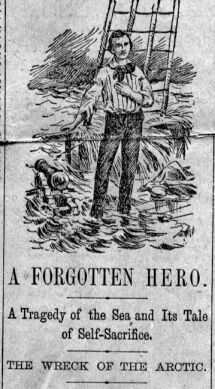
The Wreck of the Arctic, By Robert H. Harkness
A Thrilling Story of the Disaster—A Washington Boy Whose Heroism Was Conspicuous—How He Perished at His Post—A Monument Movement That Failed
The year 1854 is memorable for the number of wrecks which took place during its course among Atlantic Steamers. The loss of no less than five large vessels had already been chronicled, when, on the 3rd day of October, news reached New York that the Arctic, of the Collins line of Liverpool steamers, had gone down under circumstances of peculiar interest and horror.
She was one of the finest vessels of her time. She was a side-wheeler, had cost $700,000 and was insured for $500,000.
On Wednesday, September 27, 1854, she was on her return trip to New York, with 226 passengers (exclusive of children), mostly homeward bound tourists; a crew of 175, a valuable cargo and a heavy mail, and had gotten within sixty-five miles of Cape Race, the southeastern extremity of Newfoundland, when, exactly at noon, while steaming through a dense fog, she was struck by the propeller Vesta, bound from St. Peters to Granville.
Although the Arctic had two men in the look-out at the time of the accident, the fog was so thick that the Vesta was not sighted until within a minute of the time of collision.
The Arctic was making twelve miles an hour and the Vesta eight, and they struck head on[1]. The stern of the Vesta struck about twelve or fifteen feet abaft the stern of the Arctic. At the moment of collision the Arctic was on the crest of a large wave or swell, while the Vesta was in the corresponding trough, and the bow of the Arctic being elevated, the Vesta struck her below the water line. The anchor of the Vesta was driven through the timbers of the Arctic and broken, and part of it was left sticking in the orifice. The Arctic was pierced in three places, two of the breaks being below the water line. The Vesta had about ten feet of her bow literally stove in and crushed off, and when Capt. Luce of the Arctic hurried on deck and saw the Vesta he thought she must immediately go down. [2]
He dispatched his first mate, Mr. Gomley [A], and a boat’s crew to the Vesta to offer assistance and turned his own vessel in the direction the Vesta had taken and, reaching her vicinity, he steamed twice around her.
He found, to his surprise, that no assistance was needed [B]. The Vesta, though in appearance a nondescript craft, was provided with a bulkhead, which, reinforced by 150 mattresses, palliasses and other effects of the crew, kept out the water sufficiently (especially after the foremast had been cut away) to keep the vessel afloat until she reached her port with the 149 persons who still remained aboard her.
Soon after the collision Capt. Duchesne of the Vesta dispatched a boat with a crew of ten men to the Arctic to offer assistance, but in attempting to board the Arctic their boat was capsized and all but one of its crew were lost, either by being struck by the wheel of the Arctic or by drowning, or by both.[3] The single survivor was saved by the crew of the Arctic. Mate Gomley of the Arctic lost his way in the fog and did not get back to his ship, but eventually reached shore. [C]
The Arctic’s Grave Situation
It was not until shortly after the Arctic had resumed her homeward course that the gravity of her injuries was discovered. She was found to be taking water rapidly, and efforts were made to stop the break in her hull by passing sails under her and by thrusting mattresses and pillows into the holes. The anchor chains were thrown overboard to lighten her bow, but the fragment of the Vesta’s anchor was wedged in the timbers so firmly that it was impossible to dislodge it or to get the sails close enough to her to keep out the water. The seriousness of the situation now became apparent to Capt. Luce. The Vesta was out of sight in the fog and considerable distance away, beyond hearing of the signal guns. He headed directly for Cape Race, some forty-five to sixty miles away. For half an hour good speed was made, but the lower fires were then quenched by the rising water, although the steam and hand pumps were both at work. In another half hour the upper fires were out, and then the great ship was a helpless wreck.[4]
It seems strange as we look back at the occurrences of this sad day that the outcome was so appalling. But an ill fate seemed to hang over the vessel. When Capt. Duchesne of the Vesta saw the Arctic steam twice around him he had no idea she was seriously hurt, and afterward reported that he could have accommodated all her passengers and crew had he found out that they needed assistance. He thought when she parted from him that she had gone straight to New York.
As soon as Capt. Luce found that the Arctic must sink he took measures to save his passengers. Even then had good order and discipline prevailed all could easily have been saved. The Arctic floated for five and a quarter hours after the collision (although nobody knew but that she might go down at any moment.) The sea was smooth and so remained for twenty-four hours, and boats and rafts could easily have gotten to land.
The Panic
But it was not to be. A sad scene of insubordination and selfishness now began to be enacted, relieved, Got be praised, by some flashes of noble heroism.
Five boats remained after the first mate left. Four of these were taken by the engineers, sailors, a few passengers and the remaining officers, except Capt. Luce and Third Mate Francis Dorian. The second mate, with two boats and forty-five passengers, reached shore.
Capt. Luce, Third Mate Dorian and Mr. Geo. H. Burns, messenger of Adams Express Company, started the construction and provisioning of a large raft, while some of the passengers and those of the crew who remained worked at the pumps and fired signal guns.
The boat had been lowered to assist in building the raft and Capt. Luce and some of the male passengers were helping keep the crowd back when a panic seized those on deck and they rushed over the bulwarks onto the raft, at the same time almost sinking the boat. In this emergency Dorian cut the boat loose, and he and those assisting him hurried[5] it away from the raft. The noble man behaved throughout with great presence of mind and labored with heroic energy. When the panic started he cried: “For God’s sake, captain, clear the raft so that we can work! I won’t desert the ship while there’s a timber above water!”
Thus much precious time was lost. The people did not believe that those who were trying to assist them were sincere, and prevented them from providing means of escape.
The captain, when urged to leave, stated that the fate of the ship should be his and his little son’s.
Master Collins, a son of the proprietor of the vessel, when offered a life preserver refused it, saying he would not take it while any woman on board was without one. He perished with his mother and sister.
The Heroism of Stewart Holland
Another faithful one and one whose quiet heroism shone out brighter as the prospect became darker[6] was a young man named Stewart Holland. He was an engineer under instruction and but twenty-two years old. When most of his companions in the engine room took to the boats and deserted he remained and did all he could to help save those left in the ship. Just before the ship went down he was helping fire the signal guns. Dorian called to him to get into the boat with him, but he refused; and just as the waters curled over the ship’s side as she went down his last gun boomed over the sea and he sank with the more than 200 others still on the ship, most of them to rise no more, and among whom were all the women and children.
There was something so romantic and heroic in the self-sacrifice of one so young as Steward Holland that his story caused a sensation. He was a Washington boy and had at one time been employed in the navy yard here. The people of Washington felt proud of him, and in response to a general demand a subscription was started to erect a monument to his memory. A lithograph was published depicting him in the act of firing his last gun, copies of which picture are no doubt still in possession of some of the older residents of Washington. The monument enterprise failed [7] because the design was too elaborate for the funds and interest flagged from the long delay.
Why the Monument Was Not Erected
In 1858 those having the matter in charge were still trying to keep up interest in it, and some hundreds of dollars had been collected, but the bank in which the money was deposited failed and this money was lost. A circular issued in 1858 states that one of the last official acts of President Pierce was to designate the open space on Pennsylvania Avenue between 13th and 14th streets as a suitable site for the proposed monument.
It is greatly to be regretted that so deserving an enterprise should have been so unsuccessful. Washington city is full of monuments to national characters, but in the whole District of Columbia there is only one monument to a local hero, and that is the monument to Greenup, the fireman, in Glenwood cemetery.
It should be a cause of pride to the people of the District of Columbia that one of their young men should have shown such Spartan courage and should have died so nobly, when all the scenes he had been witnessing for five hours were enough to unnerve and frighten older men. And how sublime the thought that he knew the last gun he fired could bring no help for himself, but might bring it for others! As a local poet of the time said:
“He died like a man at the post of death, and to save was his latest thought.”
His father, Isaac Holland, was doorkeeper of one of the houses of Congress, and doubtless there are gentlemen now in public life who remember the genial old man, whose last days were saddened by the loss of his manly and handsome son. [8]
Printed in The Evening Star, Washington DC
Saturday, June 4, 1892
Also printed in: The Evening Post, Worcester, Mass.
Tuesday, July 5, 1892
“He Died Like a Man”
Notes by Tina Barton:
[A]: should be Gourlay, not Gomley.
[B] and [C]: These statements are not corroborated in other accounts. The other accounts imply that the Vesta seemed sure to sink and the captain of the Arctic, realizing the peril of his own ship, chose not to wait and find out, and tried to make to shore as quick as possible. I never saw any other account stating that Gourlay made it to shore.
Postscript: The family artifacts include Robert Harkness’s handwritten original. It is currently in Tina Barton’s possession. The original is almost verbatim of the above, without the headlines, with the following modifications:
[1] The Arctic was making twelve miles an hour and the Vesta eight, and as they struck head on, the force of the collision was as though each, while at a speed of 20 miles an hour, had struck a stationary object.
[2] The Vesta had about ten feet of her bow literally stove in and crushed off, and when Capt. Luce of the Arctic hurried on deck and saw the Vesta scraping and tearing along the side of the Arctic the spectacle was so horrible that he thought the Vesta must immediately go down.
[3] Soon after the collision Capt. Duchesne of the Vesta dispatched a boat with a crew of 10 to the Arctic to offer assistance, but in attempting to board her their boat struck her side and was capsized and all but one of its crew were lost, either by being struck by the wheel of the Arctic or by drowning, or by both.
[4] He headed directly for Cape Race, some forty-five to sixty miles away. For half an hour they made good speed, but the lower fires were then quenched by the rising water, although the steam and hand pumps were both at work, and in another half hour the upper fires were out, and then the great ship floated a helpless wreck on the water.
[5] paddled (instead of “hurried”)
[6] “darker and darker,”
[7] The monument enterprise (like most enterprises of the kind) failed….
[8] (continuation) Now why cannot the scheme of erecting a monument to the memory of Stewart Holland be revived and carried to a successful issue? Washington is full of statues of heroes of war; why can we not have some of heroes of peace? There is everything to be said in its favor; nothing to be said against it. If suitably designated, and creditably erected, it would be an abject lessen to the youth of our District and Country of incalculable benefit.