In Search of Family Landmarks
By Christine G. Barton
August 23, 2002
I grew up at 25 Sanford Drive, Newport News Virginia. In the dining room of our house, there hung for years a painting by my mother of her great-great grandmother’s nephew Stuart (or Stewart) Holland. She copied the portrait from a black and white Currier and Ives Lithograph of which she had a copy. Stuart died heroically on September 27, 1854 on board the Arctic, the most luxurious passenger liner of its day, which sank about six hours after it collided with a small French iron steamer, the Vesta. At a time when most of the crew panicked and made off with the lifeboats, Stuart, an assistant engineer on board, continued to fire the signal gun in hopes that another ship would come along and rescue the 400+ passengers and crew. No women or children survived the shipwreck, and only about 80 crew and male passengers made it back to shore. But some of those who did survive reported of Stuart’s heroism with great zeal, the lithograph was drawn, and a grand monument in Washington DC, Stuart’s hometown, was planned. The monument was designated for a piece of empty space between 13th and 14th Street on Pennsylvania Avenue, where the Freedom Plaza is. The Civil War came and went, and the monument was forgotten, until the 1960’s. Alexander Crosby Brown who worked for the Mariner’s Museum in Newport News then revived interest in the story of the shipwreck. My mother conferred with him about Stewart, and somehow it came about that the Newport News Shipyard agreed to fund a plaque in his honor, which was hung in the District Building in Washington DC, very near where the monument was to be built. And so we all trooped up to Washington DC in 1964 to witness the dedication, and though I was too small to remember much about it, my mother’s painting kept the heroic tale fresh in my mind, and gave me much pride.
Then in 2001, my sister Frances typed into her computer a precious family history researched and written by my Great-Grandfather Robert Henry Harkness (aka Harry). There, many stories of the Harknesses, Hollands, McAlwees, and Barretts were provided, and I found many more stories to increase my pride in my maternal line. It might be ironic that I ended up living in Elkridge MD, centrally located between Baltimore, Annapolis and Washington DC, the three main cities where the families in my maternal line thrived. I typed into my own computer the Harkness and Holland family trees such as I gleaned from the family history, and extended with my own immediate family and our offspring. I also learned about more ancestors from distant relations I met on the internet through the Genealogy.com GenForums. As I was looking up names, dates, and places, it dawned on me that I could certainly visit some of the buildings, cemeteries, and other sites, which have become my family landmarks. Why it didn’t occur to me before can only be explained by the fact that I am a busy Mom, Wife and mathematician.
I am most familiar and comfortable with DC and its subway system, so I decided to start there. The family landmarks that I learned of were: (1) 1409 Irving Street NW where my Great-Grandfather Harry and Great-Grandmother Anna Harkness lived, and where my Grandmother Mary Roderick Harkness Layman grew up with her sister Cornelia Gregory Harkness (Aunt Nelie); (2) The District Building, where the monument to Stuart Holland was supposed to reside; (3) Oak Hill Cemetery, where Anna, Harry and Aunt Nelie are buried, as well as Stuart’s father Isaac, and Anna’s grandmother Kitty Holland Barrett (Isaac’s sister); (4) Mt. Olivet Cemetery where George Franklin Barrett (Kitty’s son, Anna’s father) and his wife Margaret Jane McAlwee Barrett are buried; (5) Glenwood Cemetery, where Anna’s sister Margaret Jane Barrett is buried. I thought that perhaps by visiting the cemetery I could find other names in my family tree, or that should be added to my family tree, along with some missing dates.
1409 Irving Street NW popped right up on Mapquest.com. I did not know for sure where Stuart’s monument was hung. My sister Alice thought it was in the Archive building, or the Library of Congress, or something, but my Father insisted it was at the District Building. What and where the District Building was, I didn’t know. Try doing an Internet search on District Building DC, and see what pops up—everything but the building I wanted! So finally I decided I would at least see what was at 13th and 14th Street and Pennsylvania so I looked it up in my Road Atlas, and lo and behold – the District Building is there! So I put 2 and 2 together and decided Dad was right. The plaque must be there. So that site went on my itinerary. The White House is nearby, so I thought I’d just walk past it and look, which would take me right to 17th Street. It turns out that Isaac Holland, Stuart’s father (and so I assume Stuart too) lived at 17th Street between Pennsylvania Avenue and H Street NW. So though I didn’t count that as a family landmark because I was pretty sure there wouldn’t be any homes there anymore, I decided to walk through and see what was old and what was new. I decided, at this point, that I’d only be able to see one cemetery in addition to these other sites, so I chose Oak Hill, where I knew I’d find several family members.
In searching on the Internet for subway stations and maps, I found out that I could view some “Party Animals”—donkey and elephant statues decorated by local artists, placed throughout the city. We had seen similar projects in Buffalo (with bison) and Toronto (with moose), so I was very interested in seeing some of the animals, especially the elephants. Though I’m not political, I do have an affection for elephant statues!
I was able to find enough information to set my itinerary and choose my day. I planned on going on Saturday, August 24, 2002, since my husband and children are at the beach and I wouldn’t miss any time with them, or have to drag them along on possibly fruitless errands. But I learned (on the Internet) that the Oak Hill Cemetery management was not very friendly to the public, so I decided to call. The lady that manages it was affable enough, but she said the cemetery was closed on weekends, holidays and during funerals. So I set and appointment for 1pm on Friday, August 23, 2002. This drove the rest of my plans, and so here is how it all went:
I parked at Greenbelt Metro Station, and took the green Metro line to Columbia Heights. 1409 Irving Street was supposed to be 1/10 of a mile away. I got outside at 14th Street, and one of the first things I found when trying to orientate myself was Riggs National Bank! This may not mean anything to you, but it turns out that my Great-Grandfather Harry worked there until he died in 1915. I had no idea it was so close to his home site, or that it would still be in existence!
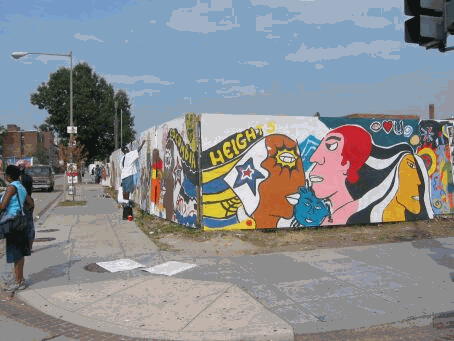
But nothing prepared me for what I saw next. I originally expected to see some charming old row homes with flower boxes and wrought-iron railings. Then a friend of mine told me that the neighborhood of 1409 Irving Street NW was not a very nice one these days, though I would not likely be shot in drug war crossfire either. But he did think that the homes would be intact. So I imagined instead a rather run-down set of row homes, with weed-strangled yards. But I must have been about a year too late to see either thing. The whole block was a vacant lot, with just one false front standing bravely over the street, and one tree near the sidewalk, which might have been a sapling when Harry died. The lot was fenced in, and around the fence was hung white plywood where many groups of people were having fun with sanctioned graffiti. I asked one set of people about what happened to the buildings, and they didn’t know anything, but told me to come back in about a year to see the new ones. They asked me to join in their painting, but I declined, opting to go instead to get a closer look at the bank.
What I saw as I crossed 14th Street NW on Irving. I hoped there might be some homes farther down the block, but there were none.
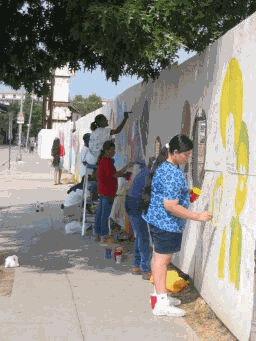
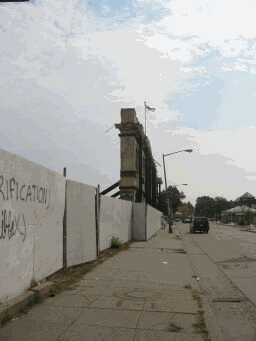
The artists I talked to. The Façade
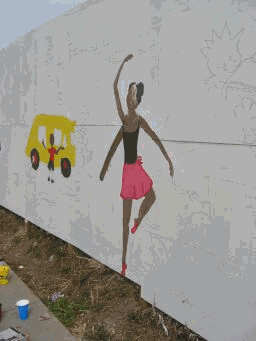
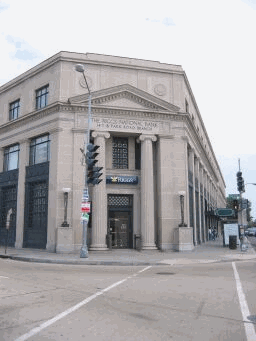
Painting done by a young woman from the Riggs National Bank
Dance Institute.
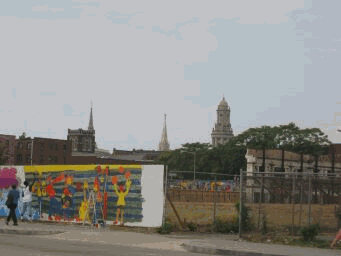
Looking at the Vacant Lot on Irving Street catty-corner, from 14 Street.
Everyone I met there was so nice. It is a mixed ethnic area now—blacks, whites, Latins, Arabs, Asians… When I went in the bank, I told them about my Great-grandfather working there, and they were very nice and let me take pictures inside. They didn’t come out very good though.
With mixed emotions, I returned to the subway station and headed on down to Gallery Place, where I had to transfer to the red line to get to Metro Center. There I took a right when I should have gone left, and so went about a block out of my way, but I soon found the District Building, actually the John A. Wilson Building, which explains why it was so hard to find on the Internet. Below is a picture of the entrance. Just Inside the entrance is a porch where some memorials are. Stuart (Stewart) Holland’s memorial is in there. I didn’t see it and I went right inside the building and asked the security guard where it might be. She was puzzled, because she didn’t know of any memorials inside the building, but then she remembered the ones in the porch. Yet another nice person on my excursion!
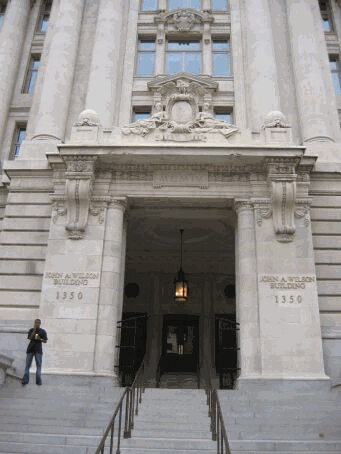
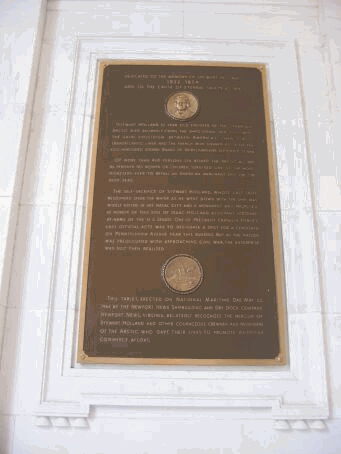
The entrance to the District Building The memorial to Stewart Holland – it’s big
The memorial itself is about 5 feet high and 3 feet wide. It is in the middle of the left wall as you enter the porch. There are empty frames waiting for 2 more on that side, and there are two other memorials, with room for one more on the opposite wall. Here is what the memorial says:
Dedicated to the Memory of Stewart Holland
1832-1854
and to the Cause of Eternal Safety at Sea
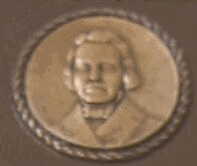
Stewart Holland, 22 year old engineer of the Steamship Arctic died valiantly firing the ship’s signal gun following the fatal collision between America’s then finest transatlantic liner and the French iron steamer Vesta on the fog-shrouded Grand Banks of Newfoundland, September 27, 1854.
Of more than 400 persons on board the Arctic, all but 86 perished. No women or children survived one of the worst disasters ever to befall an American Merchant Ship on the high seas.
The self-sacrifice of Stewart Holland, whose last shot resounded over the water as he went down with the ship, was widely noted in his natal city and a monument was proposed in honor of this son of Isaac Holland, Assistant Sergeant-at-Arms of the U.S. Senate. One of President Franklin Pierce’s last official acts was to designate a spot for a cenotaph on Pennsylvania Avenue near this building. But as the nation was preoccupied with approaching Civil War, the enterprise was not then realized.
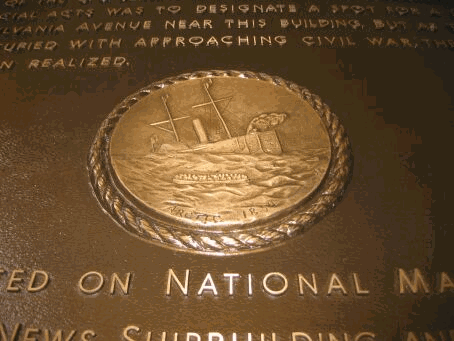
This tablet, erected on National Maritime Day, May 22, 1964 by the Newport News Shipbuilding and Dry Dock Company, Newport News, Virginia, belatedly recognizes the heroism of Stewart Holland and other courageous crewmen and passengers of the Arctic, who gave their lives to promote American commerce afloat.
Outside the District Building were two party animals:
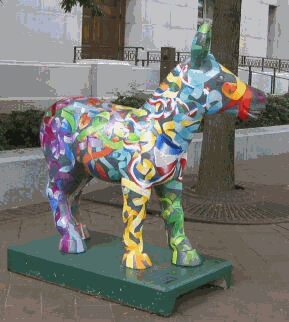
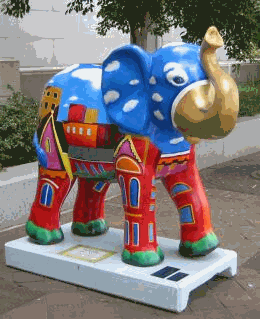
Aren’t they cute? In the middle of Pennsylvania Avenue is Freedom Plaza. From there is a nice view toward the Capitol Building:
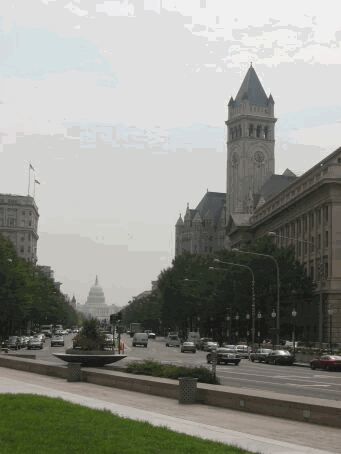
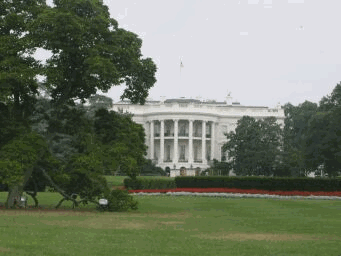
The White House
Here are some more party animals on the way to 17th Street:
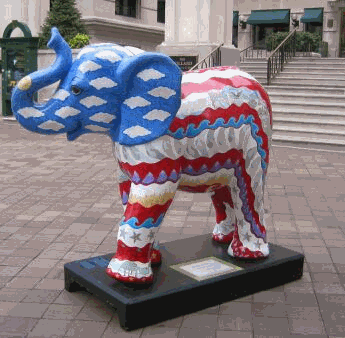
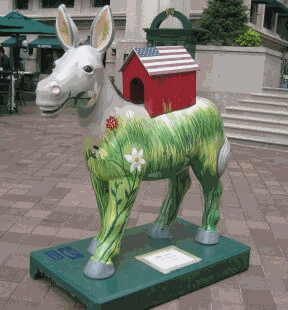
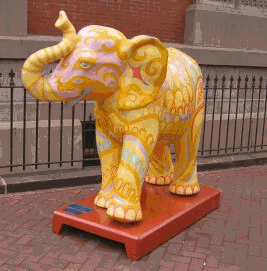
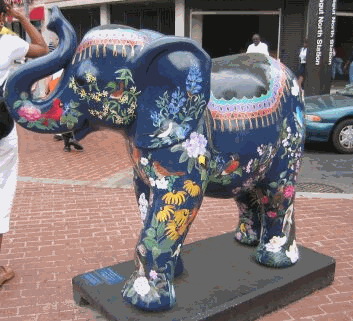
The above two party animals are on 17th Street. The yellow one is outside the Renwick Art Gallery on the block where Isaac Holland was supposed to have lived. See the yellow guy below? This museum fronts Pennsylvania Avenue.
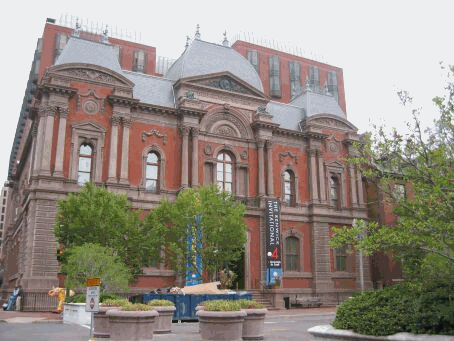
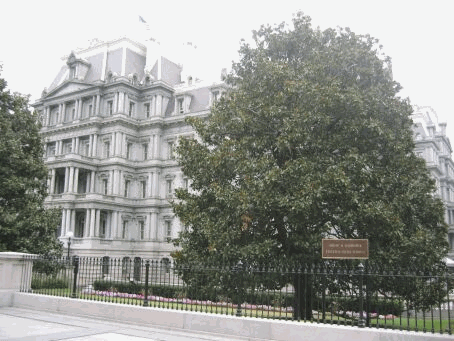
There are no homes in that block on 17th Street now, as I suspected. Here is the Executive Office Building, which was likely there when Isaac lived there. This is opposite the Renwick Gallery on Pennsylvania Avenue.
This strip of newer buildings below is where I imagine Isaac once lived. I talked to a really nice elderly gentleman in a stationary store in one of these shops, and he told me that in the 1930s and 1940s, there were four-story town homes on the block. The red sign in the left-most entrance is a McDonalds, where I had lunch. The gentleman said that in that very location was a very famous restaurant that the Administration frequented. The building all the way on the right looks like four-story town homes—I wonder if they are relics of the past yet standing.
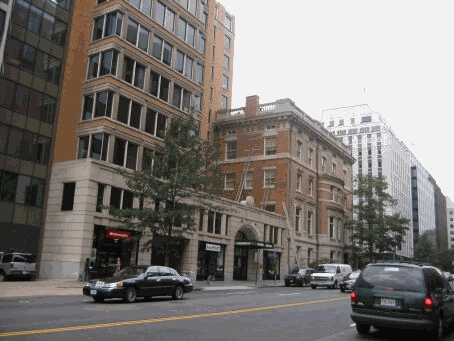
It was time to make my way to Oak Hill Cemetery to keep my appointment with the manager. She told me to take the Metro (red line) from Farragut North to Dupont Circle, and then walk 10 blocks east on Q Street to 30th Street, turn right and go up the hill to the gate. Q Street was lovely. This is actually in Georgetown, which is well known for its picturesque row homes. I stopped in the Phillips Museum near Dupont Circle because I had to use the ladies room and I also wanted to get a sketchbook and a pencil in case I felt like drawing up what I saw at the cemetery. I’d heard there is no photography allowed in the cemetery, and it turns out there is also no drawing allowed either. But the manager didn’t confiscate my camera or anything so I decided to take all the pictures I wanted. Maybe it is morbid, but in truth, as you will see, there wasn’t much to photograph, though the cemetery grounds are lovely.
Here are some of the things I saw on Q Street:
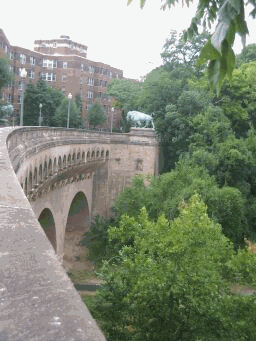
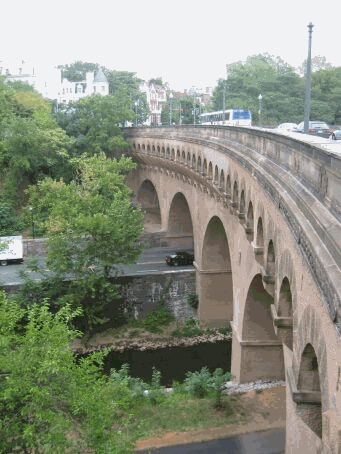
This is Dumbarton Bridge. I thought it was charming. It was built between 1912-1915 so it is doubtful that Great-Grandfather Harkness ever saw it on his way to the cemetery to pay his respects to his ancestors. There were 4 bison, one on each side at each end of the bridge – like the Lion’s Bridge in Newport News.
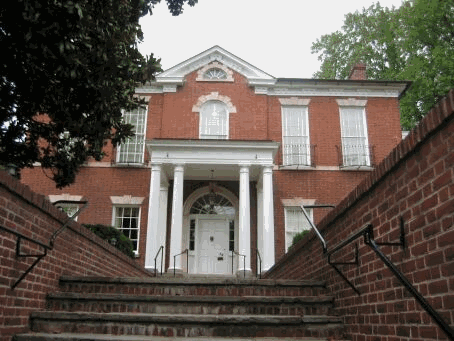
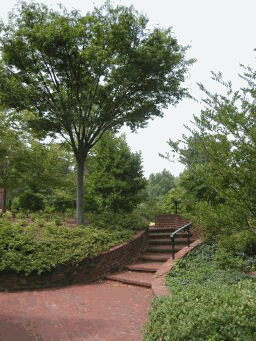
This is Dumbarton House and its garden on the side. There was a plaque which read: “Headquarters of the National Society of Dames of America. This site was part of a tract which was called “The Rock of Dumbarton” patented by Ninian Bealle. The house was probably started in 1799 by Samuel Jackson. It was completed 1805 by Joseph Nource, first Registrar of the Treasury. He sold the property to Charles Carroll who named it “Bellvue”. Purchased by this society in 1928, it was restored to the early Federal period, renamed and opened to the public 1932. The house formerly blocked Q Street and was moved to its present location 1915. Plaque erected 1951 by the National Society of Dames of Colonial America in the District of Columbia.”
The cemetery is just a couple blocks from Dumbarton House. The manager, Ella, gave me a map of the cemetery and marked the plots where the Harknesses and Hollands are buried. She showed me the records, but I didn’t think to write down all the names. I figured they’d be on the stones. The Holland plot was listed as having Isaac, four Hollands of unknown Christian name, and Kitty Holland Barrett. There were many Harknesses listed for just one plot! Many of them were moved from Holmeade Cemetery (where the Washington Hilton now stands) in 1781, including the family patriarch, Samuel Harkness. Also, I saw the names of Thomas F. Harkness, Robert H. Harkness, Anna Barrett Harkness, and Cornelia Gregory Harkness. After I was finished viewing the documents, I was sent out into the yard with my map.
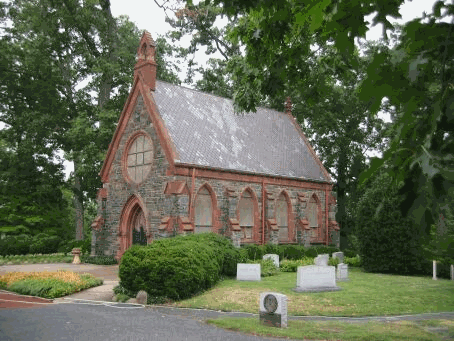
The Chapel at Oak Hill Cemetery
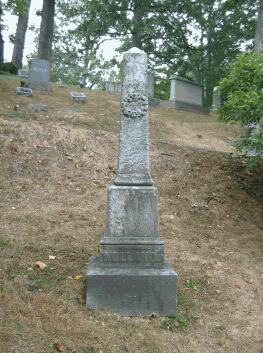
Isaac Holland’s plot is just behind (or east) of the cemetery, a couple rows down the hill. But the only marker there was a mini-Washington Monument with the word “HOLLAND” on the base, and nothing more. There were no other names given, and nothing for Kitty at all. It was a bit disappointing. Here is a picture of the monument, supposedly erected by Isaac’s friends from the Senate. It’s a nice monument, to be sure. I just expected more names.
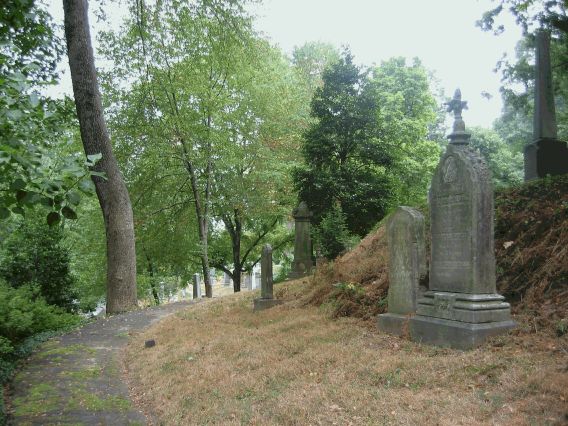
I moved on to the Harkness plot. I can’t believe that all those people are buried in one plot about 20 feet wide and one grave deep! There were three stones which looked very old. I believe they were moved from Holmeade. There were none for Harry, Anna or Aunt Nelie. Someday when I strike it rich, I will try to set these things to rights. Here is a picture of the 3 stones. The one on the left is Samuel Harkness born Jan 1st 1768, died April 25, 1830. His second wife, Elizabeth S. Harkness died Feb 24 1839 Aged 68 years is listed below him, and below her is Mary S. Barron (their daughter), died Oct 16, 1841. The next stone over is Thomas F. Harkness Sr. born May 10, 1809, died April 29, 1876 and his wife Mary A. Harkness March 1,1813-April 27, 1890. Below them is Annie S. Harkness died May 21, 1924. The skinny stone grouped with the stones on the next plot has the inscription on the side facing the other Harkness stones: “Thomas F. Harkness Jr., died Oct. 30, 1870, Aged 27 years - In my hand no price I bring, simply to thy cross I cling.” On the front of a stone, near the top is the engraving of a rose, inscribed “In Memory of Emma J. His Widow died Dec 28, 1882.” Thomas Sr. was Great Grandfather Harkness’s father, and Thomas Jr was his brother.
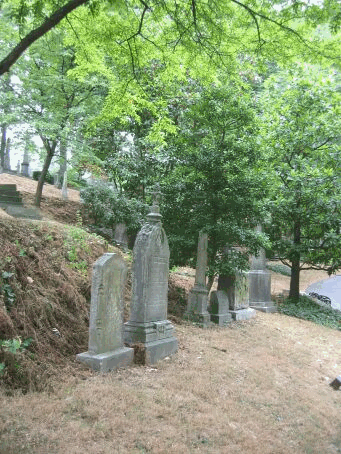
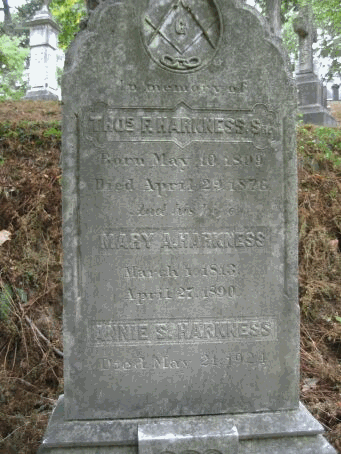
Here is a more scenic picture of the two bigger stones.
It was time for me to go home. I was going to hit rush hour traffic on I-95 as it was, and I wanted to catch the subway early enough to get a seat. As I reached Dupont Circle station, I saw one more Party Animal.
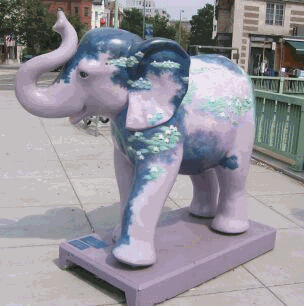
She marked a pleasant end to an interesting day!
Next trip: Annapolis Maryland in search of the Halfway House and Isaac Holland Sr.