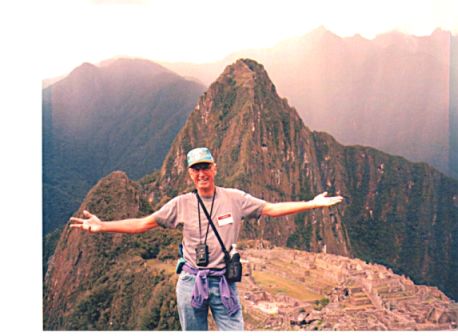
Bill Holland at Machu Piccu
By Christine Gainer Barton, November 24, 2002
Sands is a name which pops up in numerous places in our family records. As far as I can tell, there are several connections between the Sands and Hollands families of Anne Arundel County Maryland. In the first place, assuming that Isaac Holland Sr. is the son of Edward Holland of Anne Arundel County, then Isaac had a brother named James who married a Miss Anne Sands. We know nothing more about the match, except that it prospered with several children. That Isaac had a brother (indeed, several siblings) living in America was news to me.
Another surprise to me was that it is now believed that after the death of his first wife Jane Stuart (or Stewart) Isaac Holland Sr married Delilah Sands, the widow of a John Sands, in 1811. This belief has not been passed down by my family, apparently, so I wonder if there was another Isaac Holland in the area, perhaps the nephew or cousin of our Isaac. I had hoped to learn that one of Isaac’s brothers named a son Isaac who could have married Delilah. The date of death of Isaac, husband of Delilah, as maintained by his supposed offspring, is given as 1851, which does not match either our Isaac Sr. or Isaac Jr. Someone named Dottie Kearton of Lodi Township, Ohio, claims that her great-great-great grandfather is the son of Isaac and Delilah, named James H. Holland who was born in 1819, just a few years before Isaac Sr. moved in with his daughter Kitty Barrett, whom he had not seen for a number of years. In my family history, Kitty’s mother’s cousin Mrs. Lloyd (wife of Governor Lloyd) took in Kitty upon the death of her mother, around 1805, and she saw little of her father until after her marriage to Joseph Andrew Barrett, owner of an inn called the Half Way House, in 1822. Our family historian, Robert Henry Harkness, who was Kitty’s grandson-in-law, and lived with her in her last years, makes no mention of a second marriage of Isaac Sr. However, he does say that Isaac moved in with Kitty around 1823 and remained there until his death in 1826. He became very attached to his small grandson George. Assuming Delilah died at this time, why did not little James stay with his father at the Half Way House to be a companion to little George? Perhaps there was some great scandal, and Delilah ran off with little James, leaving Isaac a lonely, aging man on the hands of his daughter. And so perhaps the marriage was kept a deep dark family secret. This is all just speculation.
Apparently, Isaac Jr. was the executor of Isaac Sr.’s estate and Dottie Kearton claims to have a copy of the proceedings—certainly those documents must give an accurate date of death, which could prove or disprove this connection. I have a digital image of an email from Dottie to the great-grandson of James H. Holland, Bill Holland (shown below on a mountaintop in Peru). I have not been in touch with Dottie herself. According to Dottie, James married a Catherine McCubbin, daughter of Lloyd and Sarah McCubbin, and they had several children (names conflict depending on the source), all born in Maryland. The family moved to Ohio in 1856. In the 1870 census, Upton (Dottie’s great-grandfather) and Amos Holland were the only living offspring of James and Catherine, and James was listed as having been recently remarried to Matilda. From his second marriage, he had at least one son, James. Bill Holland, my new-found “cousin” is quite confused about this whole matter and the numerous Isaac Hollands. It is quite possible that there is no connection between our family and Bill’s.
Bill Holland at Machu Piccu
But that there is more concrete evidence of a close and continuing Sands/Hollands connection can be proved by letters in my possession from a Samuel Sands to Isaac Holland Jr. in 1826. Isaac was a young man living in Annapolis, having been apprenticed to a Mr. Brewer in the newspaper business. When the newspaper (The Maryland Republican) went up for sale, Samuel Sands (who then lived in Baltimore but professed a long-standing friendship with Isaac) was interested in buying it. But I’m afraid that their friendship took a turn for the worse. Isaac was so offended by Sam that he kept a draft of a letter he wrote to Sam, which indicates the friendship was palpably at an end. If they ever made up, I cannot discover it, and the fact that the letters were saved for his descendents makes me think the feud continued to their respective deaths. Follow this link to a partial transcription of all the letters in my possession related to the matter. The letters are slowing turning into corn flakes so there are some gaps in the transcription. I have made large jpeg images of them, available upon request.
That Samuel Sands himself was an interesting person in Maryland history cannot be denied, and I wonder how well this sat with his former friend Isaac. Following the Sands/Holland letters is a letter in answer to an inquiry made by the Sands family about Samuel. This letter confirms the legend that he was the first person to put the words to the Star Spangled Banner by Francis Scott Key to print. He went on to become a well-known force in the publishing industry. I have not yet been able to determine if Samuel was a cousin of Isaac, or a childhood friend, or both.
Another instance of the Sands/Holland connection is the fact that the grand-daughter of Isaac Holland Sr married a James Sands of Annapolis. According to our family historian, Robert Henry Harkness, Henry Stuart Holland, son of Isaac Holland Sr, had two children, Richard and Jane. Jane married a steamboat captain named Sands, of Annapolis, Md, and was mother of John, Susan, Nannie, Nellie and William Sands. Capt. Sands had a beautiful home near the Naval Academy on the Severn River. Mr. Harkness believed that the land was later included in the Naval Academy grounds. I have since been in contact with Ann Jensen of Annapolis, descendent of Henry Stuart Holland, now (2002) living in the Sands House. It may be that this is the same house Mr. Harkness wrote of. According to Ann, it didn't actually belong to her great-great grandfather James Sands, but to his unmarried sisters. It eventually came into the hands of James Sands' daughter, Susannah. The Sands House, which has been in the family since 1771 when John Sands bought it, was threatened but not taken into the Naval Academy. It is one of the oldest buildings in Maryland. An article about Ann, her mother Marjorie, and their historic house is the third appendix to this document.
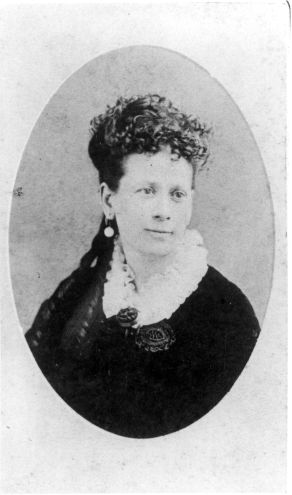
Ann’s great-grandmother was Susannah Sands, and Susannah and Elizabeth Holland, daughter of Isaac Holland Jr, were best friends. Ann has many letters between Susannah and Elizabeth, and so Ann grew up with some of the same family stories as we did. A picture, which is believed to be Elizabeth (or Eliza), is shown below.
One of the stories that was special to both our families was the one about Stewart Holland, Elizabeth’s brother – Stewart was very close to Henry Stuart Holland and divided his time between his uncle’s family in Annapolis and his father’s family in Washington DC. Ann wrote an article about the tragic loss of Stewart on board the Arctic, which was published in the Annapolitan Magazine, the fourth appendix to this article. Her account is rather different than Mr. Harkness’s, but it has some very special personal touches including letters and poems handed down her family line.