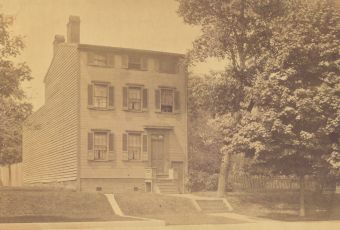
Mr (Thos F.) Harkness homestead N.Y. Ave bet. 17th & 18th N.W.(orig lot 4 of Sq. 170)
By Robert Henry Harkness, 1912
Edited by Tina Barton, 2002
My father Thomas (Fowler) Harkness, born May 10, 1809, was the third son of Samuel and Elizabeth Harkness. He adopted the middle name of Fowler himself (why, I have not been able to learn). His childhood, as well as that of his sisters and brothers, was spent in the old First Ward, and he used to tell his children many things about the early days of Washington City.
Although small of stature (about 5 ft. 4 in.) he was very strong and athletic. He swam across the Potomac River at Georgetown, and back, when only eight years old. When his mother heard of it she prepared to give him a whipping; but his father coming in at the time and inquiring the cause, told her she ought not to whip him, but to praise him, for it. When a little boy he was a favorite with the volunteer firemen whose engine house was in the market building across the Avenue from his father's house. Even at night he would creep out of bed and out of the house to follow the engine to a fire and the firemen often let him ride home on the engine. One fire which he often mentioned was the burning of what was called "the old sugar house" near the Navy Yard, during which, while the firemen were fighting the flames, he was filling his leather cap with sugar from the hogsheads that had been rolled out of the building. The sugar was hot and he ruined his leather cap. But he rode home on the engine eating the sugar.
He learned the trade of tailor, having been apprenticed to a man who overworked him so, and treated him so harshly that he ran away from him. He had been "bound" to the man; so Grandfather had to compromise with him. He was still a mere boy. He went to school to Mr MacLeod who was one of the principal teachers of the city at that time, and was extremely severe even for that period. My father went to school one day with his hair "roached" or rolled into a curl from front to back on the top of his head. For some deficiency or misconduct Mr MacLeod called him before him; and although standing some distance away from him, inserted the end of a long pointer into the curl, and, with a sudden twist, pulled the hair out by the roots. My father grabbed the curl off the pointer, put it in his pocket and went home. That, I think, ended his schooldays.
He finished his apprenticeship as tailor with some other man than the one he ran away from , and earned his living at that business until 1849 or 1850. He worked in Washington, New York and New Orleans. In Washington he had shops located on the West side of 7th Str. bet. D & E N.W>, on the North side of Pa Ave (or D Str.) bet 10th & 11th N.W., South side of Pa Ave. bet. 19th & 20th N.W., and North side of Pa AVe. bet. 17th & 18th N.W. He was not a successful business man. He trusted people too freely, and once failed. He once made a suit of clothes for President Tyler.
About 1849 or 1850 his health declined to such an extent that his physician advised him to give up tailoring and adopt an occupation that would give him fresh air and outdoor exercise. Mr John Wilson obtained for him an appointment as penny post for the First Ward. At that time there were only seven penny posts in the Washington office. His health immediately improved. He received then two cents for every letter delivered, and realized a good living. The fee was reduced to one cent at the time of the Civil War, and some time afterwards the carriers were given a salary. He remained in the City Post Office until his death, about twenty-six years, and saw the force increased to carriers.
His residences after his marriage were, excluding a short stay in New York City, all in Washington City; the old homestead on I Str. bet. 20th & 21st Str, N.W.; 13th Str. bet. E & F Str. N.W., East side 10th Str. bet. N.Y. Ave & K Str N.W., North side Pa. Str. bet. 17th & 18th Str N.W. and North side New York Ave. bet. 17th and 18th Str N.W. He increased his holdings on New York Ave. until he owned all of original lot 4 in Sq. 170, and developed there an unusually comfortable and attractive home. The house was a frame, large and convenient.
Mr (Thos F.) Harkness homestead N.Y. Ave bet. 17th & 18th N.W.(orig lot 4 of Sq. 170)
The garden contained quite an orchard, a vegetable garden, and a flower garden, besides a stable for his pretty and gentle sorrel mare "Fan" and buggy used in his work, a cow-house for "Suk" and "Jen", a chicken house, a wood-and-coal house and hay-loft. The wood-and-coal house and hay-loft was an old one-story-and-attic house that probably antedated the city. The peaches that grew in that yard for some years were the finest I ever saw—both clingstone and freestone, white and yellow, and sometimes measuring about four inches in diameter. We also had plums, damsons, apricots, cherries and grapes and pears and apples. My mother's flower garden contained most of the plants seen in the old-fashioned gardens of the time. The hollyhocks, which usurped a large part of the vegetable garden, were a sight to behold, so many and so variegated in colors and tints. I have never seen their like elsewhere.
My father was a member of the Presbyterian Church. He, with my mother, attended services at the Fourth Presbyterian Church on Ninth Str. bet. G and H Str. N.W. for some years prior to 1854, about which year they helped found the Western Presbyterian Church, at first located at the corner of 22nd and E Str N.W., and very shortly thereafter on H Str bet. 19th and 20th Sts N.W. where it has remained ever since. There he and my mother professed the faith, and remained in that church until their deaths.
He was one of the first members of Hiram Lodge #10 F.A.A.M., Washington D.C. The first Masonic funeral he ever attended was that of Lorenzo Dow. He was also a member of Friendship Lodge of Odd Fellows, Washington, D.C. (When my father died in 1876 the Masons and Odd Fellows were at variance about some matter of precedence at funerals, and because the family requested the Masons to officiate at his funeral, the Odd Fellows refused to participate, and withheld benefits amounting to $300 from my mother.)
At the breaking out of the Civil War in 1861 my father was fifty-two years old and had a large family to care for; so he could not enlist, as he would have liked to do, in the Union Army - but he gave his oldest son Thomas (then 17 years old) his horse, and had him enlist in the President's Mounted Guard for three months, during which time he walked his route and lugged the mail. At the time of the second battle of Bull Run, when news of the reverse suffered by the Union troops reached Washington City, my father and many others left Washington and tramped far down into Virginia towards Manassas to offer their services as soldiers. But they were not needed, and returned.
In politics he was a Whig as long as that party lasted, after which the Democratic Party suited his sentiments more nearly than any other although he was never an extremist. The only elective public office he ever held was that of assessor. July 1, 1848, to June 30, 1856.
He was a born sportsman. In his younger days he always kept a hunting outfit, including a fine hunting dog. And down to old age he loved to go fishing. (The fishing used to be good all along the River).
He was conscientious, courteous and genial. Among his friends were people of all classes and conditions. Down to my father's death in 1876, about forty-five years, whenever any of those five slaves of Samuel Harkness or their descendants or friends came to Washington, they would always come to see him. They were not ungrateful. And it happened that a friend of theirs came to see him a few days before his death and rode in his funeral with three other colored people. (Phebe Rollins and her daughter Rachel and her two daughters and son, after obtaining their freedom, settled in Providence, R.I. and prospered. Some of them became milliners and developed a large business.)
He died April 2(9), 1876, and was buried in his lot in Oak Hill Cemetery. The funeral services were held in the Western Presbyterian Church, and the pastor, Dr David Wills, pronounced a splendid eulogy over him, during which, looking over the pulpit down into the coffin, he said "Brother Harkness, you were an honest man."
My mother used to tell me that, while he was in the tailoring business, he was very kind and indulgent to his apprentice boys. She mentioned in particular, that some of the boys were Roman Catholics, and that he used to excuse them early on Saturdays to go to confession; on hearing which, the priest at St. Matthews Church (Father Donelan, I think) spoke of it during service and prayed for him. And Mrs Henning once told me, long after my father's death, that her brother traced his conversion to the Christian influences that surrounded him while he was an apprentice living at my father's house.