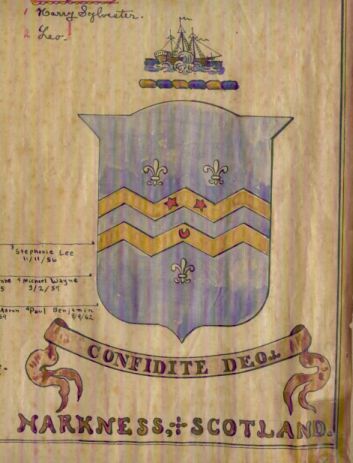
The Harkness Coat of Arms, as drawn by Charles Albert Harkness, the brother of my Great Grandfather.
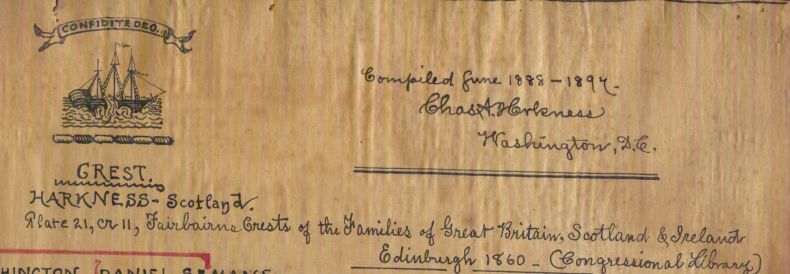
The Harkness Crest, also drawn by Charles, is shown at the bottom of this page.
By Robert Henry Harkness, 1912
Edited by Tina Barton, 2002
The Harkness Coat of Arms, as drawn by Charles Albert Harkness, the brother of my Great Grandfather.
The Harkness Crest, also drawn by Charles, is shown at the bottom of this page.
Persons of the name of Harkness appear to be quite numerous in Scotland and the North of Ireland, and individuals and families of that name can now be found all over the English-speaking world. My brother, Charles A. Harkness, some years ago, tried to trace back the name to its origin, and concluded that it was of Scandinavian nationality, and that its meaning is "hawk-nose". The termination - "ness" occurs frequently on the map of Scotland, usually as part of the name of a cape; which would seem to indicate that it means "point" or "nose".
The earliest historical mention of anyone of the name of Harkness of which I know, is in 1684, when, on July 29, three brothers, William Harkness, born in 1646, James Harkness, born in 1651, and Thomas Harkness, year of birth not given, were concerned, perhaps as leaders, in an occurrence known in the history of Scotland as "The Affair at Entreken," in which, with about three dozen others, they attempted to rescue a party of nine Covenanters from a company of twenty-eight dragoons belonging to Claverhouse forces, on their way from Drumlanrig in Southwestern Scotland through the pass of Entreken to Edinburgh. James Harkness, Thomas Harkness, Andrew Clark, Samuel McEwen, Thomas Wood and another, were afterwards captured by Claverhouse and charged with complicity in the affair. The prisoners (all except James Harkness who, on the way, escaped from the "stone jug" at Dumfries) were taken to Edinbourgh where, on their arrival, on the 15th of August, 1684, they were immediately tried for being in arms and assaulting the forces of the crown. They were wounded while trying to escape capture, but were not allowed surgical attention. At their trial they asked for an advocate but were refused. At one o'clock Thomas Harkness, Andrew Clark and Samuel McEwen were condemned; and before five o'clock they were hung in the Grassmarket. They left their written testimony which is published in the "Cloud of Witnesses" pp 279-280, and "Howie's Scots Northies" Vol. 2, pp 514-516. A full account of the rescue and its consequences is given in an article in "The Scotsman," newspaper, Edinburgh, April 1, 1901, by Rev. J. King Hewison, of Rothesay, Isle of Bute, Scotland, who has also written a monumental history of the Covenanters in which are pictures of the graves of James and Thomas Harkness (the latter the posthumous son of Thomas Harkness, Martyr).
An old gentleman named James Harkness, a stonemason, from Melrose, Scotland, who called to see my mother in 1884, was the first to acquaint me with the glorious history of the Covenanting Harknesses. Desiring to leave some of his work in Washington, I borrowed some carving tools for him from Mr Bradley, then a prominent marble cutter here in Washington D.C., and with them he carved my brother Thomas F. Harkness Jr's wife's epitaph on his monument in Oak Hill Cemetery. He went back to Scotland and I have never heard of him since.
Why my grandfather and his children either knew nothing of the "Affair at Entreken" and the martyrdom of Thomas Harkness, or, knowing of them, suppressed the information, is to me very mysterious in view of the undoubted facts related farther on in this narrative. I cannot believe my grandfather was ignorant of the facts, because he was born within a century after their occurrence. The only reason I can imagine why the facts were not handed down, is that they considered it a lasting disgrace to a family to have one of its members hung, forgetting that a martyr is a glorious being, a priceless memory to his descendants, whether he was crucified, stoned, beheaded, sawn asunder, burned, drowned, hung or otherwise sent to his reward