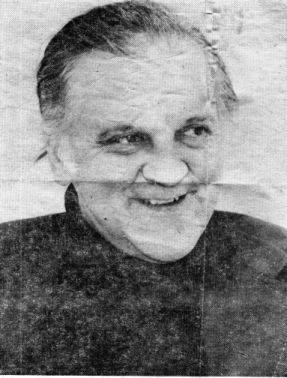
Gainer has engeinnered a scucessful avocation with his Oboe.
Staff photo by Willard Owens
circa 1979
Gainer has engeinnered a scucessful avocation with his Oboe.
Staff photo by Willard Owens
Curiosity may have killed the cat, but it's done wonders for Pat Gainer.
When he was a kid growing up in Webster Grove, Mo., he became intrigued with a friend's oboe. So, he picked it up and tried a few notes. Not a sound came out. That piqued his curiosity, so he decided to learn how to play it.
Then at age 16, his fellow oboist went to war (World War II) and was killed in action. "When I got the word, I was listening to Brahms' First Symphony. It has a beautiful oboe part, and I made a promise to myself to keep playing." And he has.
[Editorial comment by Tina Gainer Barton: Dad said that when he was in college he only had time for two of the three things on his mind: baseball, music and women. He had to make a choice, and maybe this explains why baseball lost out. And lo and behold, a beautiful clarinetist in the orchestra falls in love with him, and became his faithful wife of 47 years.]
Now at 52, Pat Gainer is the principal oboist for the Vriginia Classical Orchestra, an English Horn soloist with the Virginia Philharmonic Orchestra and a guess soloist for the Governor's Palace Orchestra, the Cantata Chorus and the Bruton Parish performances. He's also the Virginia Orchestra Group's official symphony photographer.
"Whenever someone needs an oboist, that's me."
Gainer, an aeronautical engineer at NASA for 27 years, doesn't know where his interest in engineering sprang from, but the stage was set from day one for his career in music.
His mother was a pianist. His father was known in radioland as Michael McCubbin, the Irish tenor, and sang in the chorus of the St. Louis Municipal Opera. "When I was a little kid, I went around singing. I had a good voice, but you can't sing in the band. But singing is good for woodwind players."
With a pianist mother, he also had the usual piano lessons in grade school and started taking violin from an instructor who was exchanging violin lessons for vocal lessons from senior Gainer.
But young Gainer was not destined to become a Yehudi Menuhin. His violin teacher also went off to the service and took his violin with him.
When Gainer went to college at West Virginia University, it wasn't music he majored in, however, but engineering, though he did play in the WVU community orchestra where he met his wife, Rosemary, a clarinetist. (She now plays flute with the Peninsula Community Band.)
"I took physical and chemical engineering in the same semester. That separates the men from the boys." The outcome? He switched to aeronautical engineering.
His interest in aeronautics manifests itself in other ways besides designing a satellite's reentry procedure (he worked on the first manned orbital flight) or lecturing on his concept of airplain cockpit construction. He enjoys making model airplanes and as a Big Brother for eight years, spent many an afternoon flying model planes with his Little Brother.[TGB: and also his own 6 children! His Little Brother was Steve Smith, a dear friend.]
The writing was on the wall for his role as VOG's photographer. His grandfather was an accomplished photographer, and as a youngster Gainer got a kick out of looking through the boxes of photographic plates produced by the old camera.
In college he began studying photography from an engineering angle. He built his own camera and enlarger, a feat he recently repeated.
When Gainer putters around in the kitchen, the soups he makes aren't made of chicken or broth or vegtables. He likes to experiment with simple developers that can be made in the kitchen for those amateur photographers lacking a dark room, thus kitchen soups.
He sold an article on the subject to "Photographic" magazine a few years ago. [TGB ... and many more since his retirement... just browse the internet to find some of his formulas, or adaptations of his formulas.]
"My wife was upset with me, because she writes and gets rejection slips," he says from his cluttered cubicle of an office. He crossed his feet, the yellow "jocks" socks peering out of the tops of his motorcycle boots. "If a picture came out showing a clean desk, it's not Pat Gainer." [TGB: and thank goodness they didn't come to the house! Talk about clutter!]
Amid the clutter there's his radio, which he turns on to tune out office noises, a fork, a paperback copy of "Alien," his motorcycle jumpsuit and helmet, and photos of concerts both he and his wife have shot.
He had no intention of becoming the symphony's photographer. It happened quite innocently. He had a new camera and just had to try it out. So, he shot a bunch of photos of a youth concert at the Virginia Beach Dome and presto! Another career was born. His wife has since undertaken many of the photographic duties.
Somehow he finds time to practice and rehearse, to give private oboe lessons [TGB: and you should have had to wake up to THAT on Saturday morning - it sometimes sounded like the house was invaded by a sick duck! The oboe is a difficult instrument...] and to dabble in electronics and to still play husband and father.
And it seems life is always that hectic for Gainer. Along the musical highway of his life, he played with community musical groups, the Virginia Opera Association's orchestra and was the principal oboist with the Norfolk Symphony (now the Virginia Philharmonic) before it finally got to be too much.
Gainer says that even with the merger of the three Tidewater symphonies into the VOG, the musicians can't make enough to live on unless they have a second job. Even playing for two symphonies isn't sufficient, he says. Many musicians must take in students and play concerts on the side to make ends meet.
With his studies in human factors, he finds aspects of the music world applicable to his career at NASA. "I watch musicians reading two measures ahead of where they're playing. That's what music brings to this profession. They're not separate entities. There are a bunch of intuitions you develop."
His experimentation at NASA also carries over into his music. He creates his own tools for making over a reed.
"I get very excited about playing a new piece. If I'm not worried, I get worried. You can get hypersensitive when you solo. You get to thinking any minor imperfection stands out," he says, running his hand thruogh the gray, thinning hair.
"Sometimes music is relaxing. Sometimes it's nerve-racking, but you need both."