Pelotas is a grim and ugly hell-hole of a town with no redeeming features save the highway that runs close to its dirty western fringes. Biblical rain, an electricity blackout and Brazil�s Worst Fried Chicken did nothing to endear the place to me.
It took twenty minutes to shunt and cajole and squeeze and roll the bike through rows of badly parked cars to get to where the hotel porter insisted, for no earthly reason, that I park. I was soaking wet, tired, hungry and feeling pretty unloved.
In my room on the third floor �- remember, no electricity means no light and no lift -� I coaxed a trickle of cold water out of the shower. �Food� (yes they are inverted commas...) followed, then an early night to ensure a quick getaway the next morning.
I was up and away early, in a light squall. My route now was taking me away from the coast to the border town of Jaguarao, the quieter of the frontier posts between Brazil and Uruguay.
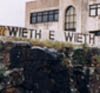
On the road south I passed a factory on a hill in the middle of nowhere. It stood proud and tall and disused at the side of the road. Nothing for miles around. A sign on the side of the wall named the company that someone had once dreamed into existence here: Wieth & Wieth. I had come a long way and didn't discover people who didn�t have exactly the same name as me. Who were they? What did they do? When?
Jaguarao is the one horse, dirt track, wild dog, dusty, dirty shanty town of a million cowboy movies. A slow and lazy river forms the border; crossing the rickety, rusty bridge was a triumph of optimism: a slow and awkward shuffle past the customs checkpoint. Everyone was sweaty. Everyone had moustaches � and yes, that includes the women.
In Uruguay at last. The customs post is a couple of miles down the road. Getting through was simple and straightforward � this was my first test of all the documents I had compiled so comprehensively in Curitiba and, you�ve guessed it, most of them weren�t even looked at.
Far from being the draconian and corrupt sleazeballs of legend, the frontier officials were courteous, friendly and swift. Why, they even let me take this picture of this momentous occasion, when I had expected at the very least a week in a dank underground prison cell with nothing but rats for company and nothing but rats for breakfast.
By the time I got through customs I had learned the following:
1. It�s harder switching from Portuguese to Spanish than you expect. Luckily, everyone understood �Portunol� (Portuguese mixed with Espanol).
2. There are countless feral dogs in Uruguay, by now in great slavering packs, and unlike Brazil they have the run of town centres as well as the outskirts.
3. There remains on the road a ridiculous proportion of historic cars � it�s nothing to see a Model T pottering along here, overtaken by a spluttering 50�s Chevy while a Morris Minor wheezes down a side lane...
4. ... but you are unlikely to see that many vehicles in the space of an hour, let alone all at once.
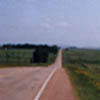
The empty roads of the northern interior were in great condition, so biking was suddenly completely exciting and fun again. At one stage I passed a sign that translated as:
Attention!
Beautiful views and
sinuous road ahead!
They weren�t kidding.
* * * *
The huge, rich sheep and cattle estancias have no need for farmworkers most of the year. So (and I�m simplifying quite a bit) most of the population has moved to the coast, to the capital, Montevideo. Leaving behind, you guessed it, mile after mile after mile of empty road, all in beautiful condition, just waiting for the next bike to come along. Which by my reckoning must be about once in a blue moon.
* * * *
Up hill and down dale, through another atrocious downpour, stopping at towns with names like �Treinte Y Tres� (�33�) to see and be seen, but always escaping back to the tarmac.
Ruta xx from XXX to XXX is one of the more beautiful in the land, they say, but in the rain it felt like an endurance test. It looked like Derbyshire, I decided, and if I'd wanted to go to Derbyshire... Now I wanted to be somewhere else � somewhere sunny and dry.
�OK. So you want to be somewhere else? Just bloody do it. Start the bike up again and ride through this wet, miserable weather in your sodden clothes because this ain�t a game. You can�t just give up and go home, or hop in to a waiting car, or switch over to another channel... You�ve got yourself here, now get yourself out again!!�
So I started the bike again and rode and rode until the road started to fall away towards the sea and the sun came out to dry me off.
From XXX south to the town of Maldonado and the chi-chi resort of Punta del Este the road wends and curls over dinky little hills, through sylvan forests and shady glades, by babbling brooks and epic lookout points. If you only ride a motorbike once in your life, this could be the place to do it.
Maldonado is old, inland, still a working town, where the locals live. Punta del Este is the brash, monied jewel on the coast. High-rise for high-rollers. Rich Buenos Aires come here for the sea air, the sand and the casinos � except when the Argentine economy is in freefall.
The middle-classes of Buenos Aires were too scared or too broke to visit their holiday homes and hotels XX minutes by hydrofoil across the estuary in Punta del Este.
The seriously wealthy, and indeed many of the toilers beneath them, have been spiriting money out of Argentina for years. Uruguay�s banks have doubtless benefited.
And that, of course, is one of the reasons for the current state of fiscal meltdown in Argentina.
|