New Solution
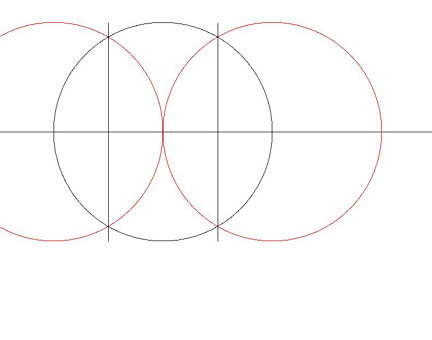

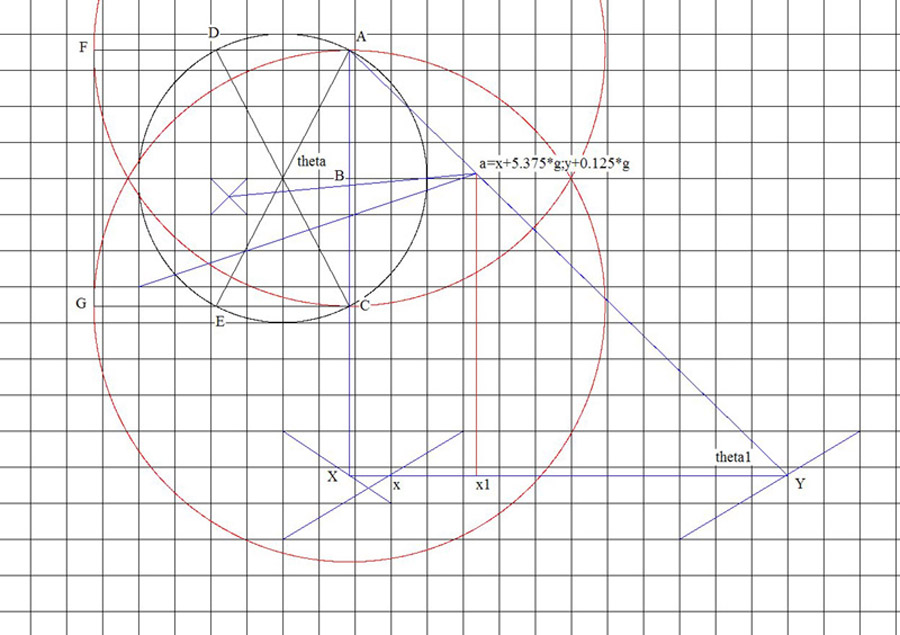
This step is the drawing of more circles, using the same method, to enable a grid to be created. Move the compass from x+2*r through x-2*r, and the same along the y axis. Then for the new process this needs to be extended to x and y times eight. When the points of intersection of the circles are joined together, a grid is formed dividing the radius into four, i.e. the x and y axis into fourteen because we are now including the triangle with a base of fourteen times 'g'.
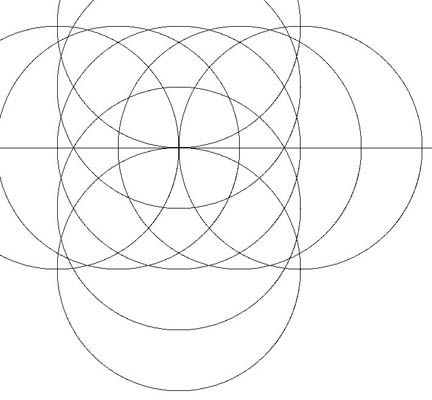
Having drawn a line across the paper and carried out the circle drawing steps create the grid by drawing lines through the points of intersection of the circles. Each square so formed has sides equal to one quarter of the radius, regardless of the length of the radius.
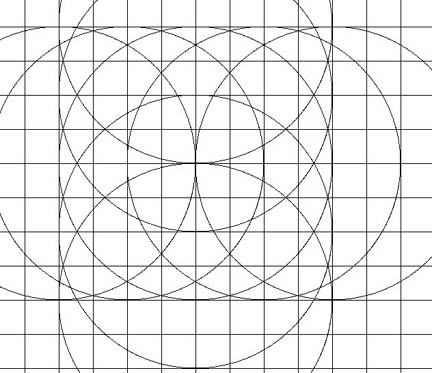
Using
your rule, draw a line from x-4*g/y-3*g through x-1*g/y-2*g through
x+2*g/y-1*g to the edge of the grid. The graphic does not show the lines to
the edge of the grid.
. Draw a line from the centre of the cross through the radius where
it intersects the circle, to the edge of the grid.
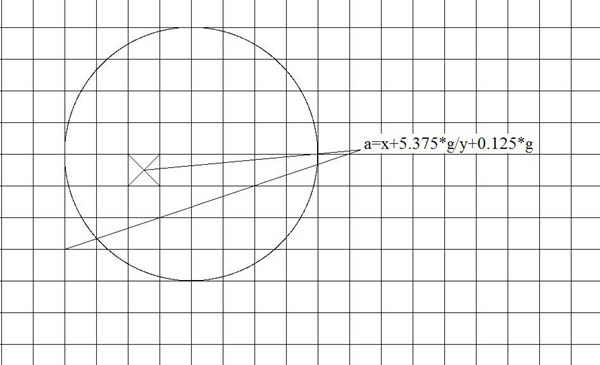
This step requires a line to be drawn from x+11*g/y-10*g to x-16*g/y-7*g to create the point 'Y' on the base line. A line from here through point 'a' to the circumference creates point 'A'. This eliminates the complex procedure in the original of finding point 'b'. X/Y=base=14*g-radius*cos (θ). A/X=height=8.25*g+radius*sin (θ).
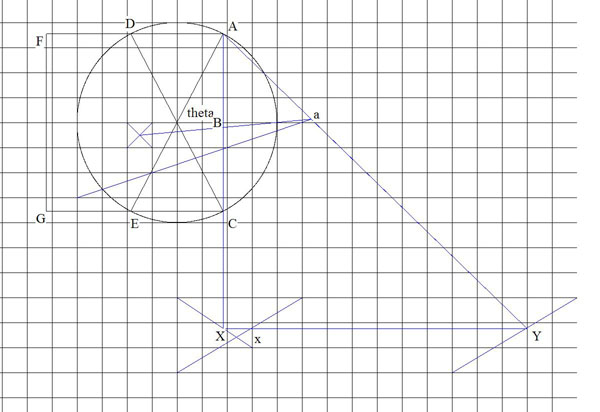
To find 'X' draw a line from x,y-7*g to x+3*g,y-9*g. Then a line from x,y-10*g to x+5*g,y-7*g. Draw a line from 'Y' through the point 'x' to the first line to form point 'X' on the base.
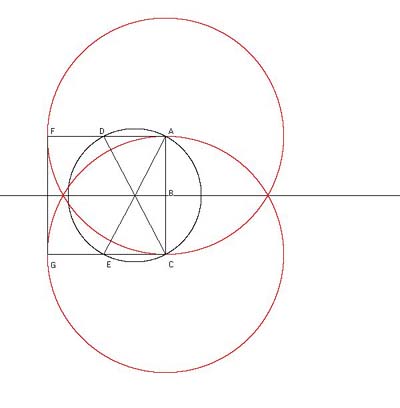
The line AB=r*sin(θ)=half the side of the square. Line AC=dia*sin(θ)=side of square. Therefore pow(AC,2) =area of square =area of circle.