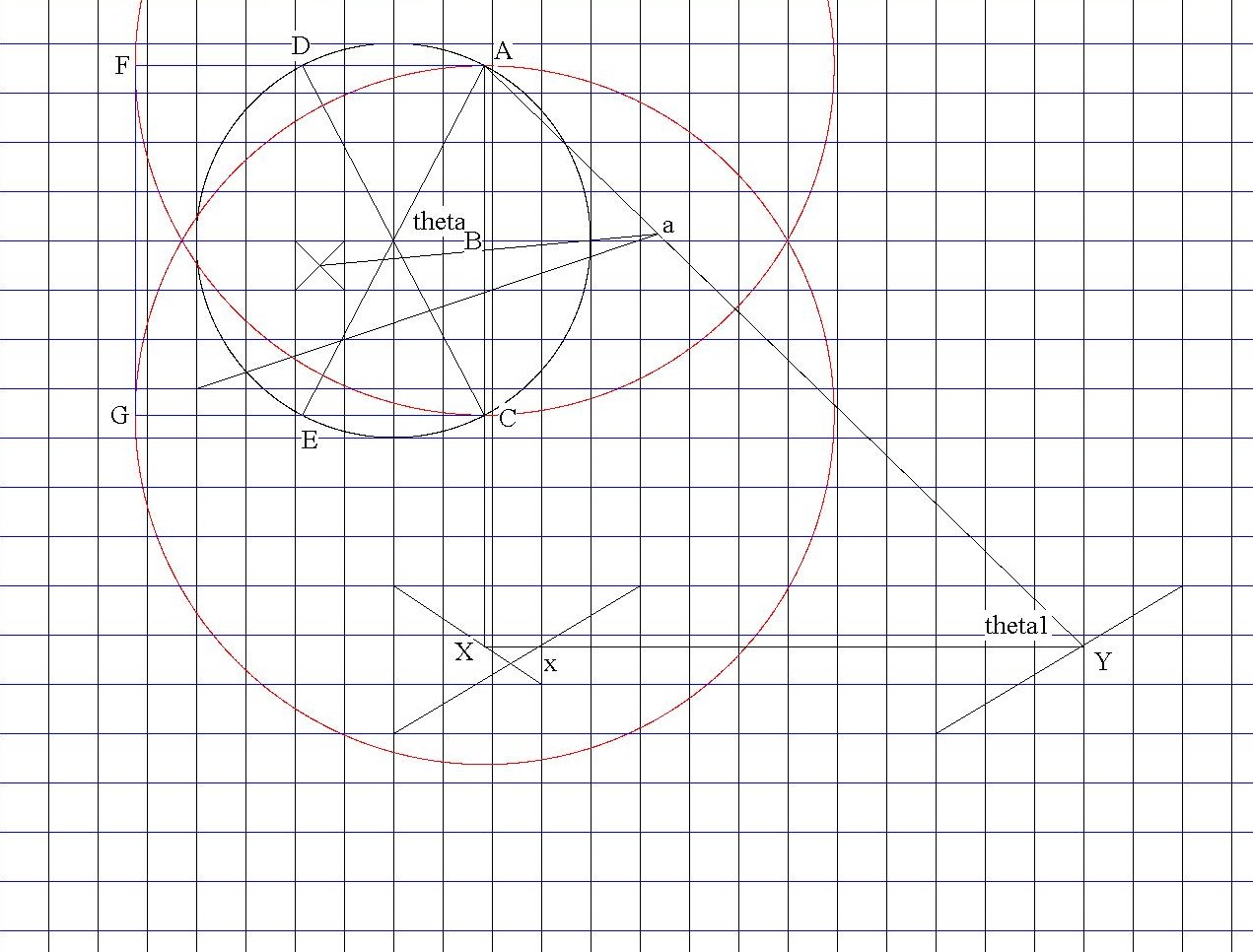
radius=400. 'g'=radius/4. Base=14*g-r*cos(θ), Height=8.25*g+r*sin(θ).
For Quadrature the angle(θ) =asin(√(π/4))
Because the point 'a' lies upon the hypotenuse, YA, a line drawn from 'Y' through 'a' creates the point 'A' on the circumference.
Setting the compass opening to the length of 'AC', still an unknown dimension, scribe circles at points 'A' and ''C'. Drawing from 'A' through the origin creates 'E' and from 'C' through the origin creates 'D'. Drawing from 'A' through 'D' to the circle creates 'F' and from 'C' through 'E', 'G'. Joining 'F' and 'G' completes the square.
The line AB =the height AX-8.25*g and therefore = radius*sin(θ) and therefore = half the side and the line AC = diameter*sin(θ) = side of square. For radius=1, AC=√(π).
Therefore pow(AC,2) = area of square = area of circle.