 |
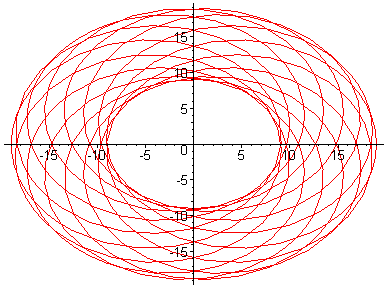
| You Try It! 1. Graph the set of parametric equations |
| x = 5cos(t) + 14cos(15t), y = 5sin(t) + 14sin(15t) |
| restart: with(plots): x:=5*cos(t)+14*cos(15*t); y:=5*sin(t)+14*sin(15*t); plot([x,y,t=0..2*Pi]); |
| Warning, the name changecoords has been redefined |
|
 |
 |
| 2. Graph the polar function r = t where 0 < t < 6*Pi |
| restart: with(plots): r(t):=t; polarplot([r(t),t,t=0..6*Pi]); |
| Warning, the name changecoords has been redefined |
 |
 |
| 3. Graph the implicit function |
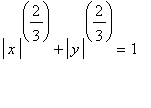 |
| on the interval -1 < x < 1, -1 < y< 1. Use 1000 points and abs(x) to get the absolute value. |
| restart: with(plots): implicitplot(abs(x)^(2/3)+abs(y)^(2/3)=1,x=-1..1,y=-1..1,numpoints=1000); |
| Warning, the name changecoords has been redefined |
 |
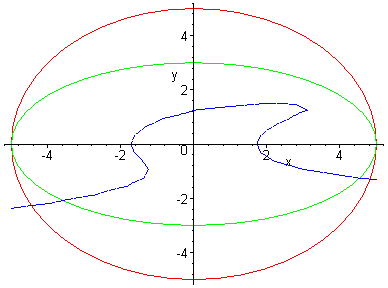
| 4. Create an implicit function, a set of parametric equations, and a polar function. Use the display command from the last handout to create a single graph containing all three curves. |
| f1:=implicitplot(x^2+y^5-2*x*y^2=3,x=-5..5,y=-5..5,numpoints=1000,color=blue): f2:=plot([5*cos(t),3*sin(t),t=0..2*Pi],color=green): f3:=polarplot([5,theta,theta=0..2*Pi]): display(f1,f2,f3); |
 |
| Parametric Graphing |
 |