 |
| Gyroscope Motion with Maple Laczik B�lint, Technical University of Budapest, Hungary |
|
| Warning, new definition for translate |
| Setting up the problem: |
| The system of differential equations for the gyroscope are from the book Kurt Magnus: Kreisel - Theorie undAnwendungen (Springer-Verlag Berlin-Heidelberg-New York, 1971) and Beggs, J. E.: Mechanism (McGraw-Hill Book Company, Inc., New York - Toronto - London 1955.): |
 |
 |
 |
 |
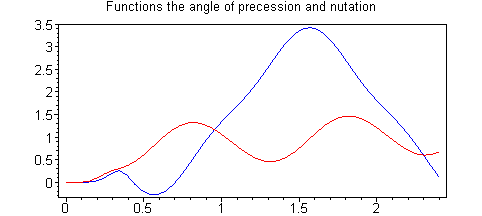
| Function the angle of frame No.1 a(t) is the precession, frame No.2 b(t) is the nutation, the moment of perturbation in to frames are M1 and M2. |
| Let's give the parameters of mechanical systems. The indexes x, y, z represente the axes of the coordinate system, the indices are of central rotated disc (1) and the frames of gyroscop (2 and 3). The center of mass for all parts of the system is in origon. The measuring units are: [kg] of mass, [cm ]of length, [1/sec] of angular velocity. |
| Material of system is constant, density r. Other data: central disc diameter d, length l, central radius the toroidal frames R1 and R2, his meridian circle radius r1 and r2. N number of points by solution and animation equal with number frames of animation, e is step of time. Negligible are the effects of axes, bearing and drag. |
 |
 |
 |
 |
 |
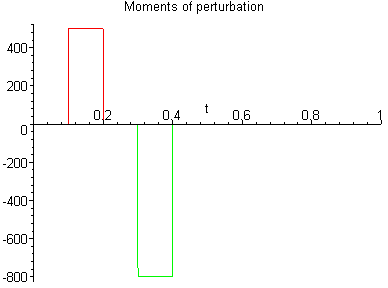
| The functions of moment perturbations to frames of gyroscope: |
 |
 |
 |
 |
| How Does the Gyroscope Move? |
| The system, variables and initial conditions: |
 |
| Numerical solution of differential equation system. |
 |
 |
 |
 |
 |
 |
 |
 |
 |
 |
 |
 |
 |
| Graphical Animation of Gyroscope |
 |
 |
 |
 |
 |