 |
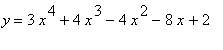
| You Try It! (1) Determine the maximum and minimum points of the function |
|
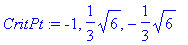
| restart;with(plots): y:=3*x^4+4*x^3-4*x^2-8*x+2; dy:=diff(y,x); ddy:=diff(y,x$2); CritPt:=solve(dy=0,x); evalf(CritPt); concave1:=subs(x=CritPt[1],ddy); ycrit1:=subs(x=CritPt[1],dy); ycrit1:=evalf(subs(x=CritPt[1],y)); concave2:=subs(x=CritPt[2],ddy); ycrit2:=evalf(subs(x=CritPt[2],y)); concave3:=subs(x=CritPt[3],ddy); ycrit3:=evalf(subs(x=CritPt[3],y)); with(student); maxvalue:=evalf(maximize(y)); minvalue:=evalf(minimize(y)); extremevalues:=evalf(extrema(y,{},x)); |
| Warning, the name changecoords has been redefined |
 |
 |
 |
 |
 |
 |
 |
 |
 |
 |
 |
 |
 |
 |
 |
 |
 |
 |
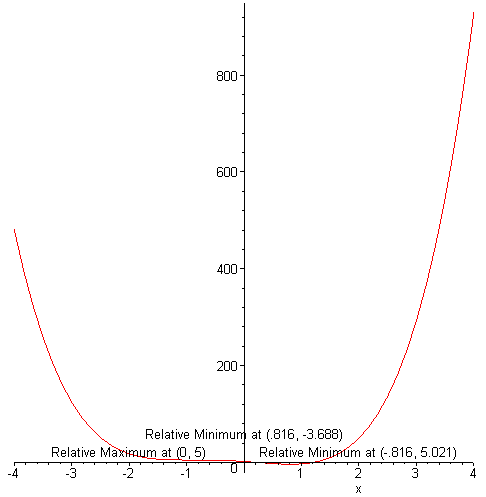
| (2) Create a graph of the function that has the extrema labeled on the graph. |
| t1:=textplot([2,12,"Relative Minimum at (-.816, 5.021)"],align=ABOVE): t2:=textplot([0,50,"Relative Minimum at (.816, -3.688)"],align=ABOVE): t3:=textplot([-2,12,"Relative Maximum at (0, 5)"],align=ABOVE): p1:=plot(y,x=-4..4): display(p1,t1,t2,t3); |
 |
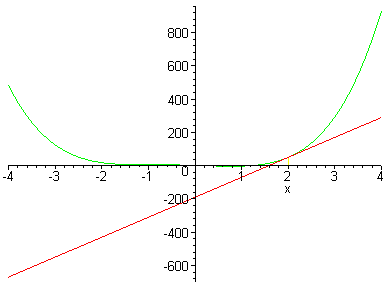
| (3) Draw the tangent line to the graph at x = 2 |
| with(student); showtangent(y,x=2,x=-4..4); |
 |
 |
 |
 |
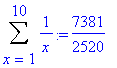
| (4) Determine the value of |
 |
| Sum(1/x,x=1..10):=sum(1/x,x=1..10); |
 |
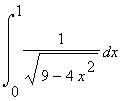
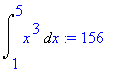
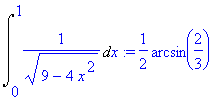
| (5) Determine the value of the following integrals |
 |
 |
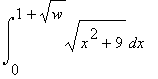 |
| Int(x^3,x=1..5):=int(x^3,x=1..5); Int(1/sqrt(9-4*x^2),x=0..1):=int(1/sqrt(9-4*x^2),x=0..1); Int(sqrt(x^2+9),x=0..1+sqrt(w)):=int(sqrt(x^2+9),x=0..1+sqrt(w)); |
 |
 |
 |
| Calculus |
 |