 |
| Derivatives |
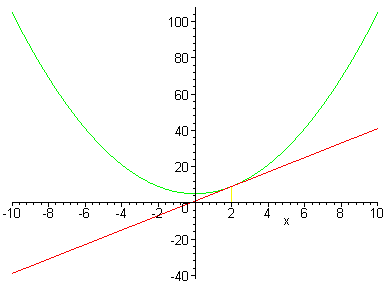
| The derivative is an integral part of Calculus as it provides the backbone for what is to come. The basic idea of the derivative is that it is the slope of the function f(x) at any point along the graph. The derivative exists only if the function is continuous at the point at which the derivative is desired. See Limits Page for definition of continuous. Here is an example of what the tangent line of f(x) = |
|
| at the point, x=2. |
| with(student): showtangent(x^2+5, x = 2); |
 |
| To calculate the derivative of a function we use the limit definiton of the derivative which is: |
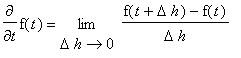 |
| What this tells us graphically is that as we make the x-coordinate smaller, the limit of that will become closer and closer to the slope of the graph untill we make the x-coordinate practically zero, the limit to zero, in which case we get the actual slope. That limit proof looks very scary and thanks to the many precisous rules, we will not have to do very many of those. |
| Now the first short hand method of doing a derivative is called the chain rule. Look at the function below and observe what the derivative is: |
| f(x):=a*x^n+b*x^(n-1)+c*x^(n-2); Diff(f(x),x)=diff(f(x),x); |
 |
 |
| So what we do is take the exponent, and multiply it by the coefficient and then take the exponent and subtract one from it. Observe. The derivative of a constant is always zero, thus the C term will always disappear. |
| g(x):=2*x^3+5*x^2+2*x+1; Diff(g(x),x)=diff(g(x),x); |
 |
 |
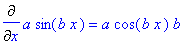
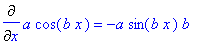
| Okay, that is great, but what about trig functions? Well, sorry, but you will need to memorize these or do it the long limit way.... When looking at these remember those horrible trig identities. Will make them look much simpler. |
| Diff(a*sin(b*x),x)=diff(a*sin(b*x),x); Diff(a*cos(b*x),x)=diff(a*cos(b*x),x); Diff(a*tan(b*x),x)=diff(a*tan(b*x),x); Diff(a*csc(b*x),x)=diff(a*csc(b*x),x); Diff(a*sec(b*x),x)=diff(a*sec(b*x),x); Diff(a*cot(b*x),x)=diff(a*cot(b*x),x); |
 |
 |
 |
 |
 |
 |
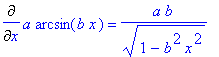
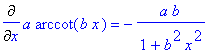
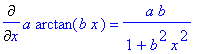
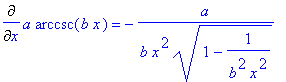
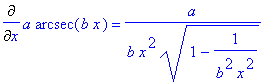
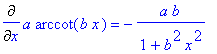
| We can also do the same for the inverse trig functions, yuck!!! |
| Diff(a*arcsin(b*x),x)=diff(a*arcsin(b*x),x); Diff(a*arccos(b*x),x)=diff(a*arccos(b*x),x); Diff(a*arctan(b*x),x)=diff(a*arctan(b*x),x); Diff(a*arccsc(b*x),x)=diff(a*arccsc(b*x),x); Diff(a*arcsec(b*x),x)=diff(a*arcsec(b*x),x); Diff(a*arccot(b*x),x)=diff(a*arccot(b*x),x); |
 |
 |
 |
 |
 |
 |
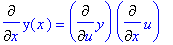
| Now comes the chain rule which looks something like this: |
| restart: Diff(y(x),x)=Diff(y,u)*Diff(u,x); |
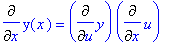 |
| What does that tell us? lets say we want the derivatime of |
 |
| ,okay? Well try doing that the first way. No way! So we set u= |
 |
| and y(u)= |
 |
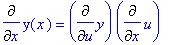
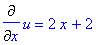
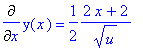
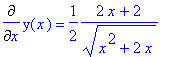
| We will then use the chain rule for this problem: And once you have that plug the substitution back in (what u was equal to, so you no longer have u as a variable). And we are done! |
| Diff(y(x),x)=Diff(y,u)*Diff(u,x); restart: Diff(y,u)=diff(sqrt(u),u); Diff(u,x)=diff(x^2+2*x,x); Diff(y(x),x)=Diff(y,u)*Diff(u,x); Diff(y(x),x)=diff(sqrt(u),u)*diff(x^2+2*x,x); Diff(y(x),x) = 1/2*(2*x+2)/(sqrt(x^2+2*x)); |
 |
 |
 |
 |
 |
 |
| We have now covered the basics of differentials. With alot of practice and patience you will be come a master of differentiation. As soon as we accomplish that then we are ready to move on to Integration. |
 |