 |
| You Try It! |
| 1. Produce a graph of the three dimensional curve x = tcos(4t), y = t sin(4t), z = cos(t) on 0 t 18. Set the number of points = 1000. |
| with(plots): f:=t*cos(4*t); g:=t*sin(4*t); h:=cos(t); spacecurve([f,g,h,t=0..18],axes=normal,shading=zhue,numpoints=1000,labels=["x-axis","y-axis","z-axis"]); |
|
 |
 |
 |
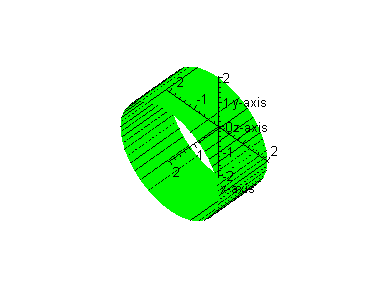
| 2. The command tubeplot([0, 0, t, t=0..4], radius = 2, grid=[50,50], axes = normal, color=blue, style=patchcontour) gave a cylinder around the z axis. Produce a simlar tubeplot that is centered along the x axis. Use a different color than blue. |
| tubeplot([t, 0, 0, t=0..2], radius = 2, grid=[50,50], axes = normal, color=green,style=patchcontour,labels=["x-axis","y-axis","z-axis"],scaling=constrained); |
 |
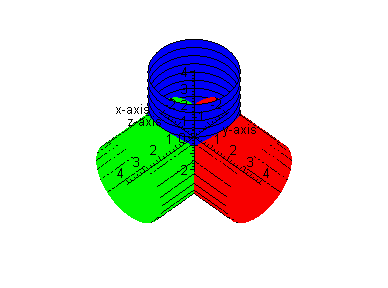
| 3. Use the display3d command to show both the tubes in part (2) above on the same graph. |
| p1:=tubeplot([t, 0, 0, t=0..4], radius = 2, grid=[50,50], axes = normal, color=green,style=patchcontour,labels=["x-axis","y-axis","z-axis"],scaling=constrained): p2:=tubeplot([0, 0, t, t=0..4], radius = 2, grid=[50,50], axes = normal, color=blue,style=patchcontour,scaling=constrained): p3:=tubeplot([0, t, 0, t=0..4], radius = 2, grid=[50,50], axes = normal, color=red,style=patchcontour,scaling=constrained): display3d(p1,p2,p3); |
 |
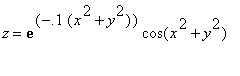
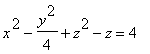
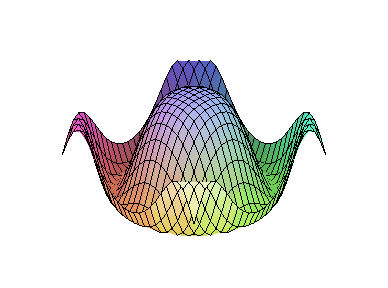
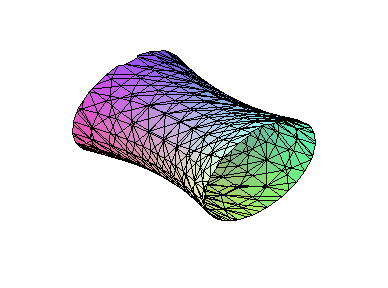
| 4. Create a graph of the three dimensional surfaces |
 |
 |
| x:=a; y:=b; z:=c; z1:=exp(-.1*(x^2+y^2))*cos(x^2+y^2); plot3d(z1,x=-2..2,y=-2..2); |
| implicitplot3d(x^2-y^2/4+z^2-z=4,x=-3..3,y=-3..3,z=-3..3); |
 |
 |
 |
 |
 |
 |
| 3D Graphing |
 |