 |
| 1. Find the equation of a plane determined by the points (1,1,0), (0,2,1), and (2,1,2). 2. For the vectors u=2i+3j-k, v=3i-3j+2k, and w=-i+4j+2k evaluate the following: a. The dot product of u and v. b. The cross product of v and w. 3. Derive the formula for the vector projection of u onto v. You may use pictures in your description, but it must be clear and easy to follow. 4. Graph the following: a. |
|
| b. |
 |
| 5. How much force is required to keep a 4500 lb van from rolling down a 12 degree slope? 6. Determine whether the following lines intersect, are parallel, are skew, or coincide. If they intersect, give the point of intersection. |
 |
| = |
 |
| = |
 |
| , |
 |
| = |
 |
| = |
 |
| 7. Find the equation of a sphere with a center at (2,3,0) and tangent to the plane at |
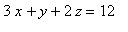 |
| 8. Consider a particle moving along the path described by R(t) = ( |
 |
| )i + ( |
 |
| )j + ( |
 |
| )k Find the following: a. Velocity b. Speed c. Acceleration d. Unit Tangent e. The curvature at t = 0 f. The Tangential and Normal components of acceleration at t = 0. 9. A particle has a velocity V(t) = |
 |
| i - ( |
 |
| )j + |
 |
| k. Find the position of the particle if R(0) = 2i-3j+4k. 10. At a certain instant the velocity and acceleration of a particle are given. Find T,N, At and An. V=<2,4>, A=<-2,1> 11. A particle with a mass of 1 slug is moving along a surface according to the equation R(t) = |
 |
 |
| )j. Find the frictional force recuired to keep the particle from skidding at t = 1. 12. Determine if the |
| i + ( |
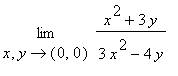 |
| exists and if so, evaluate. 13. Let f(x,y) = |
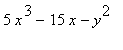 |
| a. Find the slope of the tangent line at the point f (1,3) in the direction of the x-axis. b. If the hiker is standing on the surface at the same point, what direction should the hiker go inorder to maintain their altitude? c. Find and classify all critical values of f. 14. For |
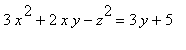 |
| find: a. |
 |
| b |
 |
| 15. A beer can is measured to be 6 inches tall with a radius of 1 inch. Use the total differential to estimate the percentage change in volume if the height is increased by 2% and the radius is decreased by 3%. 16. A 36 inch piece of wire is cut into two pieces and one is bent into a square and the other is bent into a circle. How should the wire be cut inorder to minimize the total area? 17. Find the formula for the least squares regression to the graph of |
 |
18.The temperature at any point on a plane is given by |
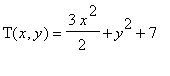 |
| . If a heat loving bug is initially placed at the point P(2,4) what path will the bug take inorder to stay as warm as possible? 19. Set up the double integral to integrate f(x,y) over the region bounded by as specified. |
 |
| and |
 |
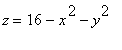
| a. With respect to y first. b. With respect to x first. 20. Find the volume of the solid enclosed by and the xy-plane. |
 |
| 21. Sketch the solid of the triple integral: |
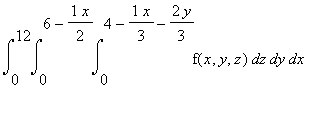 |
| and then change the order to dydxdz. |
| 22. Consider the integral: |
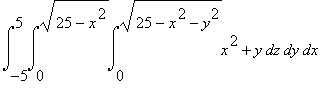 |
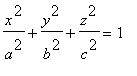
| a. Rewrite in Cylinderical Coordinates. b. Rewrite in Spherical Coordinates. 23. Use the triple integral to find a formula for the volume of the ellipsoid |
 |
| . Hint: Make the substitution |
 |
| , |
 |
| , |
 |
| 24. Evaluate |
 |
| where F = ( |
 |
| )i + ( |
 |
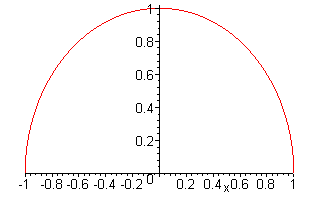
| )j and C is the curve shown below: |
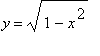 |
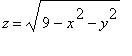
| (Use the scalar potential if field is conservative.) a. First by direct computation b. Using Green's Theorem. 25. Verify Stokes' theorem for the vector functions and surfaces given F = zi + 2xj + 3yk; S is the upperhemisphere: |
 |
 |
 |
| Math 101C Practice Final |