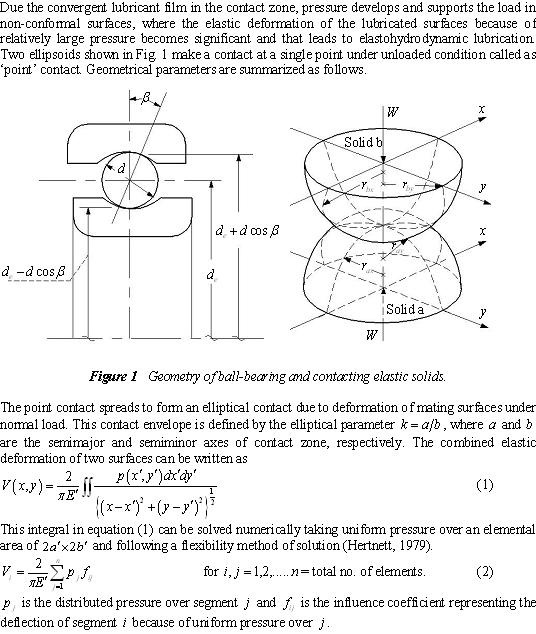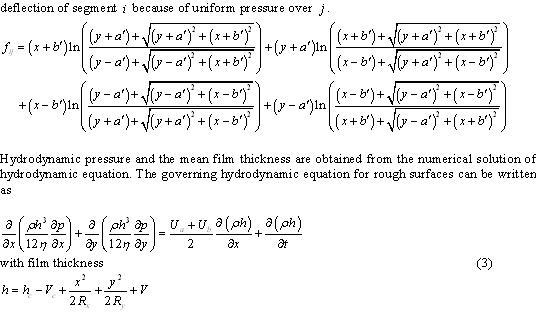
Broad area of interest
Elastohydrodynamic Lubrication
Lubricated Bearings includes ball bearings, journal bearings and others like Herringebone groove bearings
Hybrid Magnetic Bearings
Rotor Dynamics
Fault Identification in Rotor Bearing Systems
Experimental Modal Analysis
FEM Model Updating
Bearing Structural Vibration
Multigrid Solver
Basic Concept of Elastohydrodynamic Lubrication
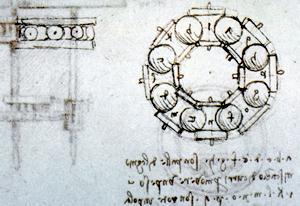
History of rolling element bearings started with the unreported work before 2500 years ago. However, the most appreciated period of greatly enhanced interest in both culture and machinery known as the Renaissance (A.D. 1450-1600), manuscripts and even printed books provide an increasing and vital store of knowledge. Illustrations of the use of roller-disc bearings in Renaissance industry can be found in texts by Agricola (1556) and Ramelli (1588). Several examples have been collected and reproduced by Dowson (1979). The potential of true rolling motion for low-friction supports was fully recognized by Leonardo da Vinci, for he wrote in the Codex Madrid I:
Figure 2.1 Early form of ball thrust bearings complete with “separator” proposed by Leonardo da Vinci in Codex Madrid I.
I affirm, that if a weight of a flat surface moves on a similar plane their movement will be facilitated by inter-posing between them balls or rollers; and I do not see any difference between balls and rollers save the fact that balls have universal motion while rollers can move in one direction alone. But if balls or rollers touch each other in their motion, they will make the movement more difficult than if there were no contact between them, because their touching is by contrary motions and this friction cause contrariwise movements.
But if the balls or rollers are kept at a distance from each other, they will touch at one point only between the load and its resistance… and consequently it will be easy to generate this movement.
The development of today’s precision ball bearings began nearly late nineteenth and early twentieth century with the establishment of some of the manufacturing companies involved in more research and development facilities as per the requirement. Very same time Reynolds (1886) described the flow of Newtonian fluids in narrow gaps. On the other hand, Hertz (1881) was the first to describe the elastic deformation of two non-conforming solids in contact. Probably, the first work on this theory of EHL started with the work of Martin (1916). The formula of load capacity derived by Martin really does not consider the effect of film thickness. It is interesting to notice that it took over half a century before Ertel (1939) and Grubin (1949) combined both effects elastic deformation and hydrodynamic action into what is now known as elastohydrodynamic lubrication (EHL). Since then, however, considerable progress has been made in theory as well as experiment.