|
The following reflection, written by Michael
Anderer-McClelland of San Miguel Chicago, provides insightful context for
the continuous growth of the Miguel School Movement.
The Miguel School Movement is a term used to describe the utter explosion of new, alternative Lasallian schools over the past 9 years. The first four schools to open (Providence, RI, in 1993, Chicago, IL, in 1995, Camden, NJ, in 1997, and Minneapolis, MN, in 2000) are all named after San Miguel Febres Cordero, a Christian Brother saint from Ecuador, who was known as an excellent scholar and linguist and had a particular affection for teaching religion to young people. Schools that have opened more recently have a variety of Lasallian names, but each has taken its inspiration from the first four schools. Currently, there are nine schools including seven middle schools, one elementary school (opened in Memphis, TN, in 2000) and one “Cristo Rey” model high school (opened in Portland, OR, in 2001) with a Lasallian twist. Four more “Miguel Schools” are scheduled to open in the fall of 2002 including Washington, DC, Freeport, LI, and second sites in Chicago and Memphis. A Miguel School is defined as a small, Lasallian elementary, middle, or high school that is not tuition-driven and serves students and families from all faiths and cultures who are at-risk due to challenging economic situations. Systems thinking is the ability to understand (and sometimes predict) interactions and relationships in complex, dynamic system. A particular set of relationships, or system, can be analyzed using a Behavior Over Time Graph (BOTG). A BOTG helps us to understand three things: what is changing, how it is changing, and why it is changing. Graph 1: The Miguel School Movement, a simple behavior-over-time graph (BOTG), shows the development of the schools over time. Graph 1 clearly illustrates what is changing (# of Miguel schools) and how it is changing (the rate at which new schools are opening). Let me suggest some initial reasons as to why it is changing. 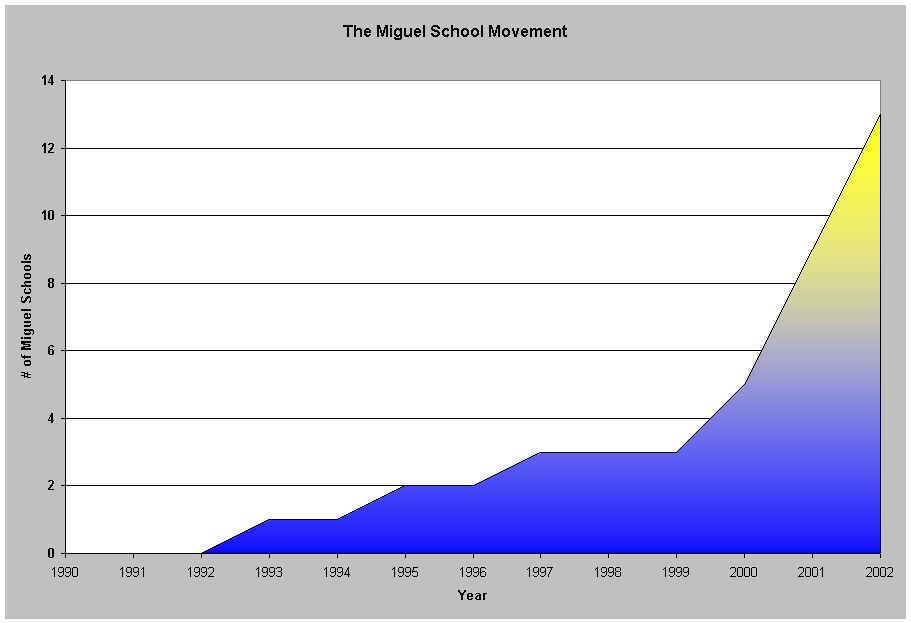
Three sets of events, or movements, predate and impact the growth of the Miguel School Movement. The first set of events is the renewal of the De La Salle Christian Brothers begun in 1966 in response to Vatican Council II. A twenty-year period of experimentation in ministry, prayer and community culminated in the rewriting of The Rule of the Brothers of the Christian Schools in 1987. Ministerially, this time was marked by a handful of individual brothers founding and leading alternative educational centers and community-based organizations. These brothers were definitely on the margins of their own districts and communities. The new guiding idea of this renewal period ─ critical to the development of the Miguel Schools ─ is the reclaiming of the direct service of the poor through education as the founding mission of the De La Salle Christian Brothers. This guiding idea is affirmed in the new Rule. The second set of events which impacted Miguel School movement has been the development of the Lasallian Volunteers. The seeds of what became the Lasallian Volunteer program were sown in New York City in 1981. A young man in his forties working at a Lasallian high school asked the community of brothers at that school if he could live with them. He had no intention of being a brother, but simply wanted to share with them a simple life of community, prayer and educational ministry. In 1989, the Lasallian Volunteer Movement, as it was called at the time, named its first director. In 1990, the first women were accepted officially as Lasallian Volunteers, and lived with Christian Brothers. In 1993, two female Lasallian Volunteers joined one DeLaSalle Christian Brother to open the first San Miguel Middle School in Providence, RI. In 1994, the Lasallian Volunteer Movement became the Lasallian Volunteer Program, and the director moved to the national office of the DeLaSalle Christian Brothers. Lasallian Volunteers are a critical component of the founding groups at nearly all of the members schools of the Lasallian Association of Miguel Schools. The final set of events is still in the midst of unfolding. In fact, the development of the Miguel Schools is one element of this third movement. It is nothing less than the refoundation of the Lasallian mission. The visionary elements of this third movement were initially stated in the 1993 document “A Shared Mission” which placed the participation of non-brothers as a welcome gift and characteristic of the Lasallian mission. In 2000, a second statement, “Association for the Service of the Poor through Education,” positioned the education of the economically poor at the center of the Lasallian mission and re-emphasized the role of lay partners and colleagues in the leadership and future of the Lasallian mission. One practical, visible element of this movement began with a gathering of brothers, Lasallian Volunteers, and lay colleagues in the Spring of 1998. It was a gathering of the diaspora of brothers who had been working on the margins for the past 30 years, of the young Lasallian Volunteers who had given new energy to Lasallian communities, and of the founders and teachers of the first three San Miguel Schools. All of the participants were working in Lasallian ministries in direct service with the poor. This gathering gave birth to a group called the Lasallian Partners for the Economically Poor (LPEP). In the fall of 2000, LPEP invited the leaders of all of the existing Miguel Schools and schools in formation together, and facilitated a weekend of sharing and visioning. The Lasallian Association of Miguel Schools (LAMS) was formed at this meeting. |