Here you will find a selection of stand-alone walls and floors, some based on a theme, others as you find them. All of these were made in some way from a combination of web images, scans from catalogues and photographs I have taken myself. It is fair to say that my family have now come to accept my madness in buying a digital camera specifically so that I can take 100s of pictures of wall and floor textures wherever I go, so for what it's worth, this collection is dedicated to my long-suffering family and friends.
All walls are priced
at §1 so you can find them easily to reprice according to your own system.
All sets
as shown are complete in one zip file. Make sure that you move any files ending
in:
.wll to C:\Program Files\Maxis\The Sims\Gamedata\Walls
.flr to C:\Program
Files\Maxis\The Sims\Gamedata\Floors
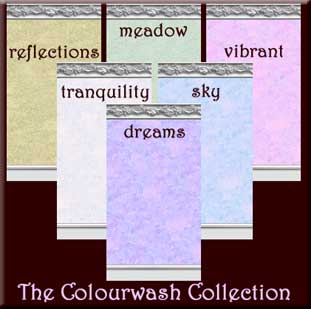

Six light colourwashes with decorative plaster cornice and matching skirting board for a light, airy feel to your walls. These are not my usual style of wall treatments, but I made them on request for someone a long while ago, and thought they would be appropriate for my first set of walls on my own site.
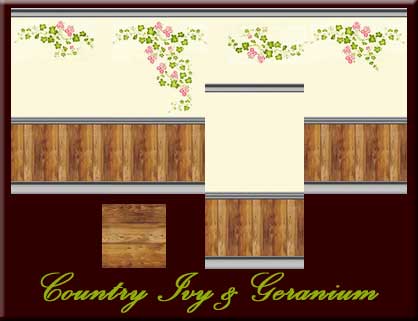
A fully
tileable mix'n'match collection of five stencilled Ivy & Geranium wall treatments
for that country look.
The zip also includes the floor tile shown.
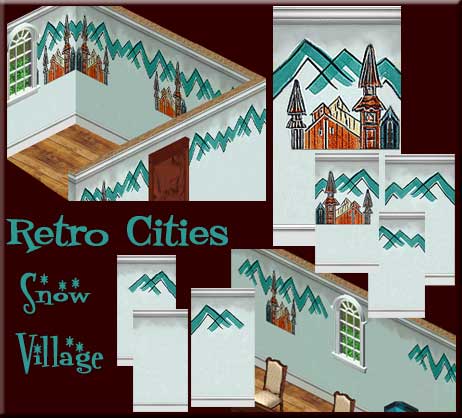
A fully tileable mix'n'match collection of seven 1950s style mural walls for your retro home.
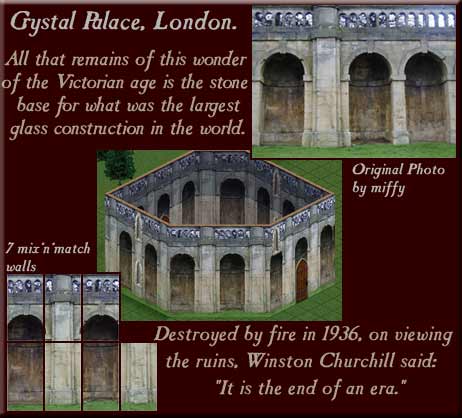
The Crystal Palace was built to house the Great Exhibition of the Industry of All Nations in Hyde Park, London, in 1851. After the Exhibition, it was moved, expanded and rebuilt on Sydenham Hill overlooking London, where it enjoyed a second life from 1854 until its destruction in a horrific fire in 1936. Photographed and siminised by miffy, each tile is fully tileable by itself or mix 'n' matched with the other lower or upper ones. I suggest laying the lower floor first to make matching the upper tiles easier.
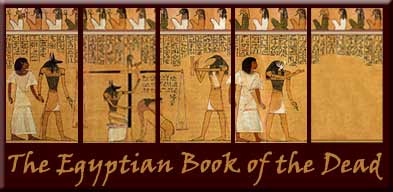
The Egyptian Book of the Dead (known to the ancient Egyptians as The Book of Coming Forth by Day) is a collection of ancient Egyptian religious texts, hymns and formulas concerned with ensuring the safe passage of the soul through Anenti (Hell) and to pass the tests set by the 42 judges in the hall of Osiris, god of the underworld.
Part of the
Book of the Dead is believed to have originated in the predynastic period of
Egyptian history. In the 5th and 6th dynasties the Book of the Dead was inscribed
on the sarcophagi in the pyramids of the kings and therefore became known as
the Pyramid Texts. By the 18th Dynasty it was inscribed on papyri, which were
frequently from 15 to 30 m (50 to 100 ft) long and illustrated in color. These
papyri were placed in or near the coffins of the dead and were sometimes called
Coffin Texts. These five wall treatments are from a fragment of one of the scrolls
from the British Museum, and show the earthly deeds of Pharoah being weighed
in the balance.