
What�s wrong with saying, �I ain�t got none�? Nothing at all, says professor Kirk Hazen. �It means the same thing as �I haven�t got any.�� Truer words were rarely spoken.
The professor teaches linguistics at West Virginia University, where he directs the university�s study of regional dialects. The study surely is academically useful. All the same, it strikes me as nonsense to contend that all dialects are equal and should be equally taught. The notion that teachers should not correct errors in standard grammar and pronunciation is a notion that ought to be stamped out.
These observations stem from a recent article in the Washington Times. The reporter quoted Hazen: �Teachers shouldn�t tell their students how they�re saying something is wrong. I don�t think it�s the job of the schools to correct dialect features.�
Ah, well, hokum. As a student of the writing art, I can agree with much that the professor says, but it is stupid to pretend that in the English-speaking world there are no standards of good, better and best � and bad, worse and worst. As a practical matter, of course there are standards. Teachers would be out of jobs if it were not so.
This much we know and can agree upon: spoken English and written English are two different things. The two languages employ different vocabularies and adjust to different audiences. It is just as the professor says. �He ain�t got none� communicates the identical message conveyed by �he doesn�t have any,� but we also know that the two statements are not at all the same. One conveys an image of illiteracy, with all its associated social impressions. The other conveys a different image.
Now, let us suppose that the purpose of public education in West Virginia is to educate only those hillbilly children who expect to remain hillbillies all their lives. If so, perhaps nothing much is lost by letting their errors in speech or writing go uncorrected. But that is not the purpose. In the field of English usage, error is there to be combated.
The rules of �standard� English usage are not immutable. The language constantly sloughs off dead wood and produces new growth. I have lived to see respectable editors approve language that once would have gotten their mouths washed out with soap. I probably will not live to chronicle the end of �whom,� but its doom is sealed. The masculine referent pronoun is in feeble shape; two generations down the road, everybody will be driving their car and reading their paper, and I will be revolving in my grave.
Meanwhile, let me counsel deference to contemporary rules, and let me urge teachers to keep red pencils sharp.
As Professor Hazen well knows, beyond the Alleghenies lies a great wide world. The first object of teaching should be to prepare the state�s children for cultural life on the other side of the mountain.
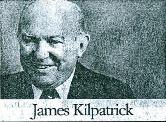
James Kilpatrick�s column is distributed by Universal Press Syndicate.