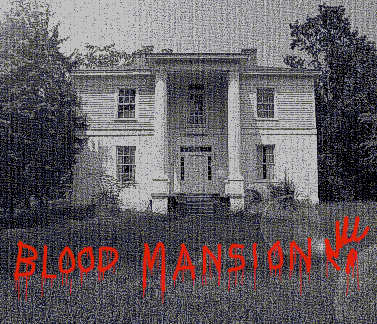
John Hodges was an immigrant who came to America to escape the hunger and disease of Ireland�s potato famine. From there he went west and made his fortune in the gold strike of 1849. That next year he married Rebecca (last name unknown ). They then moved to Georgia and bought a plantation as a place to start a family. Hodges went on to father three daughters over the next few years. Hodges also purchased some twenty male slaves with families, to work the plantation. During the first year of the war Hodges privately freed all his slaves, saying if they chose to go he would help them make their way north via the underground railroad. However, if they chose to stay they would be treated as equals and share in the land�s bounty. There were a small few who did chose to go, but most stayed loyal to Hodges. After a short stint in the Southern army, in which he lost his right arm, Hodges devoted all his energies into making his plantation prosper. Hodges and his family were little touched by the war until in December 1865, when they were forced to hide from marauders in service with Sherman in his historical march to the sea. The plantation would have been torched if not for the freed-slaves who defended the land as their own. Their freedmen�s ownership papers and their number was enough to convince the marauders to march on.
After the war the number of freed-slaves and poor white sharecroppers living on Hodges plantation had grown into a small, largely self-sufficient, community. It became one of the few profitable plantations in the region, Therefore, Hodges was able to fend off tax collectors and profiteers from the north, know as �carpet baggers.� They were called �carpet baggers� because they carried all their belongings in carpet bags. These �carpet baggers� preyed on poor Southerners in the political chaos of reconstruction. It was rumored that during this time that several of the carpet baggers in the area had formed a coalition with some local corrupt politicians to strong-arm plantation owners into selling their land for nearly nothing. This coalition would even resort to railroading plantation owners by producing false charges with the local law enforcement. They went so far as to hang many of the so-called offenders. It was sometime during the third year after the war that the coalition paid a call on Hodges. Hodges, with the strong support of his small community confidently dismissed the coalition�s offer to buy the plantation. It was said that the coalition took Hodge�s refusal to sell none too easily, but parted without violence or threats. Three days later, drawn by the smoke of several fires, nearby residents ventured onto Hodges land and were both sickened and horrified by what they saw. Most of the bodies, black and white, were impaled on stakes with their heads bashed in so bad that none were recognizable. Some of the bodies were nothing but charred statues found in the ashes of the burnt houses on the plantation. However, most of the people that had lived in the community were never found. This was not true of the Hodge�s household. Hodges head was found on a dirt road leading from the main house. His face a grim mask of pain. What was believed to be his body was found ripped to pieces some distance from the head. The body was only identifiable from the healed stump of his right arm. His wife and family�s fate were much worse. The bodies of his wife and three daughters, the youngest eleven, were found upstairs. Each body was headless. And each body showed signs of both rape and torture. Blood was found sprayed over the walls upstairs and downstairs as if some sadistic ritual had been performed. Four others, two men and two women were also found downstairs headless. However, only the head of Rebecca Hodges was found in the house. The head was propped up at the top of the stairs for all to see as they entered the front door. No other heads were found in the house. Nor on the plantation grounds. Although many suspected that other bodies were hidden on the plantation grounds, the search turned up no fresh graves or signs of other bodies. It was not known how many survived that night, but through the years no survivors ever surfaced. Residents in the area blamed the deaths on a variety of reasons. Some said that demon or Satan worshipers had summoned spirits that performed the slaughtered and carried the rest to hell. Some said voodoo magic called upon by the freed slaves had gone awry. Others believed there was an old Indian curse on the place. There were even those who whispered that the coalition carried out the massacre as a warning to anyone who refused the coalition�s offer.
The plantation house sat empty for almost a year. However, the following spring the house was resettled by none other than two prominent members of the coalition who purchased the land at a rock bottom price after no relatives showed to claim it. They only lasted three days. Their wives left after the first night, claiming the place was haunted. The men, determined to prove them wrong, lasted two more days. One was found beheaded, setting where they said Rebecca Hodges was found dead a year earlier, and the other apparently had hanged himself in the back of the plantation on the tree used for skinning game. It was ruled a murder-suicide by local law enforcement. However, no murder weapon was ever found. The house stayed abandoned until the first of the new century when a wealthy northern businessman, unaware of its history, grabbed up the cheap property as a sound investment. He had the house fully restored with intent to live there as a vacation place in the deep south. However, he, like the two previous owners wives, only lasted one night in the house. He gave no reason, but moved off never to return.
The house continued to set empty until the early twenties when it was purchased as a wedding gift for two soon-to-be newlyweds. The father of the bride had the house installed with all the modern conveyances of the twentieth century: indoor plumbing and electricity, even a telephone. Two days after the newlyweds moved in the new bride went mad. She was sent to a nearby mental asylum. Nothing more than a vegetable, she retreated so deep into her mind that no one could ever reach her. Blamed for her madness, the groom fled overseas where he restarted his life never making mention of the house again.
To this day, the house sits empty hidden behind a wall of overgrown bushes and evergreens. Progress has enveloped most of the plantation�s land into housing and roads. On a meager few acres the house lies hidden. A relic from the past that can only be partially seen in the dead of winter. Declared a historical site, she is one of many such sites that sit empty. The massacre? It eventually passed into folklore. Very few are even aware of its existence today. But there are whispers. |