
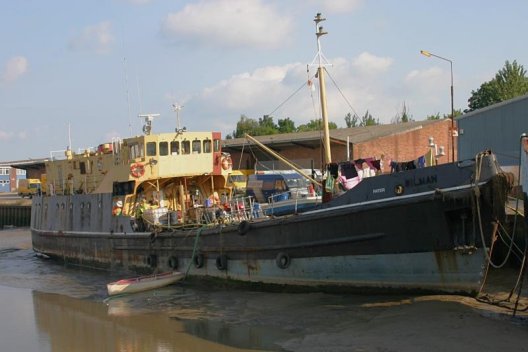
IMO No 4903236 built 1969, Ex Oilman
Photo Courtesy David Berg 9/7/05
Most members were unaware of how busy this river had been in its time.
The only operational port today is Brightlingsea on St Osyth creek and is at the most seaward end of the Colne where it meets the River Blackwater. The main cargo for the two or so coasters a week is the export of scrap. In recent history the port has been used during strikes for the import of coal and steel, but is probably most remembered for the often-violent campaign to stop the export of live animals in 1995.
Further up river was the aggregates berth at Arlesford where the �Prior� boats load. One of the busiest ports on the river was Wivenhoe where bulk grain and timber were handled. There were also several shipyards here, probably the best known being Cook�s Yard which built many barges and coasters but went into voluntary liquidation in 1986 with the �Lord Nelson� and �Kilmourne� still incomplete.The port closed in 1989.
We next �visited� the port of Rowhedge across the river from Wivenhoe that was also busy in its day, handling bulk cargoes and timber, Rowhedge Ironworks, which closed in the mid sixties, was also a busy yard which built some mid-sized coasters. Then into Colchester and the Hythe itself. During Derek�s visits in the 70s and 80s he had seen up to 14 coasters alongside at one time. Cargoes consisted of effluent, timber, bagged fertiliser, bulk grain, animal feeds, bricks and oil products. Brick exports were from the Molers at Moler Quay. The vessel mainly engaged in this trade, Moler Venture was built at Wivenhoe. Probably one of the largest ships regularly using the river was the effluent carrier from Haven Quay, which could accommodate two or three other vessels, but was not the most pleasant when during effluent loading! Other photos showed ships alongside at Colchester Dock up to the Pertwee berth. By 1999 commercial traffic up to Colchester Hythe and the wharves at Rowhedge and Wivenhoe had declined so much that Colchester as a Port was no longer viable. On 14th April 1999, M.V. �Ruhrort� of Duisburg brought the last cargo up the River Colne to Rowhedge Quay and after nearly 2000 years as a port an Act of Parliament closed the harbour in 2001.
We thank Derek for coming to show us his unique collection of slides taken over many years and for his lively and interesting commentary.