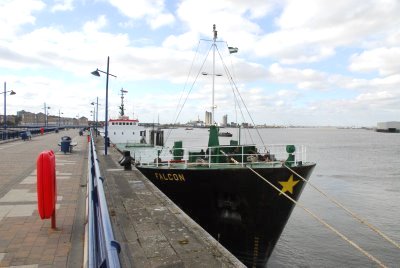
We were pleased to welcome members from across the water (North West Kent Branch) when Alan Chapman gave us a presentation titled �A Thames Summer�.
When Alan retired, his colleague�s gift of a digital camera brought him back to photography. Alan lives only a short distance from Erith riverside and gave us a show reviewing the area, the ships that visited and the ships that passed by during the summer of 2007. The presentation was displayed via a laptop computer and digital projector. Part one of the two-part show was a description of the area from Jenningtree Point in the west to Crayfordness radar station in the east. At this point Gravesend VTS hands over to Woolwich VTS and is some 15 miles from London Bridge. Alan showed current pictures of the area and commented on what used to occupy the site. Whilst some areas have been modernised and spruced up, much of the older wharves and piers of Erith�s industrial past have been left derelict and are slowly decaying into the river. Those that remain are ADM Erith specialising in Vegetable oils particularly rape seed oil, British Gypsum (CEMEX (UK) and United Marine Aggregates both handling bulk sand and gravel. The Deep-water wharf is now known as �the pier� and has an occasional visit by a coaster. Erith has a large and flourishing yacht club with the ex Norwegian ferry FOLGEFON as a clubhouse. On the Essex side CEMEX and Hanson Aggregates have wharves specialising in bulk sand and gravel. Fords transport cars and car parts to and from their jetty at Dagenham on a three ship a day ro-ro service to Vlissingen, which is operated by Cobelfret. Also on the Essex side are large landfill sites where much of London�s non-recyclable waste is deposited. The waste is bought to the area by tugs towing a string of purpose built barges.
Part two featured the visiting and passing ships. In earlier times this was a vantage point to see all the ships bound for the East and West India docks, the Royal docks, Surrey Commercial and Millwall docks and all the jetties beside the river. Today, however, the river is not so busy with international trade but it is still full of activity. The largest cargo vessels passing were bound for Tate and Lyles Sugar Refinery at Silvertown and included PONTOMEDON, ALINDA, DOXIA and ALYCIA. Passenger ships ranged from the 17,000 grt SILVER WIND to the BALMORAL and the PRINCESS POCAHONTAS. The fleet of Cobelfret ro-ros were shown as were many of
the sand suction dredgers that service the sand and gravel wharves. Also pictured was the coaster JAMES PRIOR owned by JJ Prior of Fingeringhoe who have been transporting aggregates to London by sea from their quarry at Fingeringhoe near Colchester for over 70 years. London visitors also included the replica East Indiaman GOTHEBORG and warships HMS ARK ROYAL, and the Belgian Navy�s ASTER and WESTDEIP.
Small craft included many tugs and and ancillary boats such as the PLA bed profiler NORMA the survey vessel YANTLET and the HMG�s BENFLEET. Frequent visitors to the edible oil terminal included STAR ARUBA. The transhipment of oil from Erith to Jurgens at Purfleet is a common journey which whilst a relatively short distance of 4 miles by sea replaces many road tanker journeys of 10 miles.
We are grateful to Alan for his visit and for assembling this very interesting and informative presentation. |