Mechanism of Change
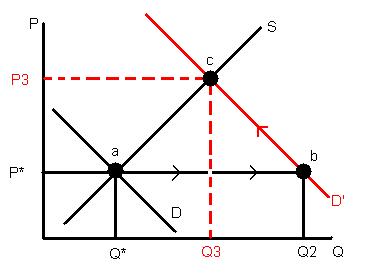
After looking at demand shifts we need to determine how we obtain the new equilibrium. The mechanism that causes the transition from one equilibrium to another is the price. Consider the graph below, we begin at the initial equilibrium, point a, with price P* and quantity Q*. Suppose that there is an increase in income and this is a normal good. This would cause demand to shift right to D'. This shift of the demand curve will cause a shortage as the quantity demanded increases from Q' to Q2. Initially price does not change, since both consumers and producers do not know of the shortage. The market is no longer in equilbirium, the quantity demanded is now Q2 but price remains at P*. We are now at point b. Eventually, producers become aware of the shortage and begin to raise price. The increase in price causes producers to make more of the good and entices new producers into the market. The price increase also causes some consumers to stop buying the product because they are no longer willing to pay the new price. We begin to slide up the demand curve D'. Price will settle at P3 and quantity will be Q3, point c. At this price and quantity the market is once again at equilibrium.
Mechanism of Change
In summary the increase in price caused a shortage of the good. Producers responded to this shortage by raising price which increased the quantity supplied and reduced the quantity demanded.

