Notice that if the percentage change in the quantity demanded is greater than the percentage change in price the value of elasticity will be greater than 1. Economists define this as being elastic demand, quantity demanded is very responsive to a change in price. You can visualize this by thinking of a rubber ball. When you throw the ball against the ground it bounces to higher point than where it began. The ball is very responsive. The same analogy can be used for the change in the quantity demanded. The change in price causes a larger change in the quantity demanded. There is a special case when an increase in price causes the quantity demanded to fall to zero. Here the change in the quantity demanded is infinite, you lose all sales. Under this special circumstance the price elasticity of demand is perfectly elastic.
The percentage change in the quantity demanded does not have to be greater than the percentage change in the price. It could be less, which would result in an elasticity less than one. Economists define this as being inelastic demand, quantity demanded is not very responsive to a change in price. You can visualize this by thinking of a granite ball. When you throw the ball against the ground it does bounce a little, but not as high as where it began. The ball is not very responsive. The same analogy can be used for the change in the quantity demanded. The change in price causes a smaller change in the quantity demanded. There is a special case where a change in price does not change the quantity demanded at all. The change in the quantity demanded is zero. Under this special circumstance the price elasticity of demand is perfectly inelastic.
Finally, there is also the possibility that the percentage change in quantity is equal to the percentage change in price. Economists call this unitary demand. The change in price is causing an equal change in quantity.
To summarize these results I have provided a table for you.
|
|
|
|
|
|
|
|
|
|
|
|
|
|
|
|
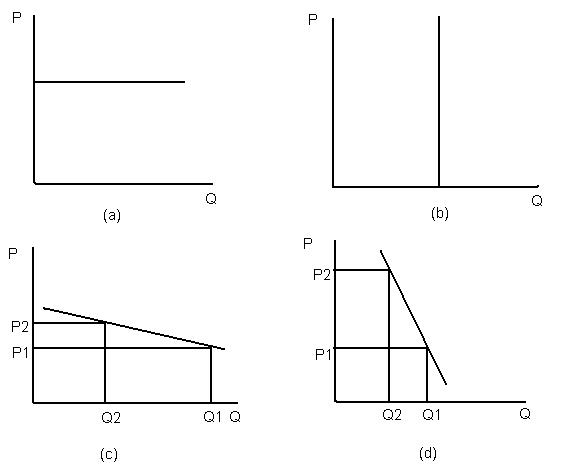
Look at the following graph.
In part (a) we see a perfectly elastic demand curve. If the price rises just a tiny amount the quantity demanded will fall to zero. In part (b) we see a perfectly inelastic demand curve. Regardless of the change in price the quantity demanded does not change. In part (c) we see an elastic demand curve. Notice that the change in quantity (Q1 - Q2) is larger than the change in price (P2 - P1). In part (d) we see an inelastic demand curve. The change in quantity (Q1 - Q2) is smaller than the change in price (P2 - P1). (Note: These graphs were drawn to exemplify the responsiveness and should not be construed as typical.)

