This page has moved : please see the
current version here
 T
H E F L O Y D F A M I L Y
OF P E R T H,
T
H E F L O Y D F A M I L Y
OF P E R T H, 
T A S M A N I A
created 2003 *
last updated 9 March 2009
by Greg Harling & Bruce
Eames
email
home Children
of William & Mary Floyd Floyd
Photographs & Documents
Acknowledgements - thanks are
due to fellow researchers and distant cousins, without which these pages
would not be possible -
Pamela Gabriel , Betty &
George Shipperley, Glenda Shearwood, Elvie Fraser
William Floyd was born on Sunday,
3 December 1797, and baptized the following Sunday (10 Dec) in the parish
church of Westbury-on-Trym, near Bristol, England. He was the fifth child
of William Floyd (1758- ) and Ann (1753-1831), but by the time he joined
the family two of his 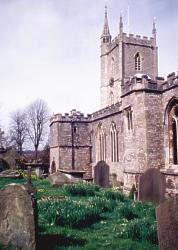 siblings
had died, leaving him with two sisters, Elizabeth (1786- ) and Ann (1795-
).
siblings
had died, leaving him with two sisters, Elizabeth (1786- ) and Ann (1795-
).
Westbury-on-Trym, 3 miles NNW of
Bristol, still retains elements of its picturesque village past,
with a 13th century church (Holy Trinity) and churchyard containing many
Floyd burials. In 1801, the village numbered 678 inhabitants, including
the Floyd family, who seem to have been connected with the parish at least
as far back as 1717. William Floyd's grandfather, Jonathan Floyd (ca 1733-1814)
married Mary (surname unknown) ca 1757, and they had six children : William
(1758- ), Jonathan (1760-1817), Sarah (1765-), Thomas (1762- ), Mary (1772-
), and Hannah (1774- ).
We know little about William's upbringing,
but years later he said he had been apprenticed to George Shepstone, from
whom he would have learnt his trade as a stonemason and bricklayer over
what was typically a 5 -7 year period. Westbury parish records confirm
the presence of the Shepstone family (including several generations of
George's) from ca 1810, and Gloucestershire directories also indicate they
were stonemasons (an 1850 directory lists James Shepstone, stonemason,
in Westbury-on-Trym)
With a trade under his belt, William
perhaps had the opportunity to lead a stable life, but soon after his twentieth
birthday he got into trouble with the law. He and 3 acquaintances - James
Davis, John Phillips, and George Mills - were accused by David Jones, victualler
of Westbury-on-Trym, of "having feloniously stolen, taken, and carried
away from a larder in his dwelling house... one leg of mutton value 5/-
and one rabbit of the value of one shilling...." The unlucky group
was thrown into Gloucestershire County Gaol (located in Bristol) on Christmas
Eve 1817, to await their trial. The gaol register records their name, age,
native parish, charge, physical description, occupation, behaviour while
in gaol, and results of the trial. James and John were older, aged 34 and
28 respectively, and are described as masons, and the younger William and
George, recorded as 21 and 15 respectively, are listed as labourers. Perhaps
they all worked for George Shepstone? William's description here is the
earliest and most minutely detailed of several made during his life : "dark
hair, dark eyes, fresh complexion, oval face, large nose, a scar between
third and fourth finger left hand, a scar on the top of his left foot,
a scar on upon left instep..., height 5' 7"...." Recorded in the register
as all being well behaved, the group waited almost 3 weeks to have their
day in court, and when they appeared on 13 Jan 1818, the justices of the
Gloucestershire Quarter Sessions found them all not guilty. Surprisingly,
they were then kept in gaol another week until being discharged on 21 January,
at which time they were presumably glad to make their way home to Westbury-on-Trym.
Were William and his friends actually
innocent of the charge, or did the trial simply fail to establish their
guilt? Despite some of our modern notions about process of law in earlier
times, courts in this period were concerned to see justice scrupulously
done and for it to be seen to be done, and "the accused was entitled to
an acquittal if the slightest error of procedure was committed" (Tobias).
We can only speculate : the event sounds more like a lark than a malicious
act, but in the case of William Floyd, given his later crimes, we
have to wonder if this was early evidence of criminal proclivities.
Analysis of crime rates in Gloucestershire
during 1820-1850 suggests that the crime rate in the parish of Westbury-on-Trym
was high in relation to the size of its population. The doubling of the
village's population over the first 20 or so years of William's life would
have also contributed to socio-economic change and unrest. The influence
of nearby Bristol was probably a bad one : a busy, cosmopolitan, port,
one of the largest cities in England with a population of 53,000 in 1821,
it came in for a lot of criticism as a breeding ground for urban disorder
and crime, and things came to a head there with the infamous riots of 1831.
On the other hand, however, it has been argued that Bristol's crime rate
was very low relative to the size of its population - among Gloucestershire
towns and villages, it was the more genteel Cheltenham which was the 'crime
capital' of the county, due to a dramatic population increase over the
years 1820-1850 and the high number of affluent residents.
In William's favour, it can be said
that he does seem to have kept out of trouble up to 1827, and there is
no record of him appearing before a court in Gloucestershire, Bristol or
Somerset in the years 1819-1826. During this time, he got on with life,
and according to his later statement recorded in the convict indent (1828-1829),
he was married and had 4 children.
The first of these children is surely
Louisa, baptized on 21 May 1820 at Holy Trinity, Westbury-on-Trym, daughter
of William and Mary Floyd. There are, however, no baptisms for subsequent
children there, nor can any be definitely identifed in the Bristol area..
Bristol marriages for this period
have been indexed and there are two possible matches for a William and
Mary. On 20 Sept 1818, a Willliam Floyd married Mary Groves at St
Philip & St Jacob. On 8 Aug 1819, there is another marriage of a William
to Mary Denmead, at St Paul's. While the first of these looked promising,
it can now be ruled out : this William was a carpenter, had 3 children
(John, William and Eliza), all baptised together on 5 Sept 1830, at St
Paul's, Portland Square, Bristol. We find them again in the 1841 census,
living at Hillgrove Sreet, Bristol (in the parish of St James and St Paul
Out). Perhpas we can tentatively assume that our William married Mary Denmead,
but we lack any confirmation of this.
More research is still required
to trace their history, but we can pick up William's trail again in August
1827, when he lived in Pipe Lane, Temple Street, Bristol. Things
had taken a turn for the worse, for on Wednesday 8 August he was arrested
by police constable George Yates, in Bedminster. Described by The Bristol
Mercury (13 Aug 1827) as "an old offender", William had broken into
the premises of John Miles of Ashton and stolen a telescope and other items
(see also Taunton Courier 22 Aug 1827 & Western Gazette (Somerset)
25 AUg 1827). He also had in his possession items stolen from the house
of E. Brice of Cleeve on 29/30 July (clothes, boots, a "handsome single
barrel gun" etc. for which a £20 reward was offered. The Bristol
Mercury 30 July 1827).
Taken before magistrate Thomas Hassell
of Bedminster, William was remanded to Shepton-Mallet Gaol. Transferred
later to Ilchester Gaol, he was taken up to the Assizes at Bridgwater and
on 18 August was found guilty of house-breaking. The mandatory sentence
for house-breaking in this era was death, but in nearly all instances this
was commuted to life transportation (e.g. in 1828-1834, less than 5% of
people sentenced to death in England and Wales were actually executed)
It begins to look at this stage
that William - the "old offender" - may well have been a serious and
habitual criminal. Descendants of convicts often preserve family traditions
that their own transportee was unfairly convicted or the victim of
circumstance, but this often seems not to be the case. The gaoler's
report from the hulk later described William's character as "Char'r Con'ns
very Bad" and this was repeated in his Tasmanian convict record, so perhaps
he had fallen in with a bad crowd in Bristol. One can speculate about what
causes a person to turn to crime. Poverty, poor housing, lack of education
and rapid urban population growth - all present in Bristol at this time
- helped to create ideal conditions ffor crime, particularly in leading
juveniles astray.
With this conviction, William's
life changed forever. He left behind his wife and young children, and also
his elderly mother Ann, who died 4 years later in Westbury-on-Trym. Soon
after sentence was passed, he was taken south and put on board the hulk
Captivity,
moored at Devonport, Plymouth. At this time, prisoners serving longer sentences
in England were not usually sent to prisons but confined to the hulks located
at various points on the coast, particularly around Plymouth, Portsmouth,
and Kent but also as far away as Gibraltar and Bermuda. These were ships
decommissioned from navy use and refitted as floating prisons. 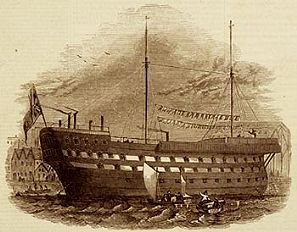 Typically,
each deck was divided into compartments containing 10-20 convicts, grouped
according to their behaviour (which was carefully recorded during their
captivity, as was their health). Gangs of prisoners were often sent ashore
to work, and were indeed in some demand from local employers.
Typically,
each deck was divided into compartments containing 10-20 convicts, grouped
according to their behaviour (which was carefully recorded during their
captivity, as was their health). Gangs of prisoners were often sent ashore
to work, and were indeed in some demand from local employers.
At 7 a.m., Thursday 14 February
1828, William and a fellow convict Charles Williams escaped from their
keepers in the dock yard. Wearing convict dress and smock-frocks, and bearing
iron rings on each leg, they fled (Trewman's Exeter Flying Post or Plymouth
and Cornish Advertiser 21 Feb 1828). Adopting the alias "Thomas Jones",
William travelled north. We do not know if he visited his wife and family
in Bristol, but he turned up in Leominster (Herefordshire) 5 months later,
where he stole 8 pairs of gloves from a Mr Bedford as well as circulating
a counterfeit sovereign (Hereford Journal 13 Aug 1828). When put
on trial at Hereford Assizes on 5 August, the game was up and "he was discovered
to have escaped from the hulk where he had been on a former conviction
for house-breaking..." (indent, Mitchell Library CY 1276 pp.433-436).
The punishment for returning from
transportation was death but this was again commuted to life in the penal
colonies. William was now sent to a different hulk, the Dolphin,
moored at Chatham, Kent, where he arrived on 12 September 1828. The largest
hulk in service, housing 650-700 convicts, the Dolphin was home
to William for an unusually short period of 11 weeks - perhaps the authorities
did not want to give him the chance to escape again. And so the time finally
came for William to be sent to the other side of the world. The convict
transport ship,
Georgiana, left south-east England on 1 Dec 1828
with William on board. It then sailed to Plymouth, where it loaded
more convicts before departing on 15 December with a total cargo of 170
male prisoners, guarded by a troop of 28 privates and 1 sergeant from the
40th Regiment, under the command of Lieutenant Francis Stafford (Hobart
Town Courier, 25 April 1829).
Sailing down the west coast of Africa,
nine weeks passed and we know from the surgeon's log that William became
ill and was treated by the ship's surgeon, Dr D. B. Conway, for fluid retention
in the abdomen and legs. The condition gradually improved over the voyage,
and in the meantime, the ship anchored at the Cape of Good Hope on 27 Feb
1829 and departed again on 7 March. On 18 April, William's long journey
ended and the Georgiana arrived at Hobart, Van Diemen's Land. His
family and associates, his old haunts in Westbury-on-Trym and Bristol,
were now 20,000 k.m. away, and he would never see them again.
The arrival of a convict transport
ship at this time initiated elaborate selection procedures and documentation.
First, the Port Officer, Colonial Secretary, and Colonial Surgeon would
board the vessel to examine the conditions and the convicts. A document
known as the indent was delivered to the Muster Master - this had been
compiled before arrival and included information such as name, height,
age, trade, when and where convicted, sentence, native place, martial status
and number of children, religion, and literacy. In the case of the Georgiana,
the indent is now preserved at the Mitchell Library, Sydney, and this is
a key document for our knowledge of William Floyd (Tas Papers CY 1276,
pp 433-436), containing his age (almost correct at 31), height (5
' 7½"), trade ("mason & bricklayer"), native place ("Westbury
nr. Bristol"), marital status and number of children (4), literacy (none),
religion (Protestant), and his trial, offence and sentence. (The Archives
of Tasmania also contains part of an alphabetical register which reproduces
most of this information, CON 23/1)
The Muster Master, accompanied by
the Principal Superintendent of Convicts, would then visit and interview
the convicts one by one and their clerks would draw up various documents
such as the convict record and physical description. This process took
several days, and the ship sat in the Derwent while William waited for
his summons to appear before the Tasmanian officials. When his turn came,
he was closely questioned and stripped to the waist for physical examination.
The physical description recorded at this time is largely consistent with
that of 1817 : no tattoos, a dark complexion with brown hair and whiskers,
an oval-shaped face, blue eyes ("dark" in 1817), arched eyebrows, medium
sized nose turned up ("large" in 1817), narrow mouth, and small chin fleshy
underneath. There is no reference to the scars seen in 1817. To a modern
viewer it is interesting enough to have such details but in the pre-photographic
era it was vital for convicts to be identifiable, e.g. in the case of absconding,
and physical details were included on all important documents such as tickets
of leave and conditional pardons. The convict record compiled at
this time draws on the indent but also contains William's own version of
his offences, and is the only record of his apprenticeship with George
Shepstone.
On 20 April, the convicts from the
Georgiana
were finally put ashore in row boats and marched off to barracks. Soon
after, Governor Arthur would have almost certainly addressed the newly-arrived
men, explaining the basic principles and practice of the penal system he
presided over. It is remarkable how humanitarian the colonial administration
sought to be : in today's popular perception the excesses of Port Arthur
were the norm, but in reality such punishment was atypical. While hard
labour, unhappiness and cruelty were no strangers to the system, the goal
was to rehabilitate by rewarding continued good behaviour with indulgences,
leading by steps to a ticket of leave or pardon. Lapses in behaviour were
often punished by withdrawal of indulgences. Sanctions such as the lash
were rarely used - only 5% of all Tasmanian convicts ever received them
- because the administration saw that they brutalized not only the poor
soul receiving them but also those employed to inflict them.
During Arthur's governorship, newly-arrived
convicts were assigned by the Principal Superintendent of Convicts (later
the Assignment Board) to various tasks or masters. Those with trades, such
as William, were usually assigned to government service, and the Mitchell
Library contains what may be the original assignment list showing in the
"How Appropriated" column that William was indeed given over to "public
works" (CY 1276, pp 414-415). (See also HO 10/48 folio 67 1829 or 1832?))
Unskilled convicts were often assigned as servants or labourers to
individual masters, and the quality of their life was highly dependent
on what their masters were like.
Thus began William's life in Tasmania.
He remained in government service throughout his sentence, and one wonders
how many buildings still standing today contain his work. Our knowledge
of his activities up to 1843 is based on his convict record. Before March
1837, he was engaged on "public works" somewhere in the south. On seven
occasions during this period, he got into trouble with the authorities
for misdemeanours such as being in a public house, neglect of duties, working
for his own benefit, and absence from church musters. Punishments ranged
from reprimands to withdrawal of indulgences, solitary confinement and
12 lashes (in 1832). In March 1837, however, he erred more seriously and
was caught with a picklock and jemmy - was the "old offender" up to his
tricks again? As a consequence he was moved to the dreaded interior, where
he was part of a chain gang at Campbell Town.
He was trusted enough to be made
overseer of a gang by early 1838, and his obituary (Examiner 21
Oct 1875) states that he "superintended the erection of the bridge at Campbell
Town." Construction of this bridge begun in April 1837 and continued
until July 1838. The obituary also describes him as superintending the
building of Perth Bridge, which took place between Jan 1836 and late 1838,
but his convict record puts him at Perth only very briefly in Feb 1838.
(His later work on Perth Bridge is more plausible and is discussed below.)
Things turned sour at Campbell Town, however : failure to help quell a
riot in January 1838 weakened his position and pilfering in March led to
him being demoted and banned from overseeing again. Consequently
put on 12 months probation, he was transferred south to Grass Tree
Hill, near Richmond, where there was a road gang operating.
This turn of events also resulted
in his application for a ticket of leave being suspended. Convicts were
entitled to apply for a ticket of leave after serving a specified period
of their sentence - lifers like William could do so after 8 years - but
they nevertheless had to earn it through good behaviour. After his probation
had run its course by March 1839 without any further trouble, William's
application was reinstated and approved, and the Colonial Secretary's announcement
(dated 24 Feb 1840) was published in the Hobart Town Gazette on
28 Feb.
He would have then visited
the nearest Police station to collect the actual document - with this in
hand, he was now free to work as he chose, own property, and move to different
parts of the island provided he informed the authorities. Attendance at
annual musters was still required, and if living within 2 miles of a church,
ticket-of-leavers had to turn up each Sunday, and the most important condition
was continued good behaviour. It was a privilege which could be - and frequently
was - suspended or withdrawn.
For William Floyd this must have
been a turning point, a time when he felt able to really build a
new life. He went North again and his convict record puts him at Oatlands
in October 1840, and Norfolk Plains in Nov 1841 and March 1843. On 27 Nov
1841, his application to marry was sent to the Muster Master. 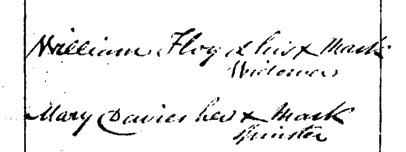 This
was accordingly forwarded to the Colonial Secretary's Office on 30 Dec.
and approved with the proviso that "the clergyman be satisfied of the death
of the former wife of man" (CON 52/2 p. 56). That said, it was often the
practice in the convict system (with some basis in law) to allow remarriage
if the convict had been in the colony for more than 7 years.
This
was accordingly forwarded to the Colonial Secretary's Office on 30 Dec.
and approved with the proviso that "the clergyman be satisfied of the death
of the former wife of man" (CON 52/2 p. 56). That said, it was often the
practice in the convict system (with some basis in law) to allow remarriage
if the convict had been in the colony for more than 7 years.
It has not been possible to trace
William's first wife or family in English parish registers or censuses.
It cannot have been easy for them and they may have ended up in the workhouse.
Whatever their fate, William was
married on 31 Jan 1842 to Mary Davis (ca. 1815-1887), at Longford Anglican
Church. Mary Davis/Davies (most documents use "Davis") was described in
the marriage register as a "free" spinster aged 27, but nothing is yet
known of her origins. Typically, the groom understated his age in the marriage
register - recorded as 39, we know William had just turned 44.
And so William's married life began.
We do not know exactly where the newly-married couple went and what they
did, and they may have had some children in this early period - victims
of miscarriage or infant mortality? - before their first recorded child
in 1846.
What we do know for sure is that
on 28 Dec 1843 the Lieutenant-Governor announced his intention to grant
a conditional pardon to William (The Courier (Hobart) 12 Jan 1844).
The final recommendation was recorded in the Home Office on 23 July 1844
((HO 10/58 folio 157), and in Tasmania the Colonial Secretary's Office
issued the conditional pardon on 8 Jan 1845 (Hobart Town Gazette
14 Jan 1845).
William was now a free man (subject
only to the prohibition on returning to Britain) , and let us for a moment
try to imagine his feelings as he received the news and shared it with
his wife, as he collected the document (which he could not read) from the
nearest Police Magistrate and then returned home, perhaps reflecting on
his old life and home in Bristol, his crimes and the completion of
his punishment for those crimes. As we might describe it in the 21st
century, this was the first day of the rest of his life!
A free man, skilled in a trade,
with a new wife - things take shape after 1845 as a stable family life.
William and Mary's first known child, William, was born on 17 Feb 1846,
and his birth registration confirms his father's livelihood as a stonemason
and is the earliest reference to their place of residence as Perth, the
town where they spent the rest of their lives. Over the period 1846-1864,
William and Mary had 9 children. In addition to William Jnr. (1846-96),
there was John Alfred (1848-95), Louisa (1850-1932), Charles (1852-1917),
Maryanne (1855-83 ), George (1857-58), George Richard (1859-69), Thomas
(1861-1912), and Jane (1864-97). Both children named George died young,
the first of dysentery at 7 months of age, the second by drowning at the
age of 10.
Like many of his fellow Tasmanians,
William made several voyages to Port Phillip. Police records list him as
a cabin passenger on the steamer Shamrock, departing Launceston
15 Feb. 1847 (POL459/2). He arrived on 18 Feb. (Port Phillip Herald
23 Feb 1847), and while we do not exactly when he returned it must have
been before mid-May when Mary fell pregnant. William was also an early
participant in the Gold Rush : on 12 December 1851, he left Launceston
on the steamer City of Melbourne (POL220/1), arriving at Melbourne
on 19 Dec. (Port Phillip Herald, 20 Dec 1851). Along with
his 125 companions in steerage - "all diggers" as the Port Phillip
Herald descibed them - he would have taken off for the goldfields.
On this occasion, his wife Mary was already 3 months pregnant so William
would not have spent more than a few months in Victoria.
Apart this brief adventure as a
gold miner, William is described as a builder, stonemason, and bricklayer
throughout this period - a busy area of work in a Tasmania with a
growing, free population.
On 6 March 1856 he bought a property
(2 roods 37 perches in size) in the Main Street, Perth, from Thomas Button
(Tas. Lands Office, memorial 5/5974 8 Jan 1869). As a property-owner he
was then qualified to vote for the Tasmanian Legislative Council
and is named in the 1856 electoral roll. The assessment rolls published
in the Hobart Town Gazette (for the purpose of municipal taxation)
record a house on the land and value it at £25 per annum.
There was always a family
tradition that their home was demolished during the construction of the
railway through Perth, and documentation has now been found to confirm
this.
The Tasmanian Lands Office records
William's sale of this property to the Launceston & Western Railway
Company on 7 January 1869, for £35 (memorial 5/5974 8 Jan 1869).
In addition, the location of the house & land are recorded in the original
survey drawn up in 1856 when a railway between Launceston and Deloraine
was proposed (National Archives of Australia (Hobart Office), P1331/2).
The document maps the section cutting through Perth (14 miles 10 chains
to 14 miles 62.4 chains from Launceston) and names the properties traversed
by the line, including owners W. Floyd, Mrs Duncan, Williams Trustees,
F. Martin, J. Clayton, C. Croome, J. Benjamin, J. Dyson, and D. Judd.
Political and economic factors delayed
the project for years and work on the railway did not begin until the ceremonial
first sod was turned at Launceston by the Duke of Edinburgh on 15 Jan 1868,
followed in August by the contractors' commencement of construction. Trains
finally ran all the way to Deloraine by late 1870 (with an official opening
on 10 Feb 1871).
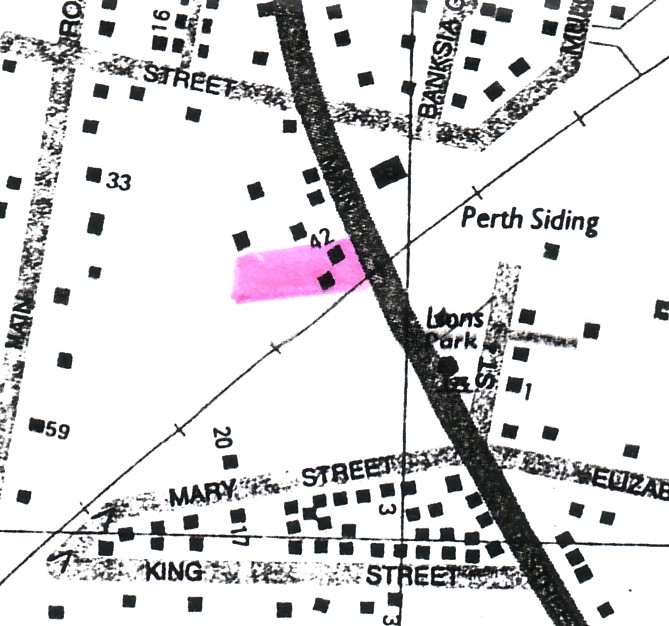 Comparison
of the 1856 survey and modern maps enables us to pinpoint the location
of William Floyd's first property (highlighted on present day map reproduced
here).
Comparison
of the 1856 survey and modern maps enables us to pinpoint the location
of William Floyd's first property (highlighted on present day map reproduced
here).
According to the assessment rolls,
William still occupied the earlier property in March 1867, but by Jan 1868
occupied and owned a new house on a 2 acre block, also in Main St, Perth
(valued at £14 p.a.). This property remained in Floyd hands until
1889 and was apparently sold in this year to Patrick Bolton ( Hobart
gazette 1 Jan 1889, 24 Dec 1889).
Unfortunately the documents concerning
the 1889 sale are not to be found in the Tasmanian Lands Office, so we
do not know the exact location of this property, nor do we know if William
Floyd's house still stands somewhere in the Main Street, Perth.
Thanks to William's obituary, we
know he worked on Perth Bridge, probably not during its original construction
in 1836-38, but we can quite comfortably accept that he was heavily involved
"when the same structure was undergoing extensive repairs a few years ago,
rendered necessary by injuries received from a very heavy flood."
This was in 1852, when 2 arches of the bridge were swept away, and reconstruction
began the following year. Thus Perth Bridge - as well as Campbell
Town's - should be considered a lasting legacy of our ancestor William
Floyd, were it not for the fact that a greater flood in 1929 completely
destroyed it, a terrible event captured in photographs as it happened (early
20th century view, 1929
just before collapse,
1929
after collapse).
Back on the home scene, by 1864,
William and Mary's children ranged in age from the newly-born Jane to the
18 year old William Jnr. Their father was aged 66 years and their mother
49 years, and no doubt their main task was continuing to raise their family.
These years saw several big family events. As mentioned above, tragedy
unexpectedly struck in the summer of 1869 with the death of their 10 year
old son George, reported in the Examiner (21 Dec 1869) and Mercury
(22 Dec 1869). On Monday morning (20 Dec), George and his 8 year old brother
Thomas were out chasing rabbits in Clayton's Paddock. It was a warm day,
so George took a dip in a flooded gravel pit. Finding it too shallow, he
went into another pool nearby and rapidly sank. Young Charles ran home
to fetch his mother - his father was away from home - who got the police,
and a rescue party went down to the pool. Alas, 45 minutes had elapsed,
and the child's lifeless body was recovered and taken home.
The other events were happier ones.
On Thursday, 20 Sept 1866, the family made a special visit to St Andrew's
Church, Perth, where William gave away his 16 year old daughter Louisa
in marriage to Edwin Weavell, and the following year, William acquired
his first Tasmanian grandchild, named William after him. Six years then
passed, during which time William and Mary saw another 2 grandchildren
born to Louisa and Edwin, and on 5 Sept 1872, they attended St Augustine's
Roman Catholic Church in Longford to witness the marriage of their eldest
son William, to Mary Sophia Matthews. The first child of this marriage
was Arthur William, born 1 June 1873. At about the same time, their daughter
Maryanne appears to have married Peter Crampton, labourer of Perth. The
marriage somehow missed out on being included in the civil records, but
we know about it from the recorded birth of their child Alfred, on 19 Sept
1873. Sadly, however, Peter must have died in the next few years, and while
his death has not been traced in civil records, we know Maryanne remarried
on 22 Sept 1876, at St Andrew's, Perth, to James Waddington, blacksmith
of nearby Cressy, and on the marriage certificate she is described as "domestic
servant, mother & widow".
All in all, the old William Floyd
saw 3 of his children married and was blessed with 6 grandchildren. On
3 Dec 1874, he turned 77, and it was his last birthday. We do not know
if he was ill, but when he died on Sunday, 29 Aug 1875, the cause was registered
as "decay of nature". On the following Wednesday, 1 Sept, he was buried
in St Andrew's Cemetery.
An obituary was published in the
Examiner
(31 Aug 1875). Headed "AN OCTOGENARIAN", his age is incorrectly given as
84 - perhaps the family's collective memory placed his birth ca 1790?
Most space is devoted to his work on the Campbell Town and Perth bridges,
and there is respectful reference to his status as a "very old colonist",
longtime resident of Perth, and family man. Many readers of the obituary
would have guessed his convict origins, but his life might be seen as an
exemplar of how the penal system could rehabilitate and reward those who
took up the opportunities offered to them.
Like many convicts, William would
have had a story to tell - of his crimes and punishments, his imprisonment
in the infamous hulks and his daring escape, the permanent exile from England
and challenge of adjusting to life in a penal colony on the other side
of the world, his struggle towards rehabilitation, and the ultimate reward
of a pardon and a life where he was again free to be his own master. One
cannot help wondering how much William thought about his past in England.
Did he reflect on the fate of his first wife and family? Did he wonder
where his English children and grandchildren were and what sort of people
they were?
William's widow, Mary, was now left
with 4 unmarried children at home, aged 11-27 years (with the possible
temporary addition of her widowed daughter Maryanne). The oldest, John
(Jack), went to the Emu Bay area for work and married 2 years after his
father's death to Ann Stubbs. The remaining sons Charles and Thomas married
in 1881 and 1884 respectively, and around this time Jane married William
Thomas Smith and moved to Evandale. Mary continued to live in the family
home in Perth - Wise's P.O. Directory for 1881 lists "Mrs Floyd, Main St"
in Perth. The assessment rolls confirm this up to 1882, but after this
date Mary is not listed as occupier of the property but only as the owner,
and it was leased to a succession of different tenants (William Horsburgh,
William Adams, and Joseph Lawson). "Mrs Floyd" is recorded as the owner
up to the assessment roll published on 10 Jan 1888 and the property is
described as belonging to "Floyd's estate" on 1 Jan 1889 (Hobart gazette)
so the property was retained for a while by her heirs.
Where did Mary go in the final years
of her life? She is not named as an occupier in the assessment rolls for
Perth or the District of Longford, but we know she died in the area, so
presumably she must have gone to live with a nearby relative or friend.
By 1884, all of her children had moved from Perth : William to George Town
& later Launceston ; John to far off Emu Bay ; Louisa to Launceston
; Charles to Launceston and later Beaconsfield ; Maryanne to nearby Cressy,
where she had died in June 1883 but where her widowed husband James Waddington
lived with their 3 children ; Jane to Evandale, also close by ; and Thomas
to Beaconsfield and later Sidmouth . One hopes at least that Mary got to
enjoy the company of her 28 or so grandchildren in these final years.
Towards the end, Mary developed cancer and on 15 Jan 1887 she died. Presmuably
she was buried with her husband.
Children
of William & Mary Floyd
© 2003