As I lay on my bed dreaming of tomorrow, the glowing firelight makes shadows that move like the people in my life.
I am Eddie Womick. I was born in 1801 and I've lived the twelve years of my life in Womick Hollow in the pole house built by my father, Edger Womick, for his bride Blue Bird. Blue Bird, my mother, is a daughter of the Bird Clan of the Christian Delaware Indians, a sweet, gentle woman who has, in her wisdom, taught me the ways of her people.
The new buds on the dogwood trees are swelling, the first signs of spring. Soon my father will join the "tallow wackers" on their summer trip to gather grease to sell down river. It's sale will provide the few supplies we will need through the cold of winter.
We live a wonderous life in Womick Hollow but I am a child alone with not even the companionship of our dog, Frosty, who, with his wolf-like ways, has little time for foolish boys. His job is to watch our home in its secluded valley; he never follows me and without his presence, I can make friends of the animals and birds.
I leave Womick Hollow only to visit the clan of my mother. The village nestles near a rippling creek at the mouth of a nearby hollow and I go there often to see my friend Robin Bird or Robin comes to my house in Womick Hollow. As we move along the trail, we take care to cover our tracks. We want no one to follow them to our home.
The creek that flows through Womick Hollow is the center of my world. It rises from a spring, ripples down the hollow past our vegetable plot and becomes a rapid brook as it falls in miniature water falls over the mossy rocks to drop into clear pools.
Spinning bubbles betray the presence of minnows and crawfish and I've developed a quick hand to catch them for use as bait on my thorn and flint chip hooks. We go to the flat holes of water along the edge of the corn field to fish for our table and we add to our food supplies by picking berries or digging roots along the banks of the brook.
How well I remember the morning I set out to explore the hollow above the spring! The area had been forbidden to me but my curiousity and greed for adventure was so great that, after breakfasting on a wild turkey egg (stolen from a nest on the hillside), I stashed some jerky in my pocket, took up my rock-tipped spear and began the journey.
Each rock, each pool, each tree beyond the spring was a new experience. I studied the runs to the water's edge to discover what animals used them; I followed the runs away from the water in search of animals' lairs. Along the rocks, I watched for copper heads and rattlers knowing that, if I found one, I should kill it as I'd done at home. Finally, I reached a level field clear of large trees but so tangled and thick with briars and brush that not even a dog could enter. Looking up the hillside, I could see the top of a huge and beckoning rock but the t hicket seemed to block my way. "Surely," I thought, "there is an animal run through these briars."
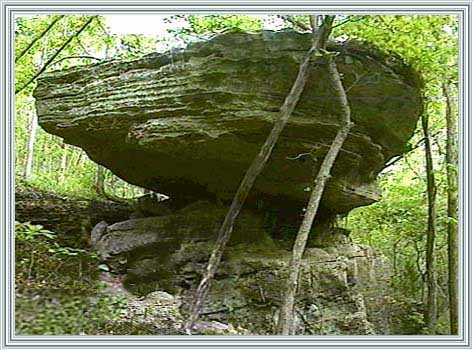
Carefully searching, I found a run that led directly to the base of the rock which proved to be as large and tall as our pole house. It balanced surprisingly, upon a much smaller rock which jutted up from the earth. Scrambling up a half-grown tree, I jumped to its flat top and snaked to the edge feeling it move under my weight and lay, indian style, watching the wild life that moved up and down the hollow. The sun passed its zenith but still I watched, entranced at the sight spread before me, until hunger finally urged me to eat my jerky and thirst forced me to leave the vantage spot in search of water.
Mother Blue Bird, I discovered, had known of the balancing rock and, though she scolded me for having disobeyed my father's orders, she promised that I could take Robin to the rock if we would agree not to wander beyond that place.
Through the long summer days, the rock was mine to share with Robin. To dedicate it as ours, we met there one morning as the sun rose to perform the ritual of brotherhood. Cutting our wrists to bring blood, we bound them together with a rawhide thong and so we remained, our blood mingling, until the day was done. "Here is my blood and here is my vow," we pledged one another, "Should you need my help, my life will be yours."
During that long day as we sat in the sun while things of the earth moved around us and the wind god made its music in the branches of the pines, we repeated the stories we had been told and listened and planned for the days when we should become great warriors. Finally after the sun had slid below the western ridge, we made our way homeward but we knew that, in the days to come, we would pass many wonderful hours together on the balancing rock.
The summer passed. With spring, Father went again with the tallow wackers and I felt the pull of the world around me. My mother, with patient understanding, allowed me to explore the hollow and along the hillsides.
One evening I worked my way to the top of the ridge, being careful, of course to leave no trail (I had been warned that raiding parties of the Osage were near and would like nothing better than to take me for trade to the savage clans of the West) and lay, carefully still, surveying the hollow before me. Suddenly, I glimpsed movement. Peering more carefully, I saw a tall, lean Indian brave stealing from rock to rock like a cat, seeming to shrink, crouch, then spring from the cover of one sheltered place to the next until he reached a point on the hillside above the balancing rock; there he seemed to vanish. For more than an hour I watched and just as I had given up hope of seeing him again, the Indian returned to view and left the area the same way he had come. He was carrying something.
I lay for a long time after the Indian had gone then, moving down the hillside till I stood before the place where he had disappeared, I inched slowly forward to discover, in the heart of the rock, a small, central hole, perhaps four foot square. The secret was plain: there was a cave so perfectly hidden that one could pass right by the site and see only a flat rock on a hillside. Its entrance could not be seen even from the highest tree.
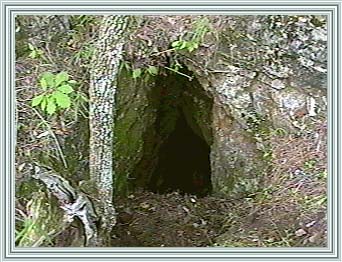
Anxious to explore this discovery, I searched for handholds within the tunnel opening but was disappointed to find none. "Tomorrow," I thought. "Tomorrow, I'll bring a ladder."
From early childhood, I had learned to weave the tall, strong grasses from along the edge of the brook into rough rope so it was no problem to weave a rope ladder for lowering myself into the cave. Thus, with the morning sun, two candles, my flint and steel and some jerky in my pockets and the rope on my shoulder, I set off to explore the cave. Though I knew that, for the first time in my life, I would be in real danger, I told no one of my plans.
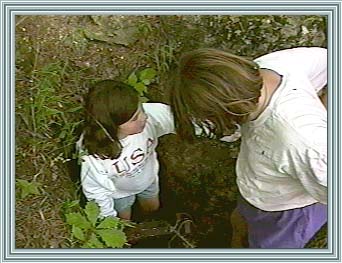
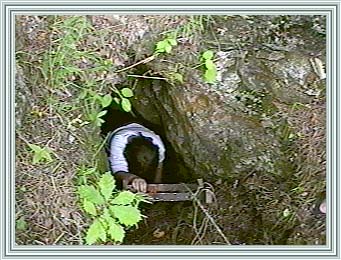
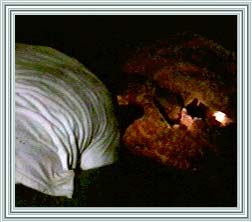
At the cave, I secured my rope, lowered myself down the twelve foot shaft and proceeded at once to build a small fire to serve as a beacon to the opening. Accomplishing this, I turned toward the tunnel leading into the hill but was arrested by the sound of my ladder being pulled up from above. Fear made me tremble. How could anyone ever find me?
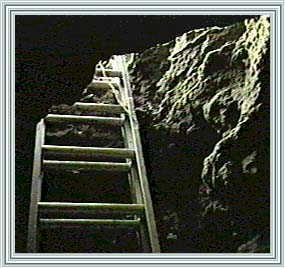
For a long time I watched the opening; finally an Indian face marred by a long, red scar appeared. The scar twitched. It was a fendish face.
Timidly, I asked him to let my rope down to me.
"You will ask no questions?" he grunted. "You will never return to this place? You will never tell of it?"
"I will never," I promised quickly.
"Will you pledge on your god?"
"Yes, I vow by my god."
The man lowered the rope; I clammered up. Roughly grasping my hand, the Indian looked long and carefully at it and what he saw seemed to please him. His eyes softened and his grasp, though still firm, gentled. In a strange language, he muttered gutteral words to make my flesh creep, took from a pouch a pinch of black to make a mark on my forehead and a pinch of white to make the mark into a cross then he said, "So signs your pledge. If you betray it, by your god, you will die."
With a grave face, the Indian left me and I returned home, happy to be free.
What is in the cave? That is the secret of Womick Hollow and I will be a man before I try to learn the answer.