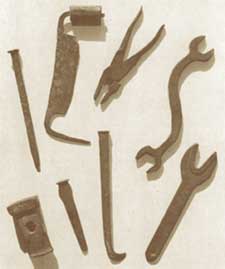
 Tools cast from shot iron picked up in the Jacks Fork River
With the formation of counties, law came to the Upper Current and Eleven Point Rivers. The settler, freed from the fear of the sky's red glare (the result of the torch and the tomahawk), took in his hands the axe and started clearing land for farms and permanent homes.
From beyond the, blue grass country of Kentucky; from beyond the fertile valleys of the Tennessee and Ohio Rivers; over the Mississippi River and through the Lower Riverways, then into the valleys of the Upper Riverways the settlers moved in a continuing stream.
There seems to be a general idea that these early settlers rode in wagons. This was far from the truth as few roads were improved enough to allow wagon travel as it is thought of today. Most settlers walked and often carried their belongings. If they had a horse, oxen, or cow they were used for pack animals. A few narrow four wheeled wagons were used but most were two wheeled carts, sleds, or slips. The start to the new home was made in the spring so the summer months were available to prepare for the winter.
The establishment of the Seat of justice brought the Courts, a Sheriff and a Recorder to record the land titles and ownership of property.
The Congress of the United States had established land as the basis for political rights by an ordinance of 1787. To vote for a representative a man must have owned 50 acres but to hold the office he must have owned 200 acres. To hold governor he must have owned 1,000 acres. The counties were organized along the lines of the Federal Government so the settlers found if they wanted a say in the government, they would have to record their land and pay taxes.
The slaveholders who had built fine farms along the Ohio and other Northern areas found that they were not liked by many of their neighbors who had fled to this country to escape oppression. The slaveholder could sell his farm and move to Missouri with his slaves and buy cheap land. Dependency on each other made the family of the slaveholder and his slaves close. They worked side by side to make the land productive because in that way each had food, shelter and clothing.
Many of the emigrants from European Countries, as well as second-generation emigrants, who had retained their family alliance, found their way to the area. The Germans and Swedes were good farmers, but while the Germans wanted a house of stone the Swedes were content with his soddie. With all European nationalities, the cow was popular for milk, butter and cheese. Soon settlers who had depended upon meat accepted the cow as a necessity for the family.
Up to this time most supplies were hauled or packed from ports on the Black River. The great epidemics that swept the ports aroused such fear among the people that they ceased going to the ports. The yellow fever hit in years 1828-1829 and the Asiatic Cholera hit in June, 1832. Many families who survived fled upriver and the supply routes were allowed to grow up. Most trade switched to the Lead Mine Trail and the Old Virginia Warriors Path.
The settlers came in ever increasing numbers to the Upper Riverways. From Missouri statehood till 1840, settlers were mainly 1st and 2nd generations. Kentucky settlers who came from the high strung Virginia Cavaliers and the solid Tennessee settlers of Carolina stock. To them, slavery was the way of life they had always known. Those who brought slaves with them; brought from one to three families. The slaves were accepting in their new location, as there was little chance of their being traded outside the family; also, in hewing out a new home for the master, they provided security for themselves.
Most of the land was open for claim and the price of patent per acre was the same regardless of the location. In making this important decision depended the future security of the family. If the location chosen had good soil, plentiful water, and there was other land close by others would settle and soon a community would be established. After the selection of the land came the location of the house. The location should be close to a water supply, near an. easily cleared area and in an area protected from the elements if possible. The first house was usually a lean-to, called an open-faced house. This was the most that could be expected along with clearing and planting enough for the first winter.
The cleared area required some kind of fence, The easiest to construct, was a brush fence and usually the first. This was often replaced by a pole or worn fence. The first plow was made' from a knotty Dogwood or Hickory and latter shod With an iron point when this was available.
No matter how humble the home, it soon became a small factory. With few tools brought with them the settlers had to produce the necessities of life from what was available. After the house was constructed nature was called upon to produce the wood poles, tree bark, and vines that was made into furniture.
Blocks were cut from round logs and hollowed out to make bowls. Longer blocks were cut then split into staves to fabricate buckets and barrels that could be banded together with tree bark or vines. These were needed to carry water and store foods. Spoons and forks coul1d be shaped from the splinters. Hides were tanned to make leather for shoes and clothing.
Few places in the Upper Riverways did not have available nearly pure iron in the form of shot iron that could be smelted in clay furnaces and then hammered into square spikes, nails, hinges, and crude tools.
Tools cast from shot iron picked up in the Jacks Fork River