The reason for the trip was that my mother had died and my father could work longer hours after my school was out if I stayed with my Aunt Maggie and Uncle Gus Springer of Mountain View.
|
As I drive toward Mountain View, Missouri, on Highway 17
and look across Buck Hollow, I see the riverlet flowing over
rocks and flowing down the old wagon road. The budding
dogwood bring back memories of a springtime trip I made
fifty-five years ago between Summersville and Mountain View
with the freight haulers. As I pass the old wagon
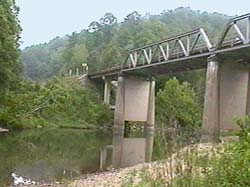
crossing of Jacks Fork at the mouth of Buck Hollow I see the
barefoot boy and a freight wagon dog following one of the
freight wagons. The reason for the trip was that my mother had died and my father could work longer hours after my school was out if I stayed with my Aunt Maggie and Uncle Gus Springer of Mountain View. |
The two main freight haulers lived close to us in Summersville. They made two trips weekly to haul the farm products to the rail station at Mountain View and return with merchanise for the merchants of Summersville. Pete Tuttle hauled for Jim McKaskill by the Buckson store at Oakside and Newt Van Pelt hauled by the Richards Store at Oakside. My father arranged for me to make the first trip over with Pete Tuttle. The night before I was all thoughts of steep hills, steam engines and clear blue water of Jacks Fork River. So I took to bed with the white flour sack that held my clothing for the summer--all packed and secure with my two quarters that my grandmother had given me for spending money. I was sure I would be awake but shortly after day break I heard Pete in front of the house with his two teams and freighters dog that was never far from the teams. We went to the Jim McKaskill store and Pete opened the basement door and hooked one team to the wagon that had been loaded the day before, the other team he tied to the rear of the wagon.
I crawled upon the wagon canvas and continued my sleep and when I woke at the Spring Valley Crossing, Pete was hooking up the extra team to the front. We were soon up the hill and to the edge of Beel Flat, here the ruts were deep and water stood along the road. The rocks piled in the mud holes made the wagon ride rough so I removed my shoes and joined the dog following the wagon.
Our next step was to change and water the teams. It was
under a large white oak tree on the S.J. Friend place. I was
hungry and he gave me molasses cookies but they made me
regret that I and the other boys in town called him deaf
dick. Near noontime, we pulled up to the store at Oakside
run by Judge Buckson and his daughter, Dora. I bought some
fig bars as they provided a lot of solid eating for my
money. The road turned west and we passed between the Jack
Richards house and the Richards store. At the Ball place,
the road junctioned with the new road that went over the
iron bridge at Jacks Fork River, but the freight haulers
used the old Buck Hollow road as there was a long hill below
the Davis place and a number of short steep hills on the
new road. The Buck Hollow road took us through about a mile
of pine timber where later the Pine Crest Community was
built and where we retired to build our home about three
hundred feet north of the old road. The pine needles in the
ruts made the wagon ride softly and I could watch the
squirrels run in the trees. We turned south down the hollow
and soon the woods were dressed with the blooms of dogwood,
red bud and service berry, also the ground was a carpet of
blue bells with lavender, yellow, white and dogtooth violets
intermixed.
| From the rock ledges hung colombine. Water oozed from the ruts under the weight of the teams. The wagon tires had wore smooth the rocky floor of the hollow so there was little noise and we could hear the travel on the other road above us. We stopped at the Buck Hollow Spring to water the horses and fill the water jugs. The water flowed along the wagon ruts and over the smooth rocky floor and I decided to walk in the water. By the time we reached the crossing of Jacks Fork River at the mouth of Buck Hollow, my feet were so cold I was glad to crawl back into the wagon and ride across the river. | 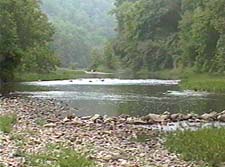 |
 | Pete hooked up both
teams to pull the south hill, he also loaded on the wagon
two poles--one about 10 ft. long to go between the rear
wheels and one about 20 ft. long to fasten under the
coupling pole as brakes down the hill on the return
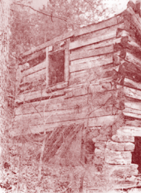
trip. Near the top of the hill we passed a log cabin by the side of the road. I didn't know who lived there. Before the sun went down we stopped at the Blaizer pond where we would spend the night. The freight haulers had built open faced shelters for the teams from poles and covered them with brush. They had also built gates and feed boxes so they could remove the harness from the teams. |
| A fire was built between some rocks that was along the side of the wagon and water for washing and for coffee was brought from the pond over a board walk built over the clear water. The freighters wanted the pond water to boil for coffee as they did not like the lime water from the springs. |  |
After supper the bed was made under the freight wagon and my day ended as I was too tired to listen to the sounds of the night. The morning came with the smell of side meat cooking over the open fire. One team was hooked to the wagon and ready to go. I was told to wash and eat. This was an invitation to a meal long remembered of meat, eggs, biscuits and coffee. It was about four miles to Mountain View and we entered the old section from the north and went along side the railroad tracks to the depot where I found my Uncle Gus waiting at the freight house.