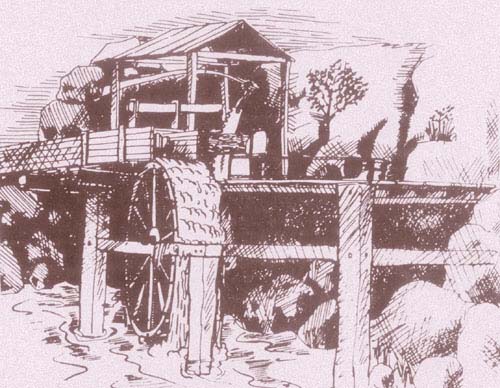
The Stoops Mill located on Upper Jacks Fork. Drawn from eye witness records and timbers at the site.
The earliest Mills to be constructed on the Upper Riverways were grist mills built to grind flour from grain by harnessing the abundant water supply of the high springs. The first mills were community owned and operated but because their maintenance required men skilled in mill construction including the building and installation of wooden shafts and gears to harness the water power they were eventually put under the jurisdiction of millers (sometimes called "millrights").
The mill flume was made from split boards which directed the water over an overshot wheel. The weight of the water then turned the wheel to supply the power to turn a burr. Sandstone for the burrs was available in abundance but their construction took long hours. A stone properly hardened by long exposure to the sun and clear of any fault that might cause it to crack in shaping was required. The top burr had a square hole in the center into which a revolving wooden shaft was fitted; as the burr revolved, it ground against a second, stationary burr. A groove or channel was cut (and restored as it wore) by a pecking tool to the proper size and depth along the side of each burr to channel the grain. The groove was larger where the grain was fed in and so placed and sized that, as the grain progressed, the hull was rejected and the cracked grain was moved onward into the narrowing groove untill the particles were ground into flour which, along with the unground parts of the grain, then fell into a sifter to be divided.
The mill was often the site of a distillary because here the excess grain could be converted most easily into alcohol. The alcohol, of course, was much easier than grain to transport.
The miller seldom received cash for his labor. Most often he maintained a store at the mill location and, in payment for milling, he took a toll from products sold at the store. The standard toll in those days for grinding and sifting was 5 to 1 and for the hulls, siftings and stock feed was 8 to 1.
Until well after the Civil War, the grist mill was the center of the community. Roads led close by and often a river crossing was established below the mill.
The mills most closely serving the Mountain View region included the Stoops Mill constructed in 1851 as a sawmill, converted to a grist mill in 1876 and located 4 miles north of Mountain View, The McCubbins Grist Mill 5 miles north on Jacks Fork and the Meadors Mill 5 miles northwest on Jacks Fork.
Other Upper Riverways Mills included 2 grist mills and 3 sawmills owned by a Mr. Nicholls located along Rocky Creek; Mahans Mill (first a sawmill then changed to a grist mill in 1880); Olds Mill built at Greens on Eleven Point River in 1850 by Thomas Old; William Kell Mill on Big Creek; Starr Mill; Montauk, on the Current River, operated by Schaefer and Blackwell; and the Watson Mills at Pulltight and Round Springs.
