|
 |
|
|
The most logical record of the origin of the Indian clans and linguistic stocks that occupied the Riverways at different periods can be found in study of historians - Adair, Vanegas and Heckwelder, translation of pictographs that record the Indian's own story of his origin - as in Brintor' translation of the Delaware pictographs called the' "Walam Olum or Red Score."
The early history of the Riverways was largely of the resident Indians; Caddoes, Osage and mixed blood clans that had their origin in the near destruction of the Caddoian culture.
Some of the overhanging bluffs and cave walls located in the Riverways have pictographs but little study have been made of them. The common translations of other Mississippi Valley pictographs show a common story of Indian origin: "that men who lived long, long, ago, came long, long ago from the north."
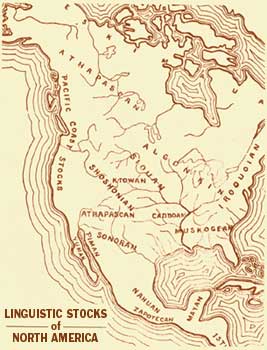
After crossing from the Asian continent, the North American of Mongoloid stock moved south from his bridgehead like a stream. The flow moved through the north plains and southward like a fan. As each stock moved into a better habitat, they acquired less barbarous ways. Some remained nomads and wandering hunters but the tribes that became more numerous built villages and became farmers and craftsmen as well as hunters. They, like Asian and European people, were forced to move to other areas by tribes of their own stock who remained more barbarous and warlike.
The first great movement of the North Americans was through the plains east of the Rocky Mountains of the present day state of Kansas. It then split with the Ute-Aztec tribes turning toward the southwest and forming the Aztec, Toltec and many other tribes. The Chata-Muskoki turned to the southeast and formed the numerous tribes of Creek, Choctaw, Chickasaw and Seminoles in the present states of Mississippi, Alabama, Georgia and Florida.
Clans from this movement that were more domestic and less restless remained in the eastern part of present states of Kansas and Oklahoma. They later spread eastward to the Mississippi River to form the Caddoian linguistic stock. From this linguistic stock the Wichita, Pawnee and Caddoe tribes were formed.
There are in addition to the language three living habits that all the tribes of the Caddoian stock had in common. First they cultivated the wild sunflower that is native to the plains and uplands which has a tuberous root that can be dug from August to May (It has the best flavor when dug while frozen). Early settlers called it the Indian Potato. It can be eaten raw, boiled, baked or made into a paste, allowed to ferment and then baked as bread. The Indian name was Kanapernut; the present name is Jerusalem Artichoke and is grown extensively in Europe and Mideastern countries. It was spread by the French in the seventeen hundreds and is pure Insulin. They built round sod houses and repaired them by the addition of more grass and sod. They buried their dead in the clan enclosure, which caused mounds to form where they built their villages. Some large mounds were formed where villages existed for long periods.
The hunter, to kill the buffaloes of the grasslands adjacent to the wooded areas along the waterways, developed the throw stick. The stick was three or four feet in length with a fork at one end so a spear with a notched shaft could be balanced on the throw stick and weighted with banner stones to balance the notched stone tip. These weapons allowed the hunter to approach from the rear of the buffalo and sprint to a position close enough to penetrate through the unprotected flank. The spear could be thrown with one arm and from a running position. After the Indian acquired the horse from the Spanish, it was simple to ride up to the flank of the buffalo and shoot an arrow into its vital parts.
The Riverways area was used at various times by wandering clans of Caddoian stock. The caves and overhanging bluffs made ideal habitat for winter camps. The artifacts of early Caddoe are to be found about two feet deep in the residue at the mouth of caves and under bluffs.
As the clans turned more to farming, they cultivated the bench lands adjacent to the upland springs. Later some villages were established on the open grasslands around natural ponds that had formed in some of the sinkholes. Where later farming has not destroyed the remains of their villages, the artifacts can be found about one foot deep. As the clans increased they became the Caddoe Tribe Caddoian stock. They remained allied to their linguistic stock, the Wichita and Pawnee Tribes. They built the same roundhouses with grass roofs but used upright wood poles in the ground for their walls and enclosures instead of sod.