Page 3
Regional & Site Specific Information
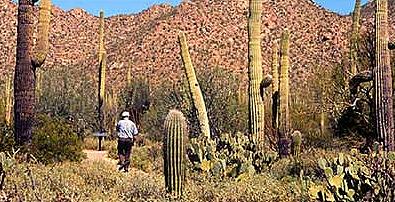
This is the hottest of our North American deserts, but a distinctly bimodal rainfall pattern produces a high biological diversity. Winter storms from the Pacific nourish many West Coast annuals such as poppies and lupines, while well-developed summer monsoons host both annuals and woody plants originating from the south. Freezing conditions can be expected for a few nights in winter.
Trees are usually well developed on the desert ranges and their bajadas. Often abundant on these well-drained soils are Little-leaf Palo Verdes, Desert Ironwoods, Catclaw and Saguaro.
The understory consists of three, four or even five layers of smaller woody shrubs. Tall chollas may occur in an almost bewildering array of species. The alluvial lowlands host communities of Desert Saltbush, wolfberry and bursage. On coarser soils, Creosote Bush and bursage communities may stretch for miles. Where the water table is high, Honey or Velvet Mesquite may form dense bosques or woodlands.
Other species are restricted to alkaline areas. Stream sides may be lined with riparian woodlands composed of Arizona Ash, Arizona Black Walnut, Fremont Cottonwood and various willows, with a dense understory of Arrow-weed, Seepwillow and Carrizo. The Sonora Desert is rich in animal life as well, with many species in all groups derived from tropical and subtropical regions.
The western part of the Sonora Desert (sometimes called the "Colorado Desert") is closer to the source of Pacific storms and is noted for spectacular spring flowering of ephemerals when there is winter-spring rainfall. (This phenomenon is not limited to here.) However, the western portion is relatively depauperate, lacking many of the species such as the Saguaro that depend on good summer rainfall.
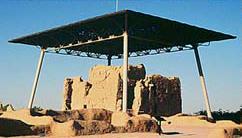
The early groups of these people cremated their dead, buried the ashes and any remaining bones in urns and pits in the ground and sacrificed the possessions of the deceased. Later, they began to bury some bodies in the ground. By the time the first Europeans arrived in this area, the Hohokam were gone and all that remained were ruins such as the Great House found at Casa Grande National Monument.
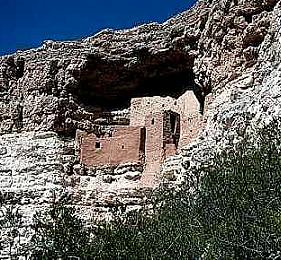
Nestled into a limestone recess high above the flood plain of Beaver Creek in the Verde Valley stands one of the best preserved prehistoric ruins in North America. The 5-story, 20-room cliff dwelling found at the 858 acre Montezuma Castle National Monument served as a "highrise apartment building" for prehistoric Sinagua Indians over 600 years ago. Early settlers to the area assumed that the imposing structure was connected to the Aztec emperor Montezuma, but the castle was abandoned almost a century before Montezuma was born.
Ancient Farmers of the Verde Valley
These parks preserve remnants of two distinctive cultures that once flourished in the Verde Valley. The first permanent settlers here were the Hohokam (Pima for "those who have gone"). They were a skillful farming people who moved into the valley shortly after A.D. 600. They grew crops of corn, beans, squash, and cotton and watered them by irrigation. They lived in one-room houses made of poles, sticks, and mud, which they built on terraces overlooking their fields in the bottomlands.
Another people also lived in this general area. They were the Sinagua (Spanish for "without water"), who inhabited the nearby foothills and the plateau beyond the valley. The Sinagua were pithouse dwellers and dry farmers, dependent on rain for their crops. They moved down into the valley about 1125, occupying land vacated by some of the Hohokam who migrated north to lands made fertile by the ashfall from the eruptions of Sunset Crater in the mid-1060s. The move altered Sinagua culture in two important ways: they adopted the irrigation system of the Hohokam, and they began to build above ground masonry dwellings, an idea they may have borrowed from the Anasazi to the north.
About 1150 the Sinagua began building their large pueblos, often on hilltops or in cliffs. This was a time of concentration in the valley center, probably in response to drought and ensuing strife. The villages at Montezuma and Tuzigoot reached their present size in the 1300s and were occupied for another century. In the early 1400s. the Sinagua abandoned the entire valley. No one can say why: perhaps too much pressure on the land, perhaps conflict with the Yavapai, who were living here when the Spanish entered the valley in 1583. Whatever the reason or reasons, the survivors were probably absorbed into pueblos to the north.
Daily Life
The Sinagua of the Verde Valley were peaceful village dwellers. They lived principally by farming but supplemented their staple crops by hunting and gathering. Far from austere, their surroundings supplied them with more than the essentials of life. There was abundant water in the central valley, fertile land in the bottoms, and sufficient game--including deer, antelope, rabbit, bear, muskrat, turtle, and duck-to augment a diet that leaned heavily on corn. The Indians here were comparatively well off in the important commodity of salt. There was a deposit a few miles from the present town of Camp Verde, and evidences of mining there by the Sinagua are vivid.
The Sinagua were fine artisans. They made stone tools of the usual variety: axes, knives, hammers, and manes and metates for grinding corn. They turned bone into awls and needles, wove handsome garments of cotton, and fashioned ornaments out of shells, turquoise, and a local red stone for personal decoration.
Pottery was not a craft at which this people excelled. They mostly turned out a reddish-brown plain ware in many sizes, which was probably used for cooking and storage. The decorated ware found here in great quantities was traded in from neighbors to the north and east.
The Sinagua were obviously daring builders, if not as skillful with masonry as their Anasazi contemporaries. The quality of the local rock may have had something to do with this. It is fairly soft and of a type that splits unevenly. Walls at Tuzigoot are massive but poorly balanced. Yet Montezuma Castle, which admittedly is well protected, was so securely built that it has stood for over 600 years and is one of the best preserved prehistoric structures in the Southwest.
Sights
Montezuma Castle
Sinagua farmers began building this five story, 20-room dwelling early in the 12th century. It stands in a cliff recess a hundred feet above the valley. Early settlers marveled at the structure and thought mistakenly that it was Aztecan in origin. A short distance west is Castle A, once an imposing six-story apartment with about 45 rooms, now a badly deteriorated ruin. This dwelling was built against the base of the cliff. The Sinaguans probably thought this was a good place to live. The creek was a reliable source of water, and there was fertile land on the nearby terrace.
Montezuma Well
Montezuma Well has all the surprise of a lake and fairly lush vegetation in the midst of desert. The well is a limestone sink formed long ago by the collapse of an immense underground cavern. The springs that feed it flow continuously. Both the Hohokam and Sinagua irrigated crops with its waters. Traces of their irrigation ditches, thickly coated with lime, can be seen. The Hohokam pithouse on view was built about 1100. The Sinaguan dwellings here vary in size from large pueblos of 55 rooms to one-room houses. Between 1125 and 1400 about 150 to 200 Sinaguans lived here.
Tuzigoot
Tuzigoot (Apache for "crooked water") is the remnant of a Sinaguan village built between 1125 and 1400. It crowns the summit of a long ridge that rises 120 feet above the Verde Valley. The original pueblo was two stories high in places and had 77 ground-floor rooms. There were few exterior doors; entry was by way of ladders through openings in the roofs. The village began as a small cluster of rooms that were inhabited by about 50 persons for a hundred years. In the 1 200s the population doubled and doubled again as refugee farmers, fleeing drought in outlying areas, settled here.
http://www.gorp.com/gorp/resource/US_nm/az_mont.htm