


or return to the INDEX
Aluminium (Al)
Antimony (Sb)
Barium (Ba)
Bismuth (Bi)
Cadnium (Cd)
Calcium (Ca)
Carbon (C)
Chromium (Cr)
Cobalt (Co)
Copper (Cu)
Gold (Au)
Iron (Fe)
Lead (Pb)
Magnesium (Mg)
Manganese (Mn)
Molybdenum (Mo)
Nickle (Ni)
Platnum (Pt)
Radium (Ra)
Silicon (Si)
Silver (Ag)
Tin (Sn)
Titanium (Ti)
Uranium (U)
Zinc (Zn)
Zirconium (Zr)
or return to the INDEX
Highest Mountains:
Everest- (Himalayas) 8842.1m
K2- (Karakoram) 8612.8m
Kinghinjinga- (Himalayas) 8581.1m
Largest Lakes
Caspian Sea- 371,795 Sq. Km
Superior- 82,414 Sq. Km
Victoria Nyanza- 69,485 Sq. Km
Aral Sea- 65,527 Sq. Km
Huron- 59,596 Sq. Km
Longest Rivers:
Nile- 6651 Kms
Amazon- 6264 Kms
Mississippi-Missouri-Redrock- 6176 Kms
Yenisey-Selenga- 5904 Kms
Deepest Ocean
Pacific- Mariara Trench, 11,036m
Atlantic- Porto Rico Trench, 8,384m
Indian- Diamantina, 8,049m
Arctic- -- 5,442m
- The average ocean depth exceeds 3,659m.
or return to the INDEX
The only natural satellite of Earth, it displays only 59% of its surface to a terrestrial observer. This is due to the period of axial rotation being equal to that of orbit, a "captured rotation".
The hidden side was first scanned by the Russian sattellite Lunik III in October 1959.

or return to the INDEX
|
. = dot |
- = dash |
||
|
A . - |
J . - - - |
S . . . |
1 . - - - - |
|
B - . . . |
K - - |
T - |
2 . . - - - |
|
C - . - . |
L . - . . |
U . . - |
3 . . . - - |
|
D - . . |
M - - |
V . . . - |
4 . . . . - |
|
E . |
N - . |
W . - - |
5 . . . . . |
|
F . . - . |
O - - - |
X - . . - |
6 - . . . . |
|
G - - . |
P . - - . |
Y - . - - |
7 - - . . . |
|
H . . . . |
Q - - . - |
Z - - . . |
8 - - - . . |
|
I . . |
R . - . |
9 - - - - |
|
|
0 - - - - - |
or return to the INDEX
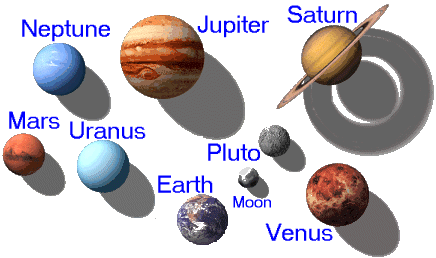
Distance from Sun (millions of kilometres)- 57.6
Diameter (km.)- 4,800
Time in days to orbit Sun- 88

Distance from Sun (millions of kilometres)- 107.5
Diameter (km.)- 12.240
Time in days to orbit Sun- 225

Distance from Sun (millions of kilometres)- 148.6
Diameter (km.)- 12,680
Time in days to orbit Sun- 3651/4
Polar diameter- 12,638 km; Equatorial diameter- 12,681 km

Distance from Sun (millions of kilometres)- 226.4
Diameter (km.)- 6,720
Time in days to orbit Sun- 687

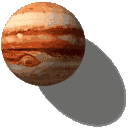
Distance from Sun (millions of kilometres)- 773.3
Diameter (km.)- 141,920
Time in days to orbit Sun- 4,333
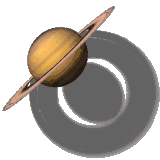
Distance from Sun (millions of kilometres)- 1417.8
Diameter (km.)- 120,000
Time in days to orbit Sun- 10,759
Distance from Sun (millions of kilometres)- 2852.5
Diameter (km.)- 49,440
Time in days to orbit Sun- 30,687

Distance from Sun (millions of kilometres)- 4469.6
Diameter (km.)- 52,800
Time in days to orbit Sun- 60,127

Distance from Sun (millions of kilometres)- 5865.6
Diameter (km.)- 6400
Time in days to orbit Sun- 90,400

or return to the INDEX
- I- One
- V- Five
- X- Ten
- L- Fifty
- C- One Hundred
- D- Five Hundred
- M- One Thousand
All other numbers are composed of repetitions or combinations of these basic characters.
When a character is followed by one of lesser or equal value, the values are added.
When a character is preceded by one of a lesser value, the smaller is subtracted from the larger.
Eg.
- IV- 4
- XII- 12
- XLIV- 44
- CCCLXXIX- 379
- MCDX- 1410
- MCMLXVIII- 1968
or return to the INDEX
Aft: Towards the stern
Athwartships: Across the ship
Avast: Hold fast
Beam: Width of a ship at widest point
Bows: The rounded fore-end of a ship
Draught: The height of the waterline above the lowest point of a ship
Forecastle (foc'sle): The for end of the upper deck between the bows
Fore and Aft: relative to the ends of the ship
Forward: towards the bows
Hove to: remaining stationary, to avoid damage
Knot: One nautical mile an hour
Port: left; to the left
Starboard: right; to the right
Stem: the extreme end of the fore part of the ship
Stern: the extreme end of the after part of the ship
or return to the INDEX
Afternoon Watch from noon to 4 p.m.
First Dog Watch from 4 to 6 p.m.
Last Dog Watch from 6 to 8 p.m.
First Watch from 8 to midnight
Middle Watch from midnight to 4 a.m.
Morning Watch from 4 to 8 a.m.
Forenoon Watch from 8 to noon.
or return to the INDEX
Light passing through a prism may be divided up into different colours.
This is due to the slight differences in refraction of each wavelength, or band of colour. The shortest visible light is violet, while the longest is red.
The commonly known colours of the rainbow as the effect is naturally observed are:
red, orange, yellow, green, blue, indigo and violet.
Another way to remember this is to think of the name ROY G. BIV, which represent first letters of each colour.
In reality there is a spectrum of colours that are conveniently classed by these common groupings.

TAKE ME BACK TO MICK'S HOMEPAGE


Return to the TOP here