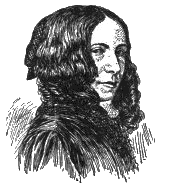
Elizebeth Barret Browning
1806 - 1862

Elizabeth Moulton-Barrett was born March 6, 1806 in Durham, England. Her father, Edward Moulton-Barrett, made most
of his considerable fortune from Jamaican sugar plantations, and in 1809 he bought Hope End, a picturesque 500-acre
estate. Elizabeth lived a privileged childhood, riding her pony around the grounds, visiting other families in the
neighborhood, and arranging family theatrical productions with her eleven brothers and sisters. Although frail, she
apparently had no health problems until 1821, when Dr. Coker prescribed opium for a nervous disorder.
An accomplished child, Elizabeth had read a number of Shakesperian plays, parts of Pope's Homeric translations,
passages from Paradise Lost, and the histories of England, Greece, and Rome before the age of ten. Barrett was
self-taught in almost every respect and during her teen years she went through the principle Greek and Latin authors,
along with Dante's Inferno - all texts in the original languages. Her voracious appetite for knowledge compelled her to
learn enough Hebrew to read the Old Testament from beginning to end. Her enjoyment of the works and subject matter
of Paine, Voltaire, Rousseau and Wollstonecraft was later expressed by her own concern for human rights in her own
letters and poems. By the age of twelve she had written an "epic" poem consisting of four books of rhyming couplets.
Barrett later refered to her first literary attempt as, "Pope's Homer done over again, or rather undone."
In 1838, The Seraphim and Other Poems appeared, the first volume of Elizabeth's mature poetry to appear under her
own name. That same year her health forced her to move to Torquay, on the Devonshire coast. Her favorite brother
Edward went along with her; his death by drowning later that year was a blow which prostrated her for months and from
which she never fully recovered.
When she returned home, she became an invalid and a recluse, spending most of the next five years in her bedroom,
seeing only one or two people other than her immediate family.
One of those people was John Kenyon, a wealthy and convivial friend of the arts. Her 1844 Poems made her one of the
most popular writers in the land, and inspired Robert Browning to write her, telling her how much he loved her poems.
Kenyon arranged for Browning to come see her in May 1845, and so began one of the most famous courtships in
literature. Six years his elder and an invalid, she could not believe that the vigorous and worldly Browning really loved
her as much as he professed to, and her doubts are expressed in the Sonnets from the Portuguese which she wrote over
the next two years. Love conquered all, however, and Browning imitated his hero Shelley by spiriting his beloved off to
Italy in August 1846. Since they were proper Victorians, however, they got married a week beforehand.
In 1849, they had a son, Robert Wiedeman Barrett Browning.
At her husband's insistence, the second edition of her Poems included her love sonnets, and this helped increase her
popularity and the high critical regard in which the Victorians held their favorite poetress. (On Wordsworth's death in that
same year, she was seriously considered for the Laureateship, which went to Tennyson.)
1857 saw the publication of the verse-novel Aurora Leigh, which today attracts more attention than the rest of her poetry.
It is still unclear what sort of affliction Elizabeth Barrett Browning had, although medical and literary scholars have
enjoyed speculating. Whatever it was, the opium which was repeatedly prescribed probably made it worse; and
Browning almost certainly lengthened her life by taking her south and by his solicitous attention. She died in his arms
on June 29, 1862.
Biography by Glenn Everett, Associate Professor of English, University of Tennessee at Martin, and Jason B. Isaacs
�


 Webpage Set Provided By
Shari's Designs