
| Habitat | Diet | Physical Characteristics | Behavior | Reproduction |
|
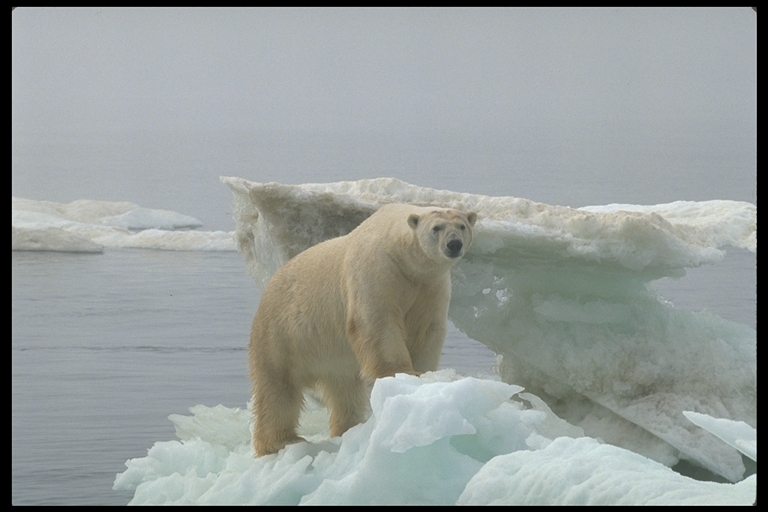
Polar bears live along shores on the areas of Alaska, Canada, Greenland, Norway, and Russia. When sea ice forms over the ocean in cold weather, many polar bears, except pregnant females, head out onto the ice to hunt seals. Polar bears have been spotted on sea ice hundreds of miles from shore. When the warm weather causes the ice to melt, polar bears move back toward shore.Polar bears, or their tracks, have been reported almost as far north as the pole; however, scientists believe few bears travel to areas as far as 88° north latitude. | 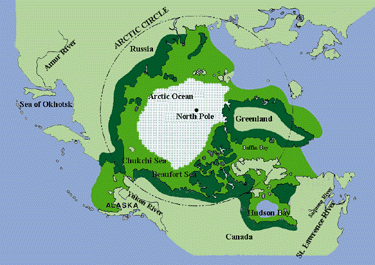 |
|
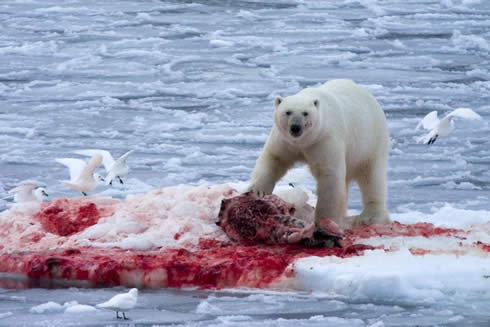
Polar bears feed mainly on ringed and bearded seals. Depending upon their location, they also eat harp and hooded seals and scavenge on carcasses of beluga whales, walruses, narwhals, and bowhead whales. A polar bear's stomach can hold an estimated 15% to 20% of its body weight. A polar bear generally eats this much only when its energy demands are high. A bear can assimilate 84% of the protein and 97% of the fat it eats.When other food is unavailable, polar bears eat reindeer, small rodents, seabirds, waterfowl, fish, eggs, vegetation (including kelp), berries, and human garbage. |
 |
|
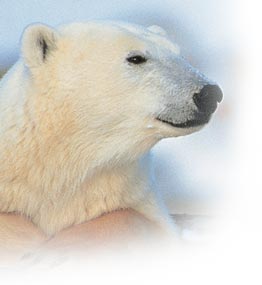
Polar bears are the largest land carnivore and can grow up to 10 feet (3 m) long and weigh about 1,700 pounds. The hind limbs are longer than the forelimbs this makes the large, muscular hind end stand higher than the shoulders. Polar bears have 42 teeth, which they use for catching food and for aggressive behavior.A polar bear's coat is about 2.5 to 5 cm (1-2 in.) thick. A dense, woolly, insulating layer of underhair is covered by a relatively thin layer of stiff, shiny, hollow guard hairs that can be as long as 15 cm (6 in.). |
 |
|
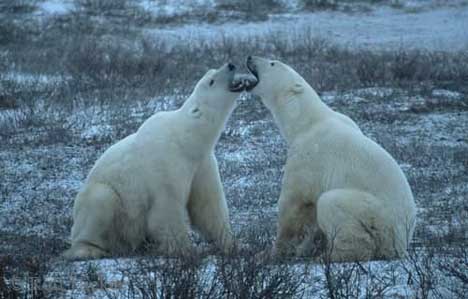
Polar bears are most active the first third of the day and least active the final third of the day.In the Canadian Arctic, adult female polar bears with cubs hunt about 19% of their time during the spring and about 38% of their time during the summer. Adult male polar bears hunt about 25% of their time during the spring and about 40% of their time during the summer, When not hunting, polar bears are often sleeping or resting. On warm days polar bears sprawl out on the ground or ice, sometimes on their backs with their feet in the air. They may also make temporary snow or earthen pits to lie in. On cold days polar bears curl up and often cover their muzzle area. During the winter, some polar bears excavate temporary dens or find natural shelters to stay warm. They may use these shelters for several months at a time.The most constant social interaction occurs between mother and cubs. Polar bear mothers are attentive, frequently touching and grooming their cubs. |
 |
|
Breeding takes place in April and May on the sea ice,
males and females find each other by congregating in the best seal-hunting habitats.
Male polar bears
follow the tracks of a breeding female polar bear in order to find a mate.
Competition for females is intense. Females breed about once every three years; therefore, there are about three adult males to every breeding female.
A polar bear threatening to attack another polar bear usually lowers its head, flattens its ears back, and gives an open mouth threat with a hisslike roar.
Fights are rarely fatal, but do result in broken canines and scars on the shoulders, head, and neck. |
 |