|
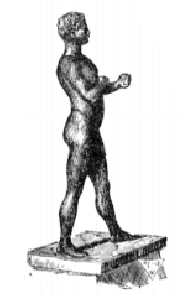
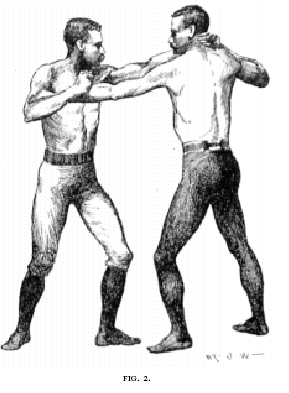
The first matter to be considered is that of upright offence and defence, and here we have no better model than our modern art of boxing. Many of the blows of a Greek Pancratiast seem curious to us, being round-arm swipes or crushing knocks on the top of the head. Several of these blows have been retained in Neo-Pancratium, although the majority of punches to be found in this new sport will be familiar to any habitue of the prize-ring or amateur boxing salon. These blows and their various stops and guards are too well-known to require any further detailing here. Where Neo-Pancratium differs significantly from modern boxing is that, when devotees of the purely pugilistic art close together, they are immediately parted by the diligent referee. The Neo-Pancratiast, by comparison, simply segues from boxing into wrestling and continues his contest. The importance of this point cannot be too strongly reinforced, especially with regards to preparation for self-defence against a determined and ruthless assailant who will not care two figs for the niceties of the Marquis� rules.
At this point during our early experiments we found ourselves at the mercy of the same set of circumstances that plagued our Olympic forebears. Just as they discovered regarding the boxer�s cestus, the modern glove, so crucial in cushioning the force of a blow, becomes an absolute handicap when wrestling. For a time we prevaricated, dividing our contests into separate bouts for boxing and wrestling, but this was found to be unsatisfactory. The solution has been to devise a novel form of glove, rather more open in the palm and with room for the fingers to grip securely, yet well-padded across the knuckles. This innovation allows Neo-Pancratiasts to successfully move between boxing and wrestling as required by the exigencies of any given contest. The Committee is presently undertaking discussions with a leading purveyor of sporting goods and hopes to be able to offer these new gloves to the public in the not-distant future. |
|
|
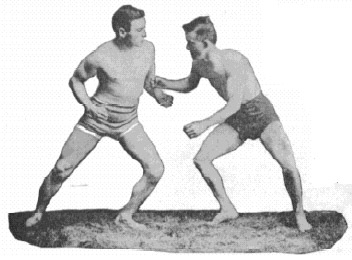
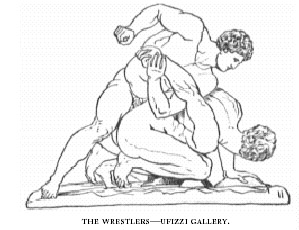
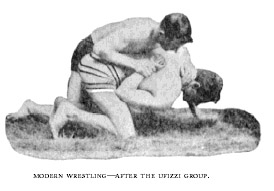
In selecting the most suitable form of wrestling to round out our new sport, the Committee has examined a variety of British and French styles and has settled for the time being on the Catch-hold method native to Lancashire, as being that most closely representative of the ancient Greek style. This method allows wrestlers the greatest freedom in coming to grips, and includes as ingenious a selection of chips and hanks as are to be found anywhere. More importantly, however, the Catch-hold school offers the option of forcing one�s adversary to surrender through painful holds applied to the joints of the limbs, exactly as was the custom in ancient Greece. This is considered to be more realistic, and certainly better suited to the exigencies of self-defence, than simply throwing him off his balance or forcing his shoulders to the mat. What man would not, in extremis, prefer to hold his attacker helpless while a policeman comes up, rather than suffer the frustration of repeatedly throwing a fit man down only to have him scramble up and renew his attack with even greater vigour and cunning?
The question remains as to how far we may follow our predecessors and yet remain within the bounds of civilised sportsmanship. For example, Englishmen regard pommeling a downed opponent to be the nadir of dishonourable behaviour, and yet precisely this method was frequently the most successful tactic of the original Pancratiasts in securing victory. Of course, in the extreme circumstance of a life-or-death struggle, the conventions of sportsmanship should not apply and one must do whatever is necessary to prevail, but how to translate this ethic into sporting competition? The answer has been, as needs must, to compromise by barring any blows against an obviously helpless athlete, who will in any case generally elect to surrender once it becomes obvious that, if he did not, more than his pride would suffer at the hands of his adversary.
In keeping with the historical flavour of this new sport, and mindful of the bounds of decency, we have devised a strip that combines the best of the old with the latest athletic fashions. For purposes of public performance at assaults-of-arms and similar spectacles, the strip consists of ribbed, flesh-coloured tights and thonged leather sandals. |
|
|
|
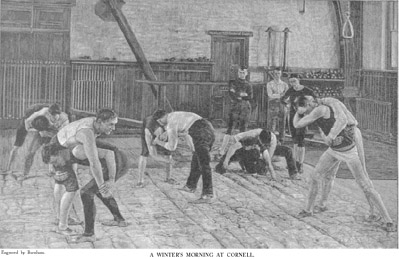
Athletes in private training, of course, may wear whatever they wish so long as it affords the requisite freedom of movement, with most opting for a combination of orthodox boxing and wrestling attire. We have also experimented with a range of surfaces upon which to stage our contests, and have found that the orthodox wrestling mattress as found in gymnasia and schools-of-arms throughout the land offers the most suitable option.
The Committee is presently in the final stages of drafting a charter and set of formal rules for Neo-Pancratium contests, which will be forwarded to the appropriate authorities forthwith. The Army has already expressed an interest and we are confident that the sport will become well-established both within the military and public Schools of Physical Culture within the next few years. |
|