Who am I and how did I get to
be that way?
In pursuit of whales, torts,
and words
In 361-some-odd years in New York,
my family has managed to move an astonishing 120 miles -- a third of
a mile, or 7 city blocks, a year, as fast as some species of tropical
vine. In nearly four centuries we have driven relentlessly west, from
the eastern tip of sandy Long Island to the hard granite of Manhattan, on and around which we have
camped for most of the past two centuries. My feeling is that we hit
the Big Apple and said, "let's stay here. This is as good as it
gets." Here's a short history of this epic trek. My Yankee ancestor,
Obediah Rogers, arrived with his family from Lynn, Massachusetts, in
1640, landing in Southampton
as one of the first English settlers of New York and beginning the
family's centuries-long quest for whales (great-great-granddad Halsey
Rogers was a Sag
Harbor whaleship captain),
torts, and words. My family left the Hamptons before too many
generations had passed, escaping well before the launch of the
Hollywood years and leaving behind but a lonely ancient gravestone.
The westward drive along the South Shore of Long Island landed us in
Brooklyn
and New
York City over 150 years
Island to the hard granite of Manhattan, on and around which we have
camped for most of the past two centuries. My feeling is that we hit
the Big Apple and said, "let's stay here. This is as good as it
gets." Here's a short history of this epic trek. My Yankee ancestor,
Obediah Rogers, arrived with his family from Lynn, Massachusetts, in
1640, landing in Southampton
as one of the first English settlers of New York and beginning the
family's centuries-long quest for whales (great-great-granddad Halsey
Rogers was a Sag
Harbor whaleship captain),
torts, and words. My family left the Hamptons before too many
generations had passed, escaping well before the launch of the
Hollywood years and leaving behind but a lonely ancient gravestone.
The westward drive along the South Shore of Long Island landed us in
Brooklyn
and New
York City over 150 years
 ago (they were separate cities then) and involved the accumulation of
relations who were more recent and, clearly, more colorful arrivals
in America. Among my Danielle Steeley forebears were an Irish
trolley-car driver who became chauffeur to American aristocracy, a
German innkeeper (who ran a waterfront bar, by legend a city block
long, that served the workers building the Brooklyn
Bridge) and his lawyer
son, plus a French educator, one
ago (they were separate cities then) and involved the accumulation of
relations who were more recent and, clearly, more colorful arrivals
in America. Among my Danielle Steeley forebears were an Irish
trolley-car driver who became chauffeur to American aristocracy, a
German innkeeper (who ran a waterfront bar, by legend a city block
long, that served the workers building the Brooklyn
Bridge) and his lawyer
son, plus a French educator, one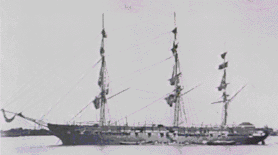 of twin brothers abandoned as children in a seaside resort town. Prominently,
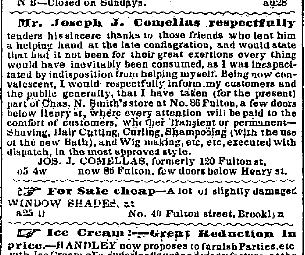
there was a family of Spanish immigrants from Barcelona and Pueto Mahon, on the Spanish Balearic Island Menorca, north of Majorca and Ibiza. They ran four "hair dressing saloons" and "bathing establishments" in Brooklyn. Those shops go back far enough for one to have been destroyed in the famous "Great Conflagration" of 1848, its proprietor injured and forced into retirement at the age of 24. Famous in the family of my great-grandmother, Angela (Comellas) Jahn, was "Uncle Juan" Quevedo, a Spanish-born career American Navy man (crewmember on the Perry
Expedition to Japan in the
1850s and gunnery officer aboard the USS Brooklyn during the
Civil War ... at whom Admiral Farragut may have been yelling when he
uttered his famous, if historically embellished command, "Damn the
torpedoes--full speed ahead"). My Latino relation finished his career
as storekeeper (purchasing officer) at the Brooklyn
Navy Yard, in the cove to
the far left in the photo below.
of twin brothers abandoned as children in a seaside resort town. Prominently,
there was a family of Spanish immigrants from Barcelona and Pueto Mahon, on the Spanish Balearic Island Menorca, north of Majorca and Ibiza. They ran four "hair dressing saloons" and "bathing establishments" in Brooklyn. Those shops go back far enough for one to have been destroyed in the famous "Great Conflagration" of 1848, its proprietor injured and forced into retirement at the age of 24. Famous in the family of my great-grandmother, Angela (Comellas) Jahn, was "Uncle Juan" Quevedo, a Spanish-born career American Navy man (crewmember on the Perry
Expedition to Japan in the
1850s and gunnery officer aboard the USS Brooklyn during the
Civil War ... at whom Admiral Farragut may have been yelling when he
uttered his famous, if historically embellished command, "Damn the
torpedoes--full speed ahead"). My Latino relation finished his career
as storekeeper (purchasing officer) at the Brooklyn
Navy Yard, in the cove to
the far left in the photo below.
Both my parents were born in New
York City, my father in Queens, my mother in Manhattan. My father was
a reporter and union activist with the New York Newspaper Guild
at the legendary Brooklyn Eagle in the years 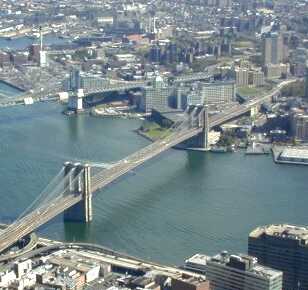 leading
up to World War II. He covered the Hindenberg Disaster, the Lindberg Kidnapping, and Hitler's attempt to established the Nazi Party in America, among other things. My mother is the bookish
... one of those rare moms who gives her young son A Portrait of
the Artist as a Young Man, Dubliners, and Ulysses
to read so he can see the career coming way off and know what to
expect ... former-librarian daughter of the Irish trolley-car driver
(the Third Avenue trolley, when it was still horse-drawn). He
wound up driving assorted vehicles for John Ellis Roosevelt, cousin
of President Teddy, and finally becoming caretaker of the man's
summer estate, Meadowcroft.
While my author instincts keep me in New York City, where most of the
family has spent most of the past two centuries, Meadowcroft, where I
did some growing up as a child, leaves me with a yearning to write an
Agatha Christie-style "mansion mystery." Don't be surprised if
Donovan turns up in such a place while on vacation one of these
years.
leading
up to World War II. He covered the Hindenberg Disaster, the Lindberg Kidnapping, and Hitler's attempt to established the Nazi Party in America, among other things. My mother is the bookish
... one of those rare moms who gives her young son A Portrait of
the Artist as a Young Man, Dubliners, and Ulysses
to read so he can see the career coming way off and know what to
expect ... former-librarian daughter of the Irish trolley-car driver
(the Third Avenue trolley, when it was still horse-drawn). He
wound up driving assorted vehicles for John Ellis Roosevelt, cousin
of President Teddy, and finally becoming caretaker of the man's
summer estate, Meadowcroft.
While my author instincts keep me in New York City, where most of the
family has spent most of the past two centuries, Meadowcroft, where I
did some growing up as a child, leaves me with a yearning to write an
Agatha Christie-style "mansion mystery." Don't be surprised if
Donovan turns up in such a place while on vacation one of these
years.
Of the various possible ethnic
surnames … English, French, Spanish, German, and Irish …
that I might have been tagged with, fate knew that eventually I would
pen the mystery titled Murder
on the Waterfront and
named me after the guy with the dockside bar. (The building, at One
Old Fulton Street, still stands. You can see it, blurred and misted
by history like my NATO family, just to the right of the bridge tower
on the Brooklyn side in the above photo, which was taken from the top
of the World Trade Center.) The historic building began life as the Steamboat Ferry Inn,circa 1830. Careful readers of Murder In Central Park will
recall that name as adorning a beer bottle.
Brooklyn Bridge photo by Gary
Feuerstein
(http://www.endex.com/gf/
).
Used by permission.
Weegee and Me
I followed my father into
newspaper work at the age of 11. My father was then editing a weekly
newspaper in Sayville,
NY This is the
aforementioned resort town, a picture book hamlet of sand, gift
shops, and Rotarians on the South Shore of Long Island halfway back
to the hallowed Hamptons digs. Once known for Blue Point Oysters and
the summer estates of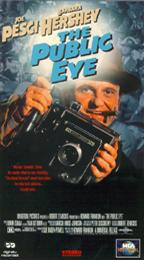 the very rich, Sayville now is famous worldwide as the place to catch
the ferry to the gay parts of Fire Island.
My father started me as a printer's devil in the back shop and two
years' later bought me a camera and turned me into his emergency
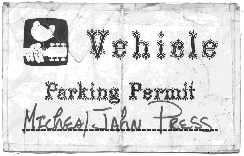
photographer. I covered fires, arrests, and car wrecks—heady
stuff for someone that age, being given a press badge and a pass
through police lines—and worshipped Weegee, the legendary New
York City police photographer who inspired the character played by
Joe Pesci in his 1992 movie "The Public Eye." After a while I traded
my Speed Graphic for a typewriter and drifted into writing and
editing, becoming news editor of another weekly at the age of twenty.
I got my first apartment in Manhattan in 1966, on the
Upper
the very rich, Sayville now is famous worldwide as the place to catch
the ferry to the gay parts of Fire Island.
My father started me as a printer's devil in the back shop and two
years' later bought me a camera and turned me into his emergency
photographer. I covered fires, arrests, and car wrecks—heady
stuff for someone that age, being given a press badge and a pass
through police lines—and worshipped Weegee, the legendary New
York City police photographer who inspired the character played by
Joe Pesci in his 1992 movie "The Public Eye." After a while I traded
my Speed Graphic for a typewriter and drifted into writing and
editing, becoming news editor of another weekly at the age of twenty.
I got my first apartment in Manhattan in 1966, on the
Upper
 West
Side, while a part-time
graduate student at Columbia
University and a full-time
supplicant to the gods of freelance writing. And it was during the
antiwar "disturbances" at Columbia in 1968, when reporters were
sitting up all night playing cards with my fellow sleep-deprived
Columbia officers waiting for the thousands of tactical police
officers swarming the campus to attack, that I heard about and
shortly thereafter got my first newspaper job in Manhattan, as folk
and rock music reviewer at The
New York Times,
replacing Bob Shelton, the Times’s legendary reviewer who
discovered Bob Dylan and had
West
Side, while a part-time
graduate student at Columbia
University and a full-time
supplicant to the gods of freelance writing. And it was during the
antiwar "disturbances" at Columbia in 1968, when reporters were
sitting up all night playing cards with my fellow sleep-deprived
Columbia officers waiting for the thousands of tactical police
officers swarming the campus to attack, that I heard about and
shortly thereafter got my first newspaper job in Manhattan, as folk
and rock music reviewer at The
New York Times,
replacing Bob Shelton, the Times’s legendary reviewer who
discovered Bob Dylan and had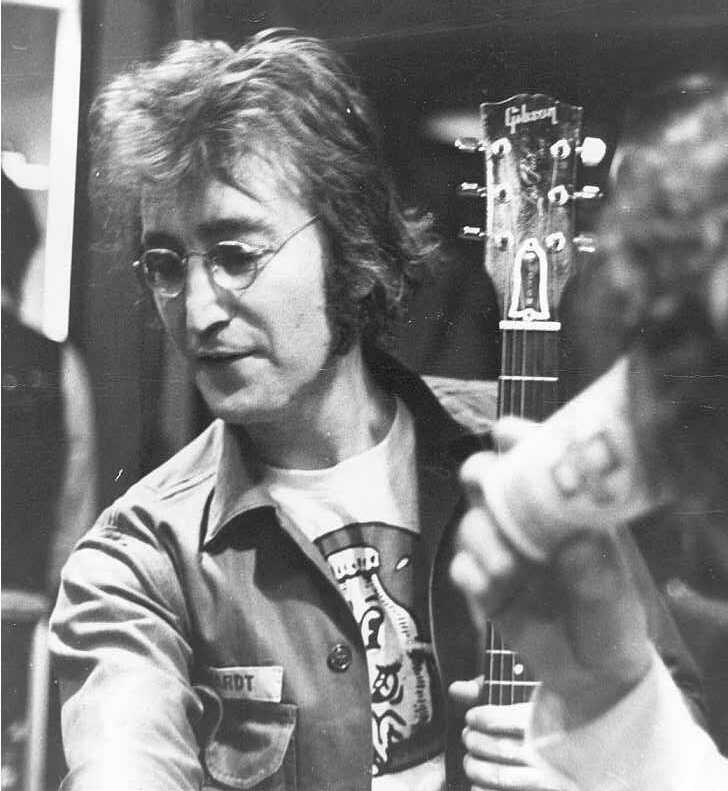 just retired to write a biography of him. Writing as Mike Jahn, the
byline I had been using since my Weegee days, I worked that beat for
six years. I covered the Woodstock Festival and hung out with many of
the countercultural and pop music icons of that age--and wrote quite
a few of their obituaries. Occasionally I took one of their photos;
the one over there of John Lennon, recording in America for the first
time in 1972, is an example. Eventually I tired of watching people
I liked die, and after two-year stint as a TV
critic and celebrity
interviewer--Leonard Nimoy
gave my son a Tribble that now is displayed prominently on his
mantle--I
just retired to write a biography of him. Writing as Mike Jahn, the
byline I had been using since my Weegee days, I worked that beat for
six years. I covered the Woodstock Festival and hung out with many of
the countercultural and pop music icons of that age--and wrote quite
a few of their obituaries. Occasionally I took one of their photos;
the one over there of John Lennon, recording in America for the first
time in 1972, is an example. Eventually I tired of watching people
I liked die, and after two-year stint as a TV
critic and celebrity
interviewer--Leonard Nimoy
gave my son a Tribble that now is displayed prominently on his
mantle--I  built
on the notoriety that a daily Times byline gave me to live my
real dream, writing fiction for a living. At first, I signed up with
MCA Universal to produce novelizations of its TV and motion picture
properties. Those included The Rockford Files, The Six Million
Dollar Man, Switch, The Invisible Man with David McCallum, and
Black Sheep Squadron. (I still do this sort of work from time
to time, a fact that is inescapable if you look
me up on Amazon.com, most
recently with Dragon: The Bruce Lee Story and The
Frighteners, a Michael J. Fox movie that I like to describe as
"Ghostbusters meets The Seventh Seal.")
built
on the notoriety that a daily Times byline gave me to live my
real dream, writing fiction for a living. At first, I signed up with
MCA Universal to produce novelizations of its TV and motion picture
properties. Those included The Rockford Files, The Six Million
Dollar Man, Switch, The Invisible Man with David McCallum, and
Black Sheep Squadron. (I still do this sort of work from time
to time, a fact that is inescapable if you look
me up on Amazon.com, most
recently with Dragon: The Bruce Lee Story and The
Frighteners, a Michael J. Fox movie that I like to describe as
"Ghostbusters meets The Seventh Seal.")
John
Lennon photo
(c) Michael Jahn
1972; all rights reserved
Then Came
Donovan
That training gave me the
courage to write my own original fiction, and my first original
mystery, The Quark Maneuver (Ballantine 1977) won the Edgar
Award 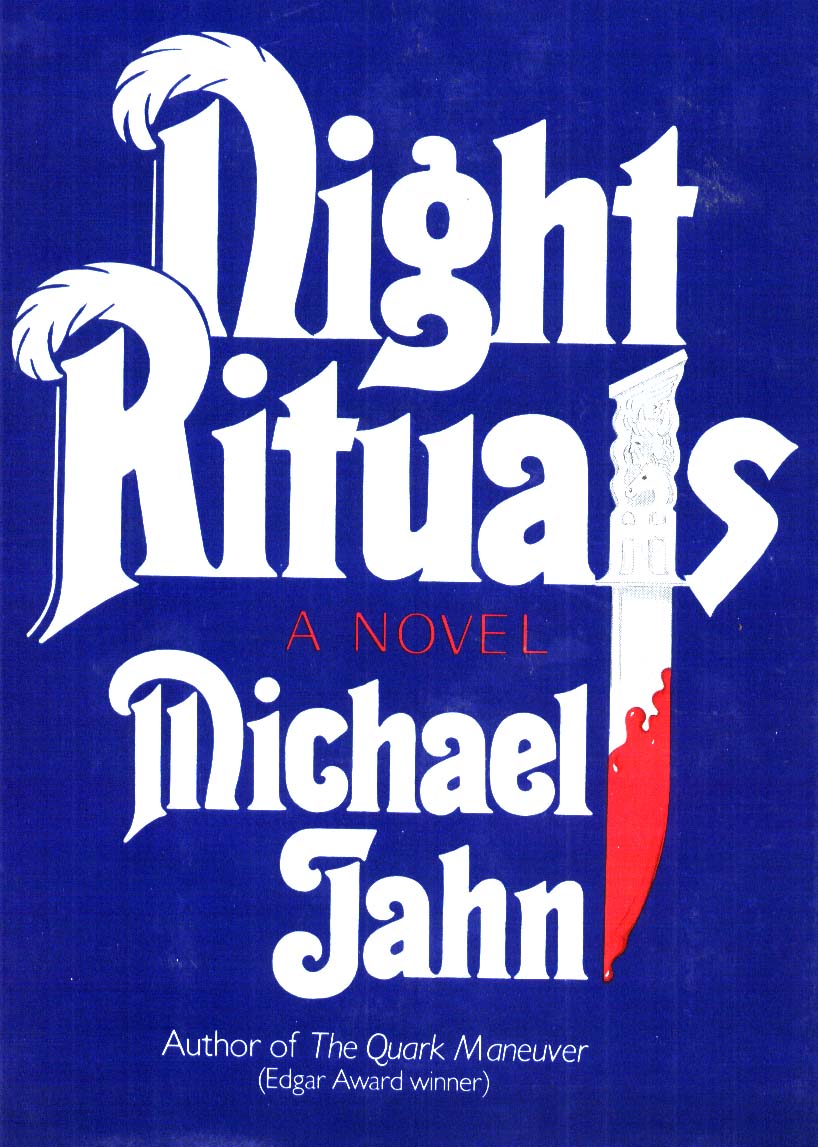 for
best paperback original mystery. A handful of paperback originals
later in genres that included science fiction (Armada) and
historical (Kingsley's Empire) as well as a dalliance with
experimental fiction, and following a byline switch to Michael
Jahn, I made the jump to hardcover fiction, starting the Bill
Donovan Mysteries in the early 1980s with Night Rituals. By
2002, I have published about 50 books.
for
best paperback original mystery. A handful of paperback originals
later in genres that included science fiction (Armada) and
historical (Kingsley's Empire) as well as a dalliance with
experimental fiction, and following a byline switch to Michael
Jahn, I made the jump to hardcover fiction, starting the Bill
Donovan Mysteries in the early 1980s with Night Rituals. By
2002, I have published about 50 books.
While most of my years in
Manhattan were lived on the Upper
West Side ... and
Donovan began his illustrious career with the West Side Major
Crimes Unit before moving up to command of the citywide Special
Investigations unit ... I also lived on the East Side near the
United
Nations, and in the
Brooklyn communities of Flatbush and Sheepshead Bay. I now live in Manhattan and thereabouts.
When I am not writing I indulge myself in rereading those writers
who influenced me. Among the mystery writers, that would include
Georges Simenon, Leslie Charteris, Agatha Christie, and Dorothy
Sayers. Among the other writers who moved me are Joyce, O Henry,
the Depression Poet Kenneth Fearing (read his "St. Agnes Eve," a
fine noir poem), Jack Kerouac ... sometimes I feel I have been
rewriting that last paragraph of On the Road for thirty
years ... and especially Meyer ("Mike") Berger, creator of the
"About New York" column in "The New York Times" and inheritor of O
Henry's talent for describing the little guy just  getting
by on the streets of New York ... get his Meyer Berger’s
New York (Random House, 1953) if you can find it. As for
Georges Simenon ... I have been known to refer to Donovan,
arrogantly, maybe, but, I hope, not entirely inaccurately, as New
York’s Maigret. Donovan does have Maigret's intuitiveness and
psychological insight. And to refer to Marcy, Donovan's
multiracial wife and, now, the mother of his child, as New York's
Emma Peel. Well, her black leather catsuit days are behind her
now; she's a mommy. As Donovan showed, we all grow
up—sometimes against the most amazing odds. Marcy still steps
in now and again to help her husband with cases.
getting
by on the streets of New York ... get his Meyer Berger’s
New York (Random House, 1953) if you can find it. As for
Georges Simenon ... I have been known to refer to Donovan,
arrogantly, maybe, but, I hope, not entirely inaccurately, as New
York’s Maigret. Donovan does have Maigret's intuitiveness and
psychological insight. And to refer to Marcy, Donovan's
multiracial wife and, now, the mother of his child, as New York's
Emma Peel. Well, her black leather catsuit days are behind her
now; she's a mommy. As Donovan showed, we all grow
up—sometimes against the most amazing odds. Marcy still steps
in now and again to help her husband with cases.
As will his son.
That's New
York
It is New York that you get in
reading my books. Beyond my family and writing, the city is my one
true love. It is this city that fills the imagination and warms
the spirit and even if you write about the view from the World
Trade Center, a young man who is raiding the Tuesday night trash
pickup seeking to furnish his flat with the castoff furniture that
wealthy families still shove out onto the curb, an Afghan
immigrant selling hot dogs so he can afford his studio apartment
on Northern Boulevard, or an old man trying to get a warm winter
sleep atop a steam vent along the West Side Highway when the wind
is blowing in raw and knife-edged from Jersey and the rest of
America across the Hudson, there is a majesty in New York City
that you don't find elsewhere. That's what I write
about.
That's New York.
Home
to Michael Jahn's New York