La provincia de los Piros: native and Spaniard in early colonial south-central New Mexico
ON AND OFF THE ROAD IN PIRO COUNTRY
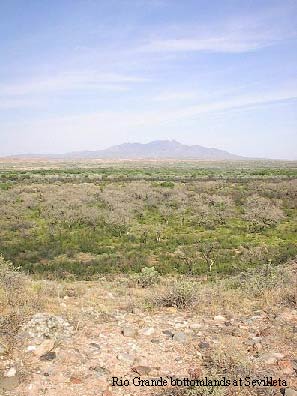 Few indigenous cultures in North Amercia remain as visible today as the various Pueblo groups of New Mexico and Arizona. Places like Taos, Acoma, or the Hopi villages have long captured the imagination of outsiders, as have the numerous archaeological remains of ancestral Puebloan communities that still dot the landscape from the Mesa Verde region of southeastern Utah and southwestern Colorado to the Casas Grandes district of northern Chihuahua, Mexico. A traveler going from Mesa Verde to Casas Grandes would be on a 700-mile trip, one-way, a trip which includes (if alternative routes are not chosen) a nearly 300-mile stretch of the Rio Grande valley in central and southern New Mexico. Along this stretch the traveler would leave the region occupied by the modern Pueblos south of Albuquerque and journey on past thinly populated river bottomlands. To the casual observer nothing here suggests that this area was once occupied by a group known to history as the Piros, and that the area formed an integral part of the Pueblo world. The only obvious hints are a few highway signs announcing the Sevilleta National Wildlife Refuge - a designation which derives from the Spanish name for a local Piro pueblo.
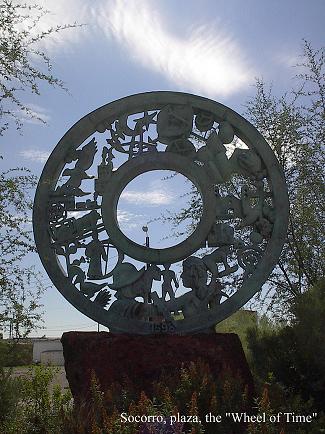
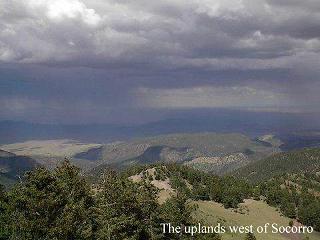
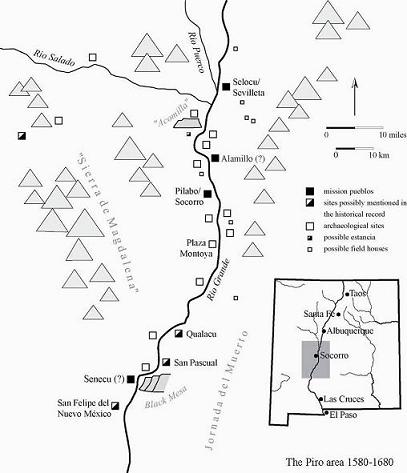
The largest modern community in the former Piro area is the town of Socorro. Established in the early 1800s on the site of a Piro settlement abandoned over a century before, Socorro can lay claim to one of the oldest European place-names north of Mexico. In mid-June 1598, the vanguard of Juan de Oñate's colonizing caravan stopped near a village whose name the Spaniards recorded as Teypama or Teypana. Up to that point, Oñate and his followers had encountered mostly empty villages, as the Piros, wary of these heavily armed strangers, had abandoned them and fled to the mountains. Teypama's residents, however, not only had not fled, but gave the Spaniards a large quantity of maize. Whether this support was altgether voluntary is not certain, but it earned the place the name "Socorro", the Spanish word for "help".
FIRST ENCOUNTERS: PIROS AND SPANIARDS
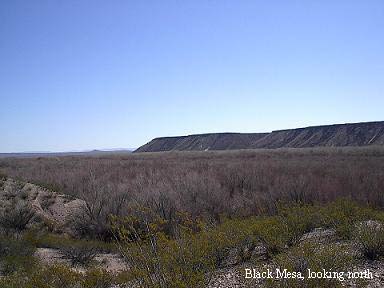 On a late summer day in the year 1581, a small group of Spanish horsemen stood outside a ruined adobe pueblo on the west side of the Rio Grande, a short distance south of the large basalt flow known today as Mesa del Contadero or Black Mesa. This was the Rodríguez-Chamuscado party, seven weeks out of Santa Bárbara in Nueva Vizcaya, a place located today in southern Chihuahua, Mexico. Wrote Hernán Gallegos, the party's scribe and main chronicler, of the event: "We came to an abandoned pueblo that had been inhabited by a large number of people, who must have been very advanced, judging by the buildings, and whose discovery would be of great importance, if they could be found". Found they were, during the next few days, and it is through Gallegos' account of these encounters that the people whom later Spaniards would call "los Piros" enter the historical record.
What had brought Gallegos and his companions north was a dream that went back to the years after the Cortesian conquests of the early 1520s. The treasures of Mexico-Tenochtitlán had fired the Spaniards' imagination that other such places might exist elsewhere. The vast unknown land stretching north from central Mexico seemed the most obvious choice of direction for any prospective conquistador, especially since native mythology placed the ancient homeland of the Aztecs who had built Tenochtitlán somewhere in the far northern interior. In one disguise or another the search for "otro México" became the driving force for a number of rambling explorations, including, famously, the one undertaken by the Coronado expedition of 1540-42. No "new" Mexico materialized, of course, but by the late 1540s another kind of wealth was drawing Spaniards northward: silver. In 1548 newly discovered silver deposits at Zacatecas turned into a grand bonanza, and within 20 years mines were being worked as far north as the Santa Bárbara area.
 There it was in the late 1570s that fray Agustín Rodríguez, a Franciscan friar stationed at a local mission, heard of people wearing clothes and living in large, terraced houses far beyond the last Spanish outposts - a rumor that had been floating around the frontier for some time.
How accurate this rumor was no one had any way of knowing, but there was plenty of room for wishful thinking on the part of the Spaniards. So far, they had encountered in the north only non- to semi-sedentary groups of hunter-gatherers and horticulturalists known collectively as Chichimecas. Spanish accounts of the Chichimecas dwell much on such "vices" as lack of permanent homes or clothing. More importantly, however, the Chichimecas had managed to embroil the Spanish intruders in a decades-long guerrilla war, which the latter were unable to end militarily. Under these circumstances any evidence, however vague, of the existence of a more "civilized" people somewhere beyond the northern horizon could only refresh the old vision of the "other" Mexico.
There it was in the late 1570s that fray Agustín Rodríguez, a Franciscan friar stationed at a local mission, heard of people wearing clothes and living in large, terraced houses far beyond the last Spanish outposts - a rumor that had been floating around the frontier for some time.
How accurate this rumor was no one had any way of knowing, but there was plenty of room for wishful thinking on the part of the Spaniards. So far, they had encountered in the north only non- to semi-sedentary groups of hunter-gatherers and horticulturalists known collectively as Chichimecas. Spanish accounts of the Chichimecas dwell much on such "vices" as lack of permanent homes or clothing. More importantly, however, the Chichimecas had managed to embroil the Spanish intruders in a decades-long guerrilla war, which the latter were unable to end militarily. Under these circumstances any evidence, however vague, of the existence of a more "civilized" people somewhere beyond the northern horizon could only refresh the old vision of the "other" Mexico.
With the "gente vestida", the "clothed people", on their minds, fray Agustín and a veteran frontiersman, Francisco Sánchez Chamuscado assembled a group of 10 Spaniards, 2 other Franciscans and 8 soldiers, plus a small number of native servants. Permission to go was granted by the viceroy in Mexico City when Rodríguez visited him in late 1580, and the would-be explorers departed Santa Bárbara in early June 1581. Their long journey lead down the Rio Conchos and then up the Rio Grande. In his account Gallegos states that after travelling for many days through uninhabited territory they were close to turning back, when "it was God's will that, on our way back to camp, we should meet an Indian about forty years of age". In a few less prosaic versions of the event the man is run down and captured by one or more of the soldiers, but regardless of what really happened it was thanks to this "guide" that the party finally reached the ruined pueblo.
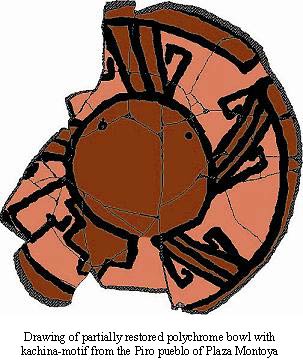 Rarely can crumbling adobe walls have left a more profound impression. Gallegos' quote at the beginning of this overview clearly shows the expectations which the explorers attached to the discovery of the pueblo. So, too, does the name they gave to both the place and the region before them: "San Felipe del Nuevo México". The following day the party departed from the pueblo and after traveling a short distance upriver, came to another pueblo. This one was occupied, but its inhabitants had fled upon the strangers' approach. Again Gallegos was much enthralled by what he saw: "We found the houses very well planned and built in blocks, with mud walls, whitewashed inside and well decorated with monsters, other animals, and human figures. There were many curious articles in these houses, more neatly wrought than those of the Mexicans when they were conquered. The inhabitants have a great deal of crockery, such as pots, large earthen jars, and flat pans, all decorated and of better quality than the pottery of New Spain".
For four days Gallegos and his companions traveled north through Piro territory, soaking up the sights and sounds around them. "The news that we were coming in peace spread so widely that there was not a day when we were not surrounded and accompanied by more than twelve thousand people", Gallegos wrote with obvious exaggeration. But whatever the real number of onlookers, the explorers' impressions of the Piros, as well as the news that more - and even larger - "towns" were located further upriver, produced a profound sense of historical accomplishment. Again Gallegos: "Before this time numerous Spaniards with ample commissions from the viceroys of New Spain had entered the land in an attempt to discover this settlement [of Nuevo México], and they had not found it".
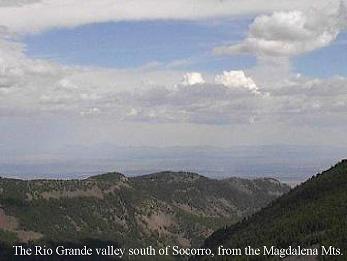
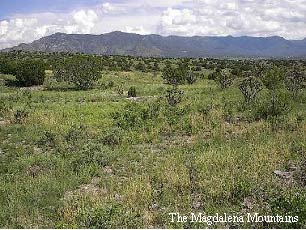 After five months of touring much of the Pueblo world the explorers again traversed Piro territory on their return trip down the Rio Grande - minus the three Franciscans. Fray Agustín and one confrère had decided to remain behind to preach the gospel among the Tiwas, the Piros' northern neighbors. The third friar had been caught alone and killed earlier somewhere east of the Rio Grande. On this last leg of their stay among the Pueblos the explorers spent some time prospecting for minerals and staking out claims. Part of the side trip may have taken them into the Magdalena Mountains, an area famous in the later 19th-century for its mineral wealth, but a few claims were apparently located further south, beyond the southernmost Piro pueblos. Finally, after a grueling journey which was overshadowed by the death of Chamuscado, the explorers reached Santa Bárbara in mid-April 1582.
The return of the expedition set the Santa Bárbara region abuzz. A local magistrate tried to confiscate Gallegos' report, presumably to make sure that if anyone were to reap a benefit from the whole venture it would be the governor of Nueva Vizcaya.
TO BE CONTINUED.
The reports of the two expeditions caused much excitement among the Spanish authorities in Mexico City and Madrid. Already in the spring of 1583 King Philip II ordered the viceroy of New Spain to enter into negotiations about a colonizing expedition to New Mexico "con la persona mas conviniente y de quién tengáis mas satisfacción que se ofresciere á hacerlo, sin que Nuestra Hacienda se gaste cosa alguna" - "with the most acceptable and to you most satisfactory person who may offer to undertake it, at no expense to Our royal treasury". It is one of the most interesting characteristics of Spanish expansion in the Americas that the enterprise of colonization was essentially a private one. An individual would apply to the crown for a patent to explore and "pacify" a certain region, at his own cost and risk. Especially after 1573, when the crown issued a long list of rules and regulations for "nuevos descubrimientos" ("new discoveries"), the applicant had to satisfy a number of requirements laid before him by the king's officials. Foremost was a pledge to carry out the assignment by peaceful means, without any of the bloodshed so characteristic of the earlier conquests of Mexico, Peru, and lands in between. "Para que los naturales vengan al verdadero conocimiento de nuestra Santa Fé Católica" - "That the natives come to the true knowledge of Our Holy Catholic Faith": so the crown's prima facie rationale for authorizing so-called "entradas" or "entries" into hitherto "unpacified" regions.
There were, of course, much more mundane motivations, too. Spanish expansion into what is now northern Mexico had been driven numerous many silver strikes up and down the eastern flank of the Sierra Madre Occidental. The crown profited immensely from taxes and tariffs on bullion, mercury, salt, and countless other commodities related to the mining industry, while a new class of "ricos hombres" gained control of the operations on the ground. Three members of this class have left particularly deep marks in the historical record of New Spain's northern frontier as the main contestants for the "honor" of becoming New Mexico's colonizer. Juan Bautista de Lomas y Colmenares, Francisco de Urdiñola, and Juan de Oñate all were wealthy frontier entrepreneurs owning mines, smelters, haciendas, and, most importantly, influence with various officials in Mexico City and Spain. The story of how it took 15 years to pick one of the three - Juan de Oñate - for the New Mexican venture abounds in such seemingly timeless Machiavellian "qualities" as political backstabbing, legal intrigue, broken contracts, and, in this case especially, endless dithering on the part of the king and his advisers.
Not surprisingly, perhaps, none of the original explorers of the Rodríguez-Chamuscado and Espejo-Beltrán expeditions played a role in all this. In fact, only one of Chamuscado's men seems to have made it back to New Mexico at all. In the 1597 and 1598 muster rolls of the Oñate expedition there appears Felipe de Escalante "son of Juan de Escalante Castilla, native of Laredo, short of stature, heavy set, swarthy, partly gray, 47 years of age". In his declarations he made no secret of his special "status". "Here I am, waiting to serve his majesty as a first discoverer of that land, which I was. In the past I spent large sums of money exploring it by order of the Count of Coruña [viceroy of New Spain in 1581], and I say further that none of the other discoverers of that land are going to serve his majesty on this expedition".
What this old explorer felt as he marched northward again, almost twenty years after his journey with fray Agustín and Captain Chamuscado, we can only surmise. Surely
It took Oñate's cumbersome caravan of ### more than ## months to reach a place at the southern edge of the Jornada del Muerto. From there Oñate dispatched a party under Captain Pablo de Escobar to reconnoiter the first Piro pueblos on the other side of the Jornada and report back to the camp. Contrary to his orders Escobar marched straight into the southernmost pueblo, a move which the suspicious inhabitants apparently took as hostile for they withdrew to some nearby mountains.
TO BE CONTINUED