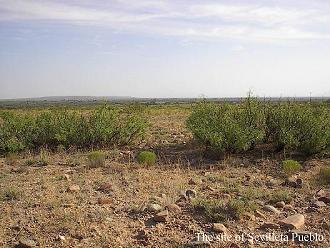
LIVING WITH THE SPANIARDS
When the first Spanish settlers established themselves among the Piros cannot be said with certainty. For at least a decade or so after 1598 the center of Spanish occupation lay 150 miles upriver, between the junction of the Rio Chama and Rio Grande, and the place that was to become the capital of New Mexico, "la villa real de la Santa Fé de San Francisco de Asís". These were trying years for both natives and colonists. The latter were imposing themselves on the former, requisitioning foodstuffs, clothing, blankets, etc. If there was resistance, it was broken by force. The destruction of Acoma in 1599 is the most infamous example of how the Spaniards dealt with native "insubordination". That a Spanish punitive expedition also struck close to what was home for the Piros is less well-known.
MISSIONS AND MISSIONARIES
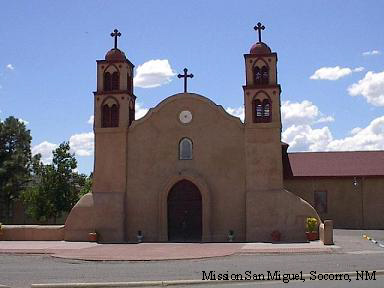 The institution which had perhaps the most profound impact on the Pueblos in general and the Piros in particular was the mission. From the king on down to the governor the religious conversion of the "heathen" natives to "our holy Catholic faith" - "nuestra santa fé católica" - was the one goal promulgated in almost all official statements justifying the colonizing effort. It is also well to remember that one of the main figures in the Pueblos' "rediscovery" of the early 1580s had been fray Agustín Rodríguez. He and two fellow Franciscans had been the first to preach to the Piros as they marched up the Rio Grande in 1581. Whether fray Agustín ever had any doubts regarding the wisdom of his venture is not known, but as his party passed pueblo after pueblo even the most zealous mind must have realized the enormity of the challenge ahead. Nothing illustrates this better than the first missionary assignments after the arrival of the Oñate expedition. In September 1598, the 10 Franciscan friars who had come with Oñate were charged with the conversion of all pueblos between Pecos and the Salinas pueblos in the east, Taos in the north, the Hopi pueblos in the west, and the Piro pueblo of Senecú in the south.
Assigned to one fray Juan Claros was "the province of the Chiguas, or Tiguas", as well as in "the province of Atzigues down the river, with all its pueblos". This last remark is a clear reference of place, if not name, to the Piro area. The Claros assignment lists forty-four "Atzigues" pueblos, twenty on the east and twenty-four on the west bank of the Rio Grande. How fray Juan fared in his task is nowhere recorded and his name is conspicuously absent from all later documents. Evidence for a possible successor or successors is likewise lacking, and there may well have been none. Only once during Oñate's time did the total number of friars exceed ten (and then just briefly, in 1601). 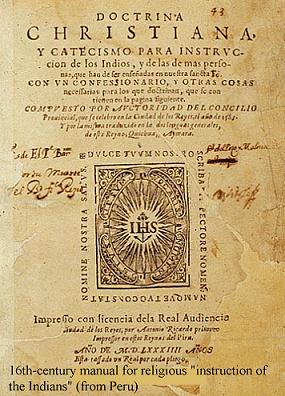 During the post-Oñate years that number was generally higher, but subject to wild fluctuations. In 1625, for instance, there were still scarcely more than a dozen friars in the province. Missionary success was hard to come by, especially early on. In the summer of 1601, one former colonist declared that in all only about 100 natives had been baptized, because the friars "wanted to see what trend matters in the province were going to take". Just what trend matters took can be gleaned from a 1605 letter of the then-viceroy, the marqués de Montesclaros, in which he informed the king that "the insecurity of the settlements and the uncertainty of preserving the land have been responsible for the number of baptized being very small". By 1607, according to Oñate himself, there were somewhat "more than six hundred Christian Indians" in the land. Things continued to look bleak. Montesclaros' successor Luis de Velasco "learned of the small harvest in souls obtained thus far, and how little the number would grow in a very long time because of the fact that the natives had so little desire for the gospel and the friars so little inclination to learn the many languages of those few people".
Amid such reports, Oñate's colonizing venture was viewed with increasing skepticism. For two decades the name "New Mexico" had been floating from New Spain's frontier zone to the halls of government in Mexico City and Spain, but now it seemed as if the land fell far short of everyone's expectations. Colonists carping about the poverty of the land were deserting Oñate in droves, and many of the Franciscans were following suit. There was even talk about evacuating the new province altogether. At this point, however, some missionaries began to throw about numbers of converts ranging in the thousands, together with urgent appeals to the "most Christian King" Philip III not to abandon such a bountiful mission field. In a report written in early April 1609, for instance, fray Francisco de Velasco informed the king that "in more than one hundred pueblos there must be thirty thousand souls, most of whom are clamoring for baptism and asking to become Christians" and who therefore "should not be denied the aid of the Spanish nation". As it was, at the time of fray Francisco's writing, the king had already decided to supply the necessary "aid" under the auspices of a new royal governor (Onate, it will be remembered, had officially resigned his position in 1607), who was to be in charge of continuing the process of colonization, with particular emphasis to be placed on the conversion of the natives.
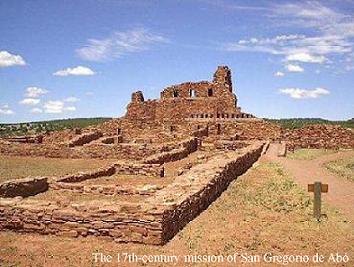
The first Pueblo missions had been established during Oñate's days at San Ildefonso and Santo Domingo, two pueblos located close to the initial nucleus of Spanish settlement near the Rio Chama/Rio Grande confluence. In the years after 1608/09, this rudimentary mission system now quickly grew to include Nambé (1613), Galisteo (1610-13), San Lázaro (1613), Zia (1610-12), Sandía (1610-12), Isleta (1613), and Chililí (1613/14). At that time, more remote groups apparently received little, if any, attention from the missionaries. In the case of the Piros, there is no documentary evidence for a permanent missionary presence prior to the mid-1620s, though after 1613 at least the northernmost Piro pueblos may have been visited every now and then by missionaries from nearby Isleta. That there should have been, from the days of fray Juan Claros to the first mission foundings around 1625, no attempt to (re-)start the conversion of such a strategically placed, easily reached, group seems, if anything, inconceivable. To date, however, no trace - material or documentary - of possible "pre-mission" missionary activities in the Piro area has been uncovered. There is only a cryptic remark by fray Alonso de Benavides, the man behind the missionary offensive of the mid-1620s, which may point to previous, for the Piros seemingly unpleasant, encounters: "If a friar only looked at them", Benavides observed, they believed "they would become Christians, and if this happened everything would go wrong with them".
Los Piros...
a continuar