
The Wrong Cause for Christians
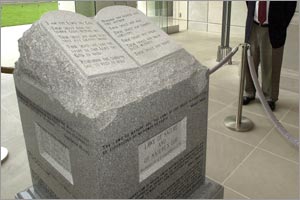
The problems began about two years ago when Alabama's Chief Justice, Roy Moore, had a five thousand pound monument of a Bible, opened to the Ten Commandments (in chapter 20 of the Book of Exodus), installed in the state's Supreme Court rotunda. Predictably, the political left went into a frenzy of protest and won a federal court order to have the monument removed from the rotunda. The fight is now intensifying as the monument has been moved to another part of the building and both Moore and his supporters are vowing to fight to return the religious symbol to its former place in the rotunda..
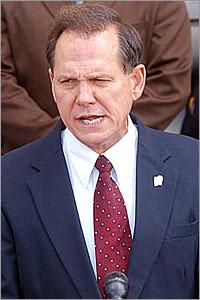
Chief Justice Roy Moore is apparently a man of devout faith. I commend him for that. I am a Christian as well. He is not, however, any sort of legitimate figurehead of political or religious martyrdom as many on the political right try to make him out to be. Justice Moore has created an unnecessary controversy that has the potential to undermine the testimony and work of millions of normal Christians all over America. Even if Moore wins his appeal to the United States Supreme Court, he is setting a dangerous precedent of government interference in religion.
Both sides of this debate have based their positions on the First Amendment. Ironically, both sides have also severely misrepresented the First Amendment along with the rest of the Constitution.
First, there is no "separation of church and state" written in the Constitution. Despite what the media and liberals routinely say, the Bill of Rights does not prevent all government from promoting religion. The First Amendment does prevent our national government (Congress) from enacting legislation that promotes religious beliefs. The Tenth Amendment also clearly states that any authority not delegated to our federal government is left to the individual states to govern. Therefore, it is Constitutional for a state government to promote religion if it chooses. If anything, the federal court order to remove the state's monument in question is unconstitutional. To some degree, this battle could be one of states' rights even though Justice Moore, his supporters and his opponents have not focused on this point of the controversy.
Having said that, it should be noted that an action by government is not necessarily right just because it passes Constitutional muster. Justice Moore's actions are terrible public policy and force all taxpayers to fund his personal religious beliefs. By purchasing the monument and displaying it in a publicly maintained amd funded building, he forced all citizens of Alabama - regardless of their agreement or disagreement with the Bible - to pay for his promotion of his religious principles.
I have heard and read Christian activists claim that the federal court order to remove the Ten Commandments monument is a violation of Justice Moore's First Amendment right to freely express his religious beliefs. This claim is among the most absurd I have ever heard. Nothing, including the court order, is violating Roy Moore's ability to express his Christian faith. His freedom to speak in defense of Christian beliefs and in opposition to other religious beliefs is not threatened. However, his ability to use public money and thereby force all taxpayers to fund his statements is rightfully being threatened.
The individual right to freedom of expression is absolute, and should be as long as no one else's rights are violated. If Justice Moore were being ordered to remove a religious symbol from his front yard, I would contribute to the legal defense fund. Obviously, that is not the case. What Justice Moore is doing is simply wrong. In fact, he is defying his own court considering that all eight of the other state Supreme Court justices agree that the monument is inappropriate for the building's rotunda. Roy Moore is abusing his position as Chief Justice in order to force the issue of religion in government. Keep in mind that both the federal judge who issued the order and the other state Supreme Court justices have said there is no problem with the monument being kept in a different part of the building, such as Justice Moore's chambers.
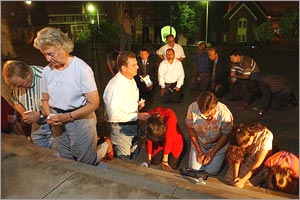
Unfortunately, many Christians have flocked to his defense because they claim the effort to remove the monument is some sort of attack on faith in God. They are holding constant prayer vigils and protests next to the monument. Many of these supporters of Justice Moore have already been arrested for trespassing when they refused to leave the rotunda after closing time in some misguided defense of the symbol. Several vowed to physically prevent the removal of the monument and shouted at the workers who were hired to move it. These zealots should be a source of extreme embarrassment to all Christians.
For too many in America, we demand freedom to do what we want without considering the precedent being set for those who follow us. Justice Moore's supporters point out that he never made a secret of his faith when running for election. Again, I commend him for his apparent consistency and steadfastness of his personal beliefs. Indeed, the moral viewpoints and personal beliefs of candidates are important. We need more moral people to become involved in government. The fact is, though, that Mr. Moore was elected to administer justice based on both the United States Constitution and the laws of his state, not to decide what the collective religious philosophy of Alabama should be. True faith is not collective and religion should never be considered up for a vote.
Should he win his appeal to the United States Supreme Court, Moore would be providing future judicial leaders, via precedent, with immense power to impose any form of personal beliefs at the expense of others. While that is certainly a problem we deal with now in the form of activist judges, like the liberals on the Ninth Circuit Court of Appeals in California, a victory for Justice Moore would give credibility to all forms of judicial activism. We must never forget that all freedom we fight for must be applied to everyone, including those who disagree with us. Freedom is indivisible.
I believe we need more discussion about the presence of God in our society, but there is a right way and a wrong way to spur the start of that discussion. Celebrating Justice Roy Moore as a religious hero cheapens the very message he claims to defend. Bringing the debate of the role of faith in our everyday lives to the halls of government results in a centralization of discussion and thought. It also puts government and elected officials in a pseudo authority position in regards to religious issues. That trivializes and politicizes matters of faith and matters of the church. It also provides government with the potential to impact religious communities of all types to a greater degree.
That is why, despite even the best of intentions, there must be a degree of separation between church and government. I do not worry about protecting government from religion, I worry about protecting religion and the church from government once that line is crossed. Government, by its nature, is unable to instill personal morality. Personal beliefs, whether secular or pertaining to matters of faith, should remain just that: personal and without governmental interference. Mixing a religious message with government undermines what is really important: the message of faith.
The conflict in Alabama is not about God, despite how much Justice Moore wishes it were. It is about the role of government in religion and the potential unintended consequences of allowing the former to infiltrate the latter.