
| Description | Habitat | Behavior | Food Supply | Endangerment |
|---|
|
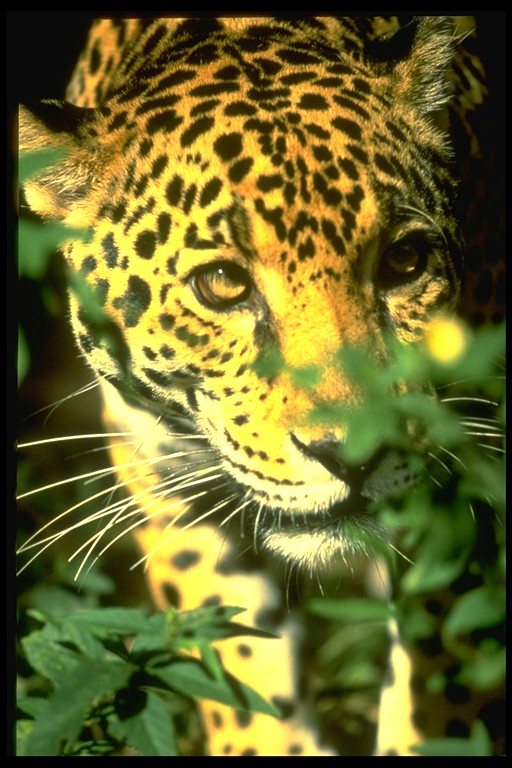
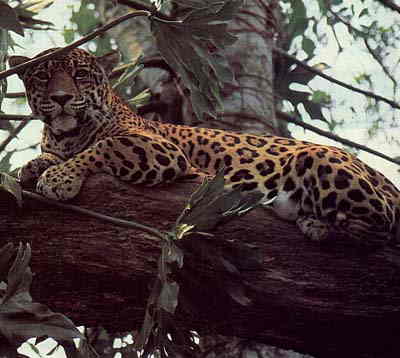
The jaguar is the largest and most powerful wild cat in the Western Hemispere. The jaguar is larger then the leopard. The jaguar's coat has different colors, but they are usually yellow-brownish with black spots, like leopards. Some jaguars are even white. The jaguar's coat on its side and back is spotted with large black rosettes, each consisting of a circle of spots surrounding a central spot. The spots on its head, legs, and underside are solid black. An adult male jaguar may be four to seven feet long, excluding the long tail. Its tail is about 45 to 75 centimeters long. The jaguar stands about three feet high at the shoulder, and it weighs up to 300 pounds when full grown. They live 12 – 16 years in the wild. 20 plus years in captivity. |
 |
|---|---|
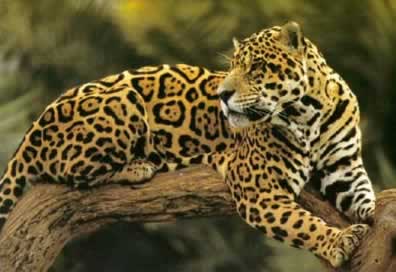
Jaguars are found in tropical rainforests, arid scrub, and wet grasslands. They prefer dense forests or swamps with a ready supply of water. Geographically they are found in the Southwestern United States throughout Central America and into Northern South America. For thousands of years, jaguars have symbolized the power of the forest and nature for the native people in its range from the Mayans, Incas and Aztecs to the Guaran ' Indians of the Gran Chaco. The very word jaguar is derived from a language spoken in the heart of Amazonia. The Guaran ' word "yaguara - means - the animal that kills with one leap." The Maya believed that the secretive cats were the rulers of the underworld while the Aztec formed jaguar societies, such as the jaguar knights, who represented the elite warrior class. Their human sacrifices often ended with the victims' hearts fed to a captive jaguar. |
 |
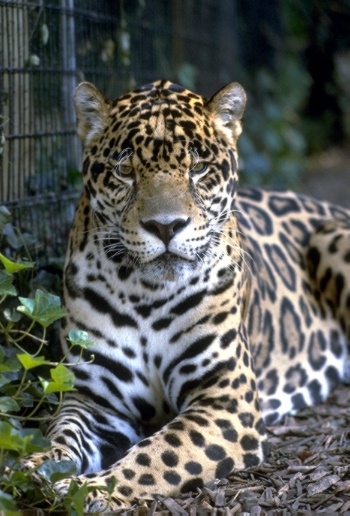
The jaguar is the fiercest of the cat family. Its roar is between a cough and a growl. The jaguar is a very good hunter and can attack and kill its prey to eat. It also swims well and wades in water to catch a fish. On land, the jaguar stays hidden in caves or bushes and creeps close to its prey, and then jumps. When herds of prey stop to eat or drink, it climbs trees easily, and hides to pounce on its prey. The jaguar seizes its catch with its muscular forelegs, and kills its prey with a bite to the neck. |
 |
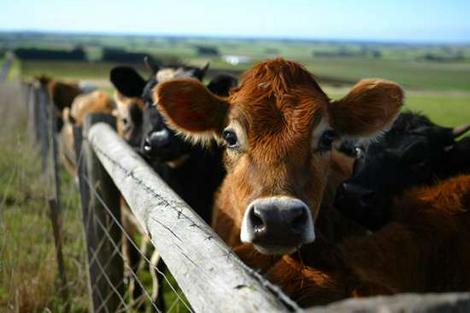
The jaguar feeds on a wide range of terrestrial and aquatic animals; it eats more then 80 different kinds of prey, one of which is cattle (that is one reason why humans kill the jaguar). Jaguars prey as well on sheep, and feed on rodents, peccaries, deer, birds, fish, armadillos, turtles, and crocodiles. In high grass or bushes, jaguars stalk or ambush their prey such as peccaries, capybaras, deer, and tapirs. In the forests, they hide in the trees to spring on birds and monkeys, or capture turtles on the river banks and fish from the water. On the plains, they prey on sheep and cattle. They eat almost any kind of animal including deer, their favorite food, fish, wild pigs, iguanas, turtles, capybaras and other kinds of rodents. Jaguars rarely attack humans. |
|
Humans are the main threat to the jaguar. A jaguar seldom, if ever, attacks humans unless it is cornered. Humans hunt the jaguar for sport, for its spotted hide, and to protect their domestic stock. The jaguar is endangered because it is hunted for its fur, and farmers kill the jaguar because it killed their cattle. Jaguars are reputed to be so destructive of cattle and horses that the larger Mexican ranches retain a 'tiger hunter' to kill them or at least drive them away. Poaching jaguars by hunting is still a problem, as there is a great demand for their coats. Today, there is still poaching, but not nearly as common as before. During the sixties and seventies, around 18,000 jaguars were killed every year for their beautiful coat. Formerly prized furs, such as those from the leopard, cheetah, or jaguar, may no longer be hunted in the countries where they are indigenous, and many other countries forbid their importation
|
|
Resources
The Largest Cat of the Americas