 Michael's
World Page 2
Michael's
World Page 2
Which Scales Should I Learn?
Beginning to learn scales and modes can be daunting. There are
so many scales out there. There are six scales discussed on these pages. Should
I learn all of them? If not, then which ones should I choose? This page is
designed to answer this question. To use this page, simply look for your musical
interest, and read that section. It's that easy. This page is by no means
exhaustive, but it should give you an idea of where to start.
Rock/Classic
Rock
Rock music consists mostly of major keys and major chords.
Therefore, rock guitarists often make use of the major scale or the major
pentatonic scale. If a minor key is encountered, simply translate the major
pentatonic scale into the minor pentatonic scale.
Alternative
Alternative
music consists almost entirely of major keys. Alternative guitarists usually
limit themselves to the major pentatonic scale, though the major scale is also
encountered.
Folk
Folk music consists almost entirely of major keys and
major chords. Folk musicians usually use the major scale.
Blues/Jazz
Blues music
contains many minor chords and seventh chords; in both major and minor keys.
Blues guitarists therefore use many minor scales and both the major and minor
pentatonic scales. The melodic minor scale is a good place to start.
I hope this helps! Remember, don't bother learning all the scales, just learn
the ones that pertain to your music. Good luck with the scales, and I hope the
pages help you
Fretting and Picking Scales
Modes are an easy way to divide up your fretboard into small blocks (called solo
boxes) where you can play fast solos. The secret to playing solos is to keep
your motion confined to a small number of frets but to use all the strings in
that small area. This minimizes hand motion along the neck (which is very
inaccurate and inefficient) and maximizes hand motion between strings (which is
much more accurate and is extremely efficient). The only way to utilize this
efficiency is to know how to fret and pick these scales. This page will discuss
fretting and picking these modes to make them easy to play.
Picking
There are two ways to pick
scales: flatpicking (with a pick) or fingerpicking. Your technique of playing
scales is drastically different depending on the style of picking you prefer.
Flatpickers should use alternate picking. This may take a while to get used to,
but it will help your playing immensely when you master it. Alternate picking
involves picking down on the first note, then picking up on the second, then
down on the third, etc. This allows you to play much faster and eliminates a lot
of wasteful hand motion that occurs when you only pick down.
Fingerpickers
should try to change fingers frequently , but use your index and middle fingers
most often because they are easiest.
Fretting
The most important
technique necessary for playing scales, though, is your fretting style. This
will allow you to play scales extremely fast with a minimum of hand motion.
Notice how all the mode boxes I have provided are limited to a small number of
frets. The number of frets used on any given string will not exceed four. Guess
what: you have four fretting fingers. Therefore, the four frets you need to play
exactly match your four fretting fingers: index, middle, ring, and pinkie. Play
this excerpt from the G major scale using the fretting fingers shown, and notice
how little hand motion is required:
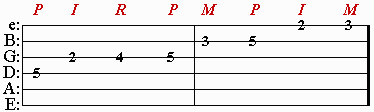
I =index,
M =middle, R
=ring, P =pinkie
In this example, your
four fingers are always playing the same frets: index=2nd fret, middle=3rd fret,
ring=4th fret, and pinkie=5th fret. This means that all you do is place your
hand on the neck with your fingers on these frets and push down whenever you
need to. This makes your solos much much faster because your hand is not moving
up and down the neck, it is just moving between strings. So when you are playing
a scale box, just locate the four frets you will be playing on. On some strings
you may have to shift your hand up or down one fret, but the four fret limit
will still apply and you should be able to fret it all without much hand motion.
Getting the proper hand motion when this must happen is one of the keys to
learning scales.
One thing to work on while doing this: when you pick up your fingers to move
them, pick them up about half an inch off the fretboard. Don't pick them up all
the way because that means it will take you longer to put them back down again.
You will be able to play so much faster if you follow this advice. This was one
of the most difficult techniques for me to master, but it is so important for
playing scales fast. We've come upon another reason to practice scales: you
learn the proper hand motions involved in playing guitar, not just the frets you
play in a scale.
Home
Enter Page
3
25- Dec-2003 to 16th Mar 2005 - 809 visits. Counter Reset to '0'
You are visitor number :

free hit counter
© 2003 Michael Sachin


Enter Page 3
25- Dec-2003 to 16th Mar 2005 - 809 visits. Counter Reset to '0' You are visitor number :
free hit counter
© 2003 Michael Sachin