X-RAY
PHOTOELECTRON SPECTROSCOPY
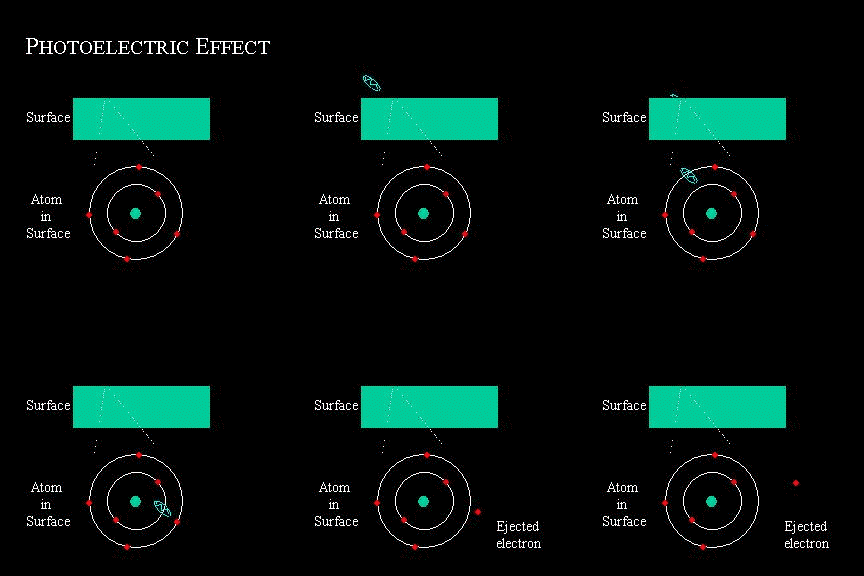
X-ray Photoelectron Spectroscopy (XPS) or otherwise known as Electron Spectroscopy for Chemical Analysis (ESCA), was conceived as early as 1914. As the name implies, XPS utilises the photoelectron effect which is shown below. The photoelectric effect, discovered by Hertz in 1887, has been well understood since 1905 when Einstein published his famous paper on the photoelectric effect. As shown in the animation below, when photons of sufficient energy are incident upon a metal surface, an atom may be ionised and an electron is ejected from the atom and is called a photoelectron. This photoelectron has kinetic energy given by EK = hv - EB - Q where hv is the energy of the photon, EB is the energy binding the electron to the atom, and Q is the energy required to leave the surface of the material. In the diagram, the emitted electron comes from the 2s electron shell but it may be emitted from other electron shells. The photoelectrons released have characteristic energies corresponding to the particular atom on the surface that it originated from. The photoelectrons are therefore collected and analysed and tell us what elements are on the surface. |
 |
XPS is routinely used for surface analysis in a wide range of industries including, the semiconductor industry, catalysis, and nanoelectronics to name a few. This technique has been continually developed with higher resolution and sesitivity. The use of synchrotron radiation sources enables much higher x-ray intensities that are tunable to the energy needed and allows even greater resolution to be reached. XPS is very often the preferred surface analysis technique for observing surface elemental composition due to its speed and ease of use. XPS however measures approximately the top 3-4 atomic layers, therefore the composition that is measured will be what is in these layers. To get the composition that is on the very topmost surface layer other techniques must be used such as LEIS. |