INTERLAYER DIFFUSION
|
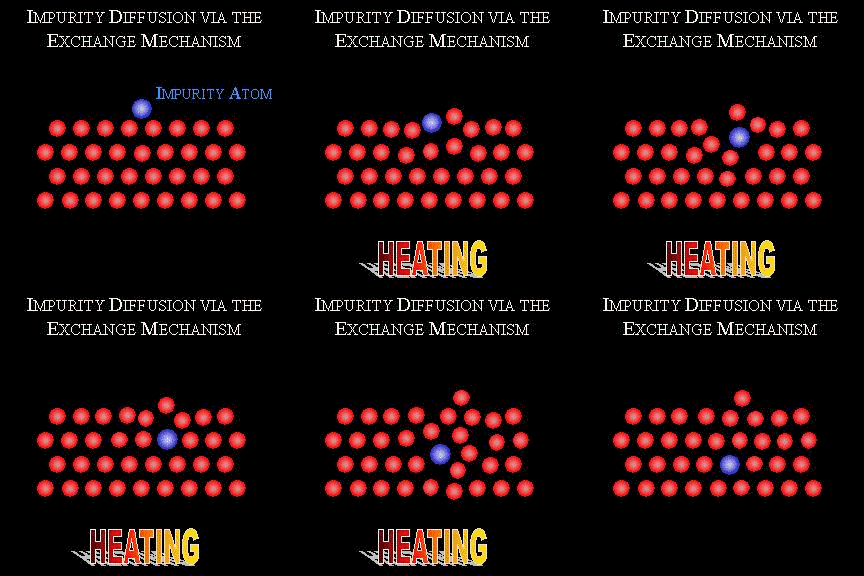
There are many different ways atoms may move within a solid. This movement is called diffusion and some of the different mechanisms are atom exchange, vacancy and interstitial diffusion. The exchange mechanism requires that an atom jump in one direction be accompanied by the jump of a second atom in the opposite direction. It had been thought that atoms or ions undergoing the exchange process simply squeezed by one another however, more recent calculations showed that rings of three or more atoms could rotate simultaneously with less energy than required for direct exchange by just two atoms. For bulk diffusion systems this process is not usually observed because it generates a zero net atom flux even though the atoms move throughout the crystal. There is an overwhelming number of independent methods that substantiate the claim that the vacancy mechanism is by far the most general and important of all the diffusion mechanisms. All of the exchange mechanism cases that existed for bulk diffusion now appear to operate via vacancies. Vacancy diffusion is a consequence of defects within the bulk(or surface) that are called vacancies or sites where atoms are missing. Adjacent atoms can move into the vacancy site and consequently produce a vacancy at the site they were bound to. As a result of the vacancy diffusion mechanism, a flux of diffusing atoms in any given direction requires an equal magnitude of vacancies moving in the opposite direction. Interstitial Diffusion is similar to both vacancy and the exchange mechanisms. Atoms move into sites called interstitial sites in between atoms. The energy requried for this process is larger than for both exchange and vacancy mechanisms. |
|
![]() |
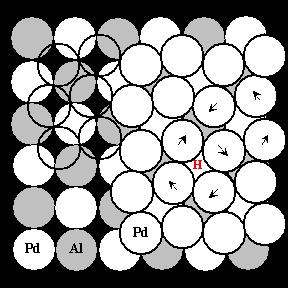
The research I have been doing involves the diffusion of Al in Pd(100) surface. If Al is deposited on a Pd(100) surface and annealed to temperatures above 700K, the Al diffuses into the Pd . Low energy Ion Scattering (LEIS) showed there was a 50:50 ratio (½ML Al trapped) in the second layer. This process generates a special surface alloy called a p4g surface which consists of groups of 4 atoms on the very topmost layer rotating by a small angle as shown on the left. |
![]() |
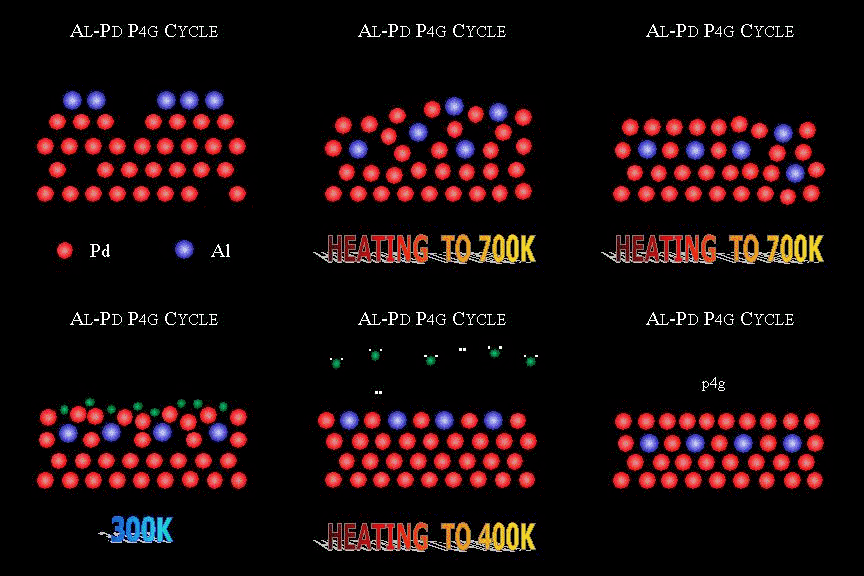
If the p4g surface is dosed with oxygen, the Al trapped in the second layer is dragged toward the surface and in the process removis the p4g reconstruction and producing the original Pd(100) surface. The oxygen can then be removed with hydrogen leaving a Pd(100) surface with 0.5ML of Al adsorbed on top.If the surface is then reheated to above 700K, the remaining Al diffuses into the second layer and again produces the clock reconstruction. This cyclic process has been found to be repeatable continuously and is pictorially described |
|
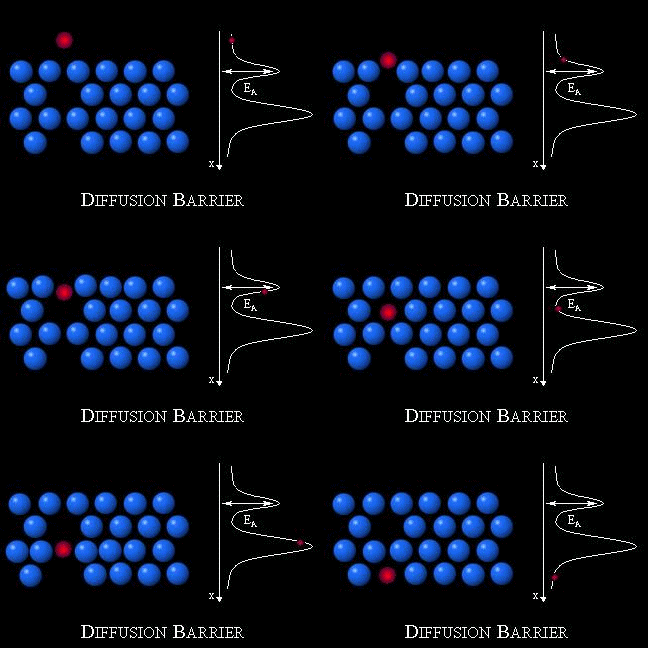
Some of the questions that come from the creation of the p4g surface are; 1. What mechanism does the Al move into the second layer of the Pd(100) surface? Vacancy, Exchange or Interstitial? 2. What is the diffusion barrier for the Al diffusion? The diffusion barrier is an energy barrier an atom must overcome before it can move to another site and is shown on the right. |
![]() |
|
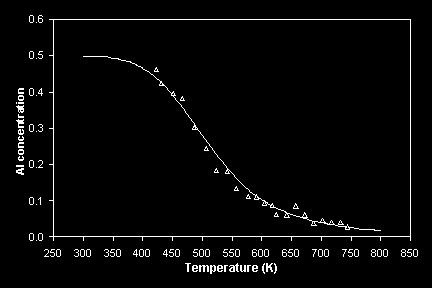
The triangles represent the experimental data and the line represents the model based on Fick's law of diffusion. |
Part of my PhD research involved modeling and measurement of the barrier that Al must overcome to diffuse into the second layer. To model this process, Fick's Law of diffusion was used for the single process of jumping from the first layer to the second. A special boundary condition was also put into the equation to represent the trapping of the Al in the second layer. The model produced the following equation. C = 1/ 2(1+Aexp[-Ea/kT]) where Ea is the diffusion barrier energy, k is boltzmanns constant, T is the sample temperature and A is an arbitrary constant. To measure the concentration of Al on the surface, LEIS was used due to its extreme surface sensitivity. This allows the measurement of Al concentration as the temperature is increased to 750K which is shown on the left. The diffusion barrier between the first to second layer was determined to be 0.41 + 0.02 eV. This value is lower than expected for Al diffusion into the Pd but strongly suggested that the dominant process was Pd diffusion out to the surface. |