I became interested in texas hold'em poker when one boring Friday night I happened to channel hop my way round to Channel 4 and found an intriguing array of smartly dressed / smug faced individuals squatting round an oval table frantically throwing small colored plastic discs at each other.
Hmmm me thinks, what an interesting new sport.
I sat glued to the screen, hell bent on deciphering what the hell was going on.
My initial guess was that of an evil evolved version of the usually calm and friendly pastime "tiddliewinks".
In a dramatic penchant to witness which player would successfully launch the perfectly projected plastic disc-like weapon
in such a fashion as to knock his opponent unconcious.
This didnt happen.
Upon closer inspection I formulated a new theory.
There appeared to be a direct correlation between the amount of Aces one held in the hand,
and the physical widening of the grin on such player.
Upon further research none of these theories seemed to hold true .
Albeit, I was hooked. Late Night Poker became my new religion.
Since then I have enjoyed playing hold'em through www.pokerroom.com under the name acetrumper,
taken from one of my favourite (probably misled by poor judgement) late night poker players.
For those of you who do not comprehend this bizarre obsessive compulsive social pastime,
here are a few pointers:
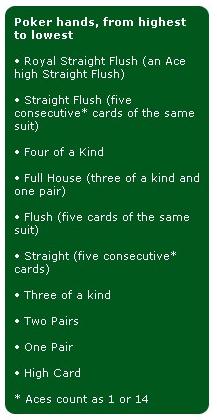
Poker is a game whereby cards are related in merit via the following league table:
7 cards explained.
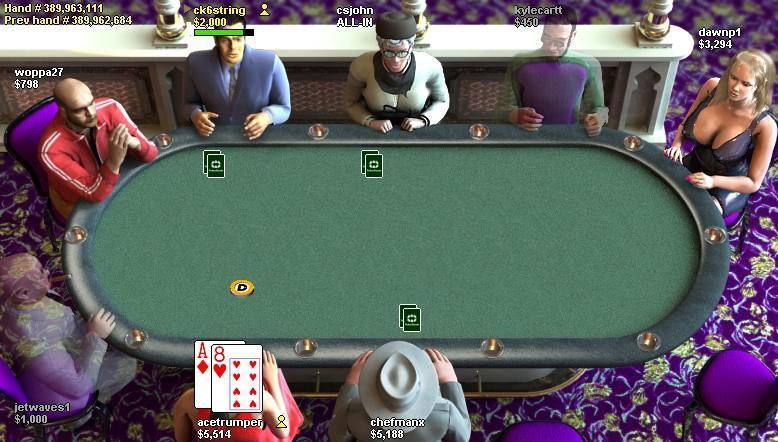
At the start of each hand you will be dealt two cards, known as pocket cards, or hole cards, (Pictures will explain this lower down).
The concept behind Texas holdem poker is that you use these two pocket cards together with a further five that will be placed face up on the table. These table cards are known as board cards, or community cards.
Basically you are playing regular poker, with the exception that you have access to 7 cards (2 pocket, 5 board). This provides the major advantage of having more cards, and a better chance of a decent hand, the down side is that you and every other player at your table use the 5 board cards.
The object of the game, as with all variants of poker is to possess the best hand, based on the universal poker ladder above.
Despite 7 cards being available to you, your final hand is the best configuration you can make from using just 5 of the 7 cards available to you.
For example, if you were dealt 3,4 and the board cards show as 56789, then yes you do have a straight, but the best hand you can make using just 5 of the available 7 cards is merely what�s on the table, which everyone shares anyway. Unfortunately in this example your final hand would be 56789 and your pocket cards 3,4 mean nothing, and if someone has a pocket card of value 10 then they have already beaten you.
You don�t have to use your 2 pocket cards, eg: if a flush appears on the 5 board cards, then everyone has a flush, of course if you have a higher flush card in your pocket, then you have the distinct advantage.
Betting.
Betting occurs 4 times in each hand.
1)
At the beginning of the game, everyone is dealt two cards (pocket cards). At this stage no-one knows what the board cards will be, but based on how strong these 2 pocket cards are, you may like to raise the stakes, or back out completely.
For instance if your pocket hands are a pair, then you may already have a strong hand.
A pocket pair of 2�s isn�t that great, but if you score pocket Kings or even pocket Aces, then this is an excellent time to place a bet.
Especially when your opponents are so eager to see the board cards.
Suited connectors are tricky animals EG: 9 diamonds with 10 diamonds
they are suited for a possible flush, but also connected (adjacent values) for a possible straight.
although they do often bring false hope.
2)
Once everyone has met the cost of the bet, or folded (given up on that hand) then 3 cards are laid on the table.
These three cards are known as The Flop.
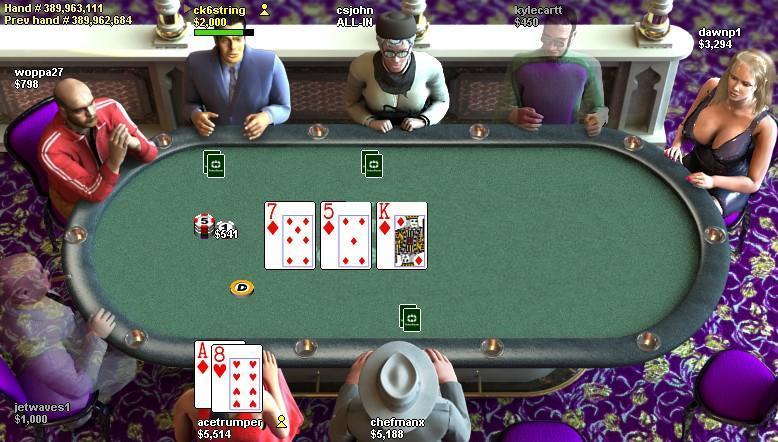
At this point everyone can see how their 2 pocket cards can relate to the 3 cards on the board.
A further bet is made here, although if no-one raises, everyone can �Check� which basically means seeing the fourth board card for free.
If someone does raise based on the first 3 board cards, then you have three choices, you can call his bet, thereby placing in the same amount of chips as him, you can re-raise if you believe you have a better hand, forcing him to commit more of his chips, or you can fold, thereby surrendering your pocket cards plus whatever chips you have already bet.
Folding is not a weakness, it just means that you admit that your cards are going nowhere and you want out.
If you have trash, it is wiser to fold now, and keep your chips for when a stronger hand comes your way.
Once a price is agreed, the fourth card on the board is shown.
3)
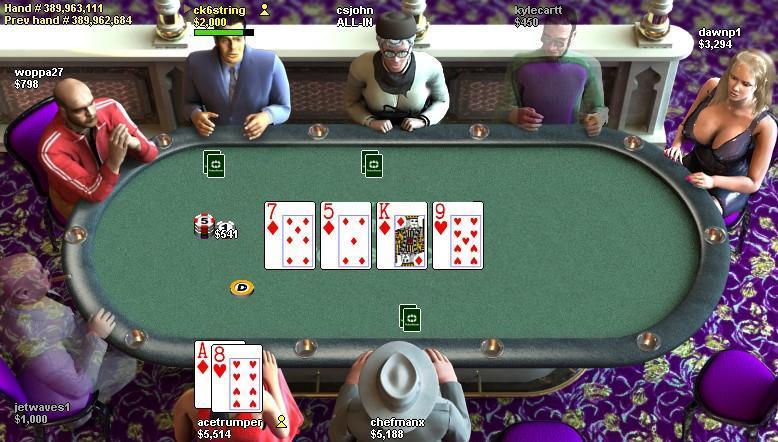
The fourth card on the board is known as the Turn card, and at this point you have a better idea from the available 6 cards as how strong your final hand will be.
A further Check, Fold, Call or Raise option occurs once the fourth board card is shown.
4)
Once a price is agreed, the fifth card on the board is shown.
The fifth card on the table is shown, this is called the River card, and is as good as a sink or swim scenario.
Now every player can see the full 7 cards that are available, The flop, turn and river cards on the table, plus their 2 private pocket cards.
Each player now makes the best poker hand possible from using ANY 5 cards from the 7 available.
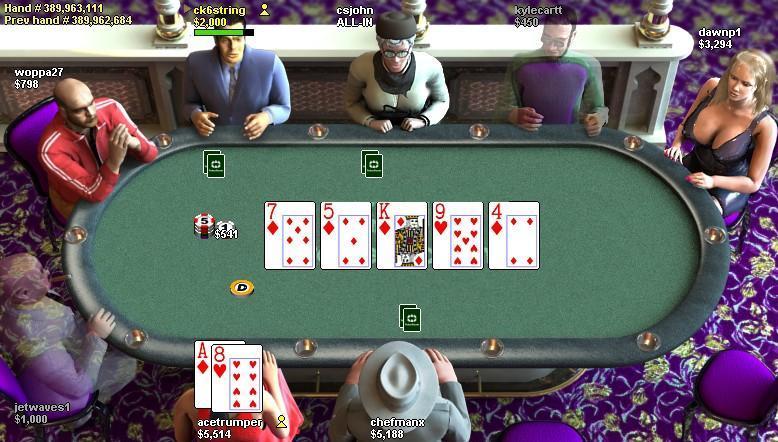
Here lies the final bet.
It is possible that not many players are still participating in this hand, but it is also a fair bet that most of the remaining opponents have reasonably strong hands.
Decide what your chances are and make your Fold, Call, Check or Raise decision.
Next comes the Showdown, where private cards are displayed.
The highest hand wins the entire pot.
If players share the highest hand, then the winnings are shared between them. Known as a Split-pot.
Minimum Bets.
A table will usually have a bet limit, both minimum and maximum.
In a $5-$10 table, the minimum cost of seeing the flop is $5 However if upon the flop, everybody merely �Checks� then the next card is seen for free. This also applies if unanimous Checks occur on the fourth card and the final fifth card.
Theoretically it is possible to reach the final showdown of a hand at a cost of the minimum bet. Although this doesn�t make the winnings too attractive.
If at any point a player raises, then his bet will be determined by the table limits. Eg: in a $5-$10 table, a raise would be $10, a re-raise would be a further $10 making the new price $20.
Generally the maximum bet between each board card being displayed is 4 times the raise limit.
EG: In a $5-$10 table, a raise would be $10, with 3 possible re-raise�s. This limits the maximum bet between cards as $40, no more re-raises are allowed and then the next board card will be shown.
Blinds.
A Dealer disc passes its way from player to player once each hand ends. The player who holds the dealer button generally operates last during bets in that hand.
At the beginning of each hand, before people bet, the player to the immediate left of the dealer makes a compulsory bet of half the table minimum. The next player leftwards has to make a compulsory bet of the full minimum.
EG: in a $5-$10 table, even if everyone folds at the beginning of a hand, there is still $7-$8 available to win.
This is to insist that there is always a little amount of the money available to win in each hand.
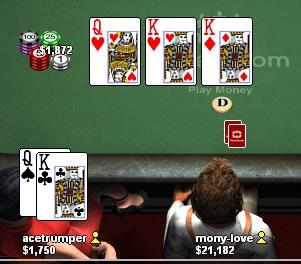
Upon the flop (first 3 cards) I have a full house.
The only hands that better this would be 4 of a kind, ie oponent has KKKK,QQQQ
However there is only 4 Queens / Kings in the deck. I have one of each, so my opponent CANNOT have 4 of a kind.
My next immediate threat is my opponent holds the potential for a Straight Flush.
This IS possible, but since the chances of gaining a Straight coupled Flush are 3744/2598960 = 0.144%
I'm guessing that I have won.
would you now bet?
I Didnt.
And there is a good reason!
ASK if arsed.
Acetrumper says:
Even with poker application add-ons
which advise on the strength of your hand
It can all go BAD:
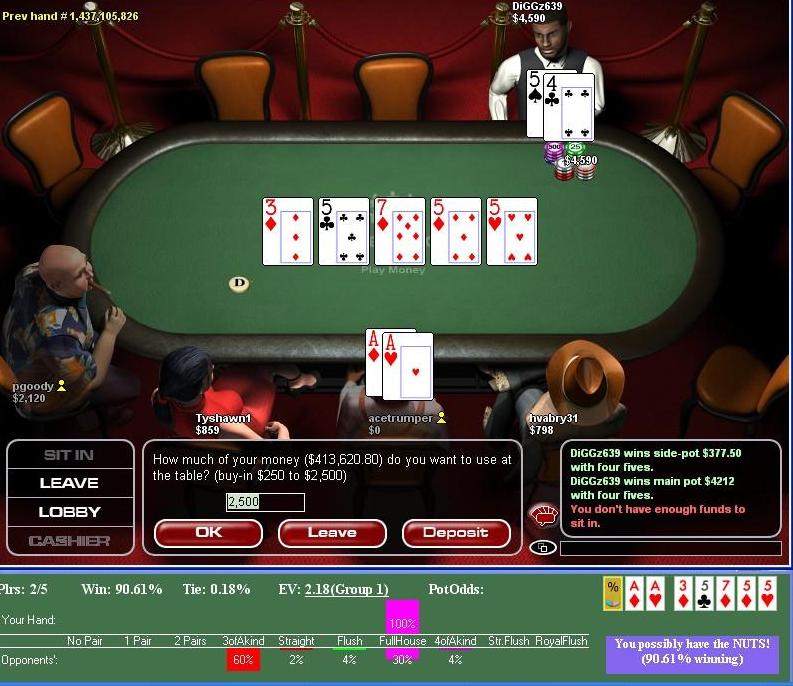
More Screen shots to come, if anyone is arsed, that is.
